Showing posts with label Ethics. Show all posts

Thursday, 8 August 2019

Like unicorns, the 'free market' doesn't exist

What we have is not capitalism, it’s corporatism. Under real capitalism, the free market would prevent the destruction of our environment. All our problems would be solved if we just returned to the good competitive capitalism. There never has been, is not and never will be a capitalist free market economy. 
  • Capitalism is meant to pivot around the free market. If the market were rid of government regulation then true competition would reign, with corporations battling it out to provide their goods and services to rational, all knowing consumers. This would provide stable and accurate prices and quality for goods and services as competition would aggregate supply, demand and pricing.
  • The success or failure of a company would be directly proportional to its ability to meet the needs of its consumer.
  • The recent failures – the bankers bailout, the corporatisation of government, the decline in social mobility – are because we do not have real capitalism. We are in fact in a post capitalist, state capitalist of fascist state. Whatever state we are in, it is as a direct and inevitable result of capitalism. 
  • Corporations themselves are rabidly anti-competition.
  • In Britain today, 97% of food purchased, is bought in supermarkets, with only four corporations making up 76% of those sales. In the US, 72% of food is purchased in supermarkets. As these figures continue an upward trend, we can see that monopolies are being created in food production.
  • If we take a look and test the theory that the consumer would benefit from this process of corporate battles. Since the 1950's, the percentage of the US household budget spent on food dropped from 32% to 7%. In the UK the proportion spent on food has dropped from 33% to 15%. With supermarkets making record profits, and household food budgets down, who is paying the price for our food? The answer is the farmer and the environment. 
  • Seventy years ago, there were nearly seven million American farmers, today there are two million. Now 75% of US produce comes from just 50,000 farming operations.
  • The free market has seen a few corporations rise to dominate the market, set their own prices and lead to negative social impacts. While some consumers might see a fall in the price of the food they are buying, they cannot be sure that they are comparing apples with apples and while perhaps benefiting as consumers, they are losing out as producers.
  • As seen above, it is not in the interest of the corporation to maintain a free market. The corporation has no reason to apply any kind of ethics whatsoever. Adidas employs child and sweatshop labor in the far east because it is cheaper than employing people on a living wage, with decent terms and condition.
  • Historically the government, the purported servant of the people has been the enforcer of rules necessary to restrain the ‘market’ from behaviors which from point of view of the corporation would lead to undesirable social outcomes.
  • In the US, by 2011 the largest thirty corporations spent more that year on lobbying government than they spent on taxes. 
  • In the UK, corporations with outstanding tax issues are currently in working groups with the to redraft the very tax rules they are doing their best to avoid. 
  • When corporations break the law, they are either not tried or given a fine which comes nowhere near the profits reaped by breaking the law.
  • Recently banks have instituted fraud on a global scale by simply making up the LIBOR rate, the base interest rate, at the cost of savers and pensioners and to the benefit of their traders who specialize in debt, not capital.
  • In 1950, corporate taxes made up 30% of federal revenues in the US. By 2012, this had fallen to just 7%. In the UK, Corporation Tax rates were cut from 52% to 35% over just two years between 1984-86 and has continued to be cut until it stands at just 21% today.
  • Corporations do not want any rules which stand in the way of making profit. Left unregulated, they would simply operate in ways which maximized their profits regardless of social outcomes. When we introduce a regulator, corporations seek to and succeed in compromising them. The issue is not to blame one or other of the players, but the game of capitalism itself.
  • The free market myth is nothing but a nonsense. It is a self serving nonsense propagandized by its beneficiaries.
In conclusion, not only is the market not free, but it never can be. It requires legislation to prevent rational corporate behavior which would undermine it, and any regulator (state or otherwise) will be corrupted by corporations seeking to influence them. The sooner we abandon this madness, the sooner we can answer the bigger question: how do we create a means of economic organisation which has the highest chance of meeting our social goals? We must abandon the myth of the free market, just as we gave up on Santa Claus and Unicorns – it is time to put away childish things so we can become grown up caretakers of ourselves, each other and the planet.


Thursday, 14 March 2019

Corporate Social Responsibility

Corporate social responsibility (CSR) is a business approach that contributes to sustainable development by delivering economic, social and environmental benefits for all stakeholders. CSR is the integration of socially beneficial programs and practices into a corporation's business model and culture. CSR makes the companies be conscious of the kind of impact they are having on all aspects of society including economic, social, and environmental. The four types of Corporate Social Responsibility are environmental sustainability initiatives, direct philanthropic giving, ethical business practices and economic responsibility.
  • Prevent financial ramifications: Compliance with the spirit and letter of the law through self-regulatory processes will prevent fines, put your business low on regulators' radar screens, and lower legal expenses.
     
  • Increase employee loyalty: Treating employees fairly and generously as a part of corporate social responsibility encourages high professional and moral standards increases employee loyalty and by procuring only those overseas products produced at factories where workers were treated ethically, you gain support among "Fair Trade" advocates.
     
  • Maintain a positive reputation: Demonstrated consciousness in a variety of areas can garner publicity and give a business tangible proof of their conduct. These include
  • ➢ Environmental consciousness: Reducing waste, recycling, minimizing carbon footprint, producing only sustainable products, lowering energy usage, and supporting environmental causes.
  • ➢ Social Concern:  Donating to humanitarian causes that fight poverty, help the victims of epidemics, assist those displaced by natural calamities etc.
  • ➢ Local Community: Involvement in local community projects, through donations, employee participation, connecting your customers, promoting the project through advertising and fundraising etc.
CSR is a concept with many definitions and practices. The way it is understood and implemented differs greatly for each company and country. Whatever the definition is, the purpose of CSR is to drive change towards sustainability.


Sunday, 15 July 2018

Economic freedom, informal economy, ethics and corruption


Austrian-British economist Frederick Hayek foresaw more than 60 years ago, economic freedom is required in all aspects of economic life in order for countries to improve their economic efficiency and the living standards of their people. 
  • Corruption is a symptom of over regulation, lack of rule of law, a large public sector and not the root of the problem. 
  • Morality and ethics are hard to measure. Economic freedom removes opportunities for corruption and promotes ethics not just for its moral implications, but also because of its economic value.
  • Ethics is defined as 'rules of behavior based on ideas about what is morally good and bad'. In general, we call unethical those actions for which there is a social consensus that they are a bad thing. 
  • Corruption has several meanings and for most people corruption is something unethical, something considered a wrongdoing. A closer look at human behavior in economic life suggests that corruption does not reflect lack of ethics as it reflects a lack of economic freedom.
  • Economic freedom is defined as “the absence of government constraint or coercion on the production, distribution, or consumption of goods and services beyond the extent necessary for citizens to protect and maintain liberty itself.”
  • The Index of economic freedom provides a framework for understanding how open countries are to competition; the degree of state intervention in the economy, whether through taxation, spending or over regulation; and the strength and independence of a country’s judiciary to enforce rules and protect private property. 
  • Corruption does not always reflect inherent unethical behavior especially for those who are forced out of the formal economy into the informal economy through burdensome regulations, taxation, and weak property rights.
  • As economic freedom vanishes, the informal economy takes a larger share of GDP. The size of the informal economy in economically unfree and repressed economies is almost three times the size of the informal economy in free economies.
  • The economic repression has its perverse effects on the ethics of ordinary people and on the perpetuation of their poverty conditions. 
  • In most developed countries, people have a better standard of living due to credit access.  In USA, without credit, most people would not have a house, a car, a TV, a vacation, or many of the products that add comfort and convenience to my life. Credit makes it possible for middle-class people, to improve standard of living in many ways.
  • To have access to credit, you need to have income or property. To prove that you have income, you need a formal job, and to prove that you have property, you need a property title.
  • The availability of formal jobs depends on ease for people to invest and do business. The friendlier the business environment, the more formal jobs will be available. In most low to middle income countries, it is extremely difficult for small and medium investors to operate, both because of the regulatory environment and because of the lack of a strong rule of law. 
  • In developing economies, the problem with the legislation is that it assumes that all employees are equally good, equally responsible, and equally productive, which is not true. The burden of regulations compels small and medium businesses to create jobs in the informal sector, where the benefits are negotiable and tied to performance, and not forced by law.
  • The rules of the state creates perceived unethical behavior by private employers and employees when what is really in question is the ethics of such a regulatory burden.
  • If they do not have a formal job, poor people can still get access to credit if they have a property title to use as collateral. The poor own many things that they could use as collateral, but it is bureaucratically impossible for them to validate their property rights. As a result, they are unable to raise credit and their standard of living.
  • In the developing world many of the poor people have property but the bureaucracy they have to go through in order to get a property title is huge. The poor own many things that they could use as collateral, but it is bureaucratically impossible for them to validate their property rights. As a result, they are unable to convert what they own into capital and, therefore, raise their standard of living. For example, in Peru, “to obtain legal authorization to build a house on state-owned land took six years and eleven months, requiring 207 administrative steps in 52 government offices. To obtain a legal title for that piece of land took 728 steps.”
  • Informality is a response to economic repression, not to something inherently unethical in those who circumvent legislation. What is most unethical about informality is the condition in which the  government forces the poor to live. Informally employed people are condemned to a standard of living that is significantly lower than that of formally employed people, who have credit access. Informality creates a culture of contempt for the law and fosters corruption and bribery in the public sector as a necessary means to navigate the bureaucracy.
  • As economic freedom vanishes, corruption flourishes. The level of perceived morality in economically free countries is almost four times the level of perceived morality in the public sector in most unfree or repressed economies.
  • Weak rule of law adds to the level of corruption in the public sector as well as the amount of informal activity. A weak judiciary is a 'blind eye' on anything done outside the law. With a weak judiciary, corruption goes unpunished and informality flourishes.
  • In 2003, 108 of the 161 countries received bad scores in both regulation and property rights, undermining the efforts to improve the living standards of the poorest.
  • The unethical behavior stems from the environment and convoluted regulations and weak rule of law foster a culture of corruption and informality both in the private and public sectors.
  • In the public sector, convoluted regulations and weak rule of law provide ample opportunities for public officials to accept bribes without punishment. In the private sector, those two factors push some people to do business informally as a means to survive and others to profit far more than they would if the possibility of bribery did not exist. Both result is an increasingly unequal society, in terms of the opportunity to create wealth and improve living standards.
  • To fight corruption and informality, it is essential to understand that corruption is a symptom--of over regulation, lack of rule of law. A large public sector is not the root of the problem. The real problem is the government action/regulations causing undesired behavior of the private sector. The unethical/corrupt behavior of the private sector, leads to the government to press more on private-sector activities. The solution is to eliminate burdensome regulations so that unethical behavior does not occur.
Countries must advance economic freedom in all possible areas of the economy, with particular emphasis on regulations affecting small and medium business, in order for corruption and informality to decrease. Countries must also preserve the independence and effectiveness of the judiciary to punish corrupt actions. Economic freedom with a strong rule of law will foster a culture of investment, job creation, and institutional respect in massively improving the living standards of ordinary people.

Let no young man, choosing the law for a calling, for a moment 
yield to the popular belief  that lawyers are necessarily dishonest. 
Resolve to be honest at all events; and if, in your own judgment, you 
cannot be an honest lawyer, resolve to be honest without being a lawyer. 
Choose some other occupation, rather than one of which you do, 
in advance, consent to be a knave ... Abraham Lincoln

The observations in the article are highly theoretical but the reality in India is some what different. The most unethical, corrupt and tax evading people are rich, highly educated, well placed & well connected.  The poor people are ethical and law abiding. The middle classes are torch bearers of traditions although corrupt & unethical. The small bribe paid by a poor man for obtaining birth certificate etc is understandable, the corruption by businessmen in collusion with politicians & bureaucrats, escalating project costs siphoning of funds to tax havens etc burdening the whole nation is a criminal act and deserves harshest punishment. Corruption & lack of ethics is so rampant that today it hard to find and ideal person.


Sunday, 3 December 2017

Fortis charges over Rs 15 lakh to treat child with dengue

 
  • Every person, especially who is doling out lakhs of rupees to hospital, is entitled to know the details for all such payments prior to payment and and justification thereof and whether the treatment is being done in right direction or not.
  • Self certification that there is no negligence, no over billing done, all protocols followed etc are unacceptable when parents/children/relatives of the patient are kept in dark about the condition of patient deteriorating and at the end patient dies.
  • Isolating the patient in ICU in the name of 'infection control' is another reason for trauma.
  • The underlying reason is the greed of the corporate hospitals having invested crores of rupees in the hospital & its facilities and doctors who spend millions for acquiring their medical degree and post graduation degrees etc.
  • Teaching, Medical and Justice dispensation are noble professions, and doctors and hospitals must follow ethics under all circumstances. Immorality and corruption in these professions are contemptible. Justification that their degradation is in line with general degradation of society as such, is unacceptable nonsense.
  • Corporate hospitals & doctors charging exorbitant amounts resulted in abnormal premiums being paid by all insurers.
  • Prima facie, 660 syringes and 2700 gloves indicates the whole bill is cooked up and the patient might have passed some days before. Only a thorough criminal investigation will bring truth to the forefront.

An elite class that is free to operate without limits - whether limits imposed 
by the rule of law or fear of the responses from those harmed by their behavior - 
is an elite class that will plunder, degrade, and cheat at will, and act endlessly 
to fortify its own power ... Glenn Greenwald


In the absence self discipline and adherence to ethical practices, robust consumer protection laws, active consumer awareness and ruthless law enforcement mechanisms, emulating liberalization and promoting private sector and destroying public sector is grossly injurious to semi literate societies like ours. Today, the condition of government hospitals and schools doesn't enthuse anyone to avail its services. Arogyasri, Tuition fee reimbursement etc seemingly does good for common man but in reality it fills coffers of corporate hospitals and fulfill greed of doctors while depriving precious funds for government colleges and hospitals. The realistic solution would be strong govt and non-profit trust hospitals virtually competing with corporate hospitals. Govt must increase its spending from present 1.2% of GDP to at least 5% of GDP on health care and also spending on school education from present 2.5% to over 5% of GDP, of course with transparency and accountability and corruption eliminated. This requires political will and administrative honesty apart from public patronizing. 

Monday, 13 November 2017

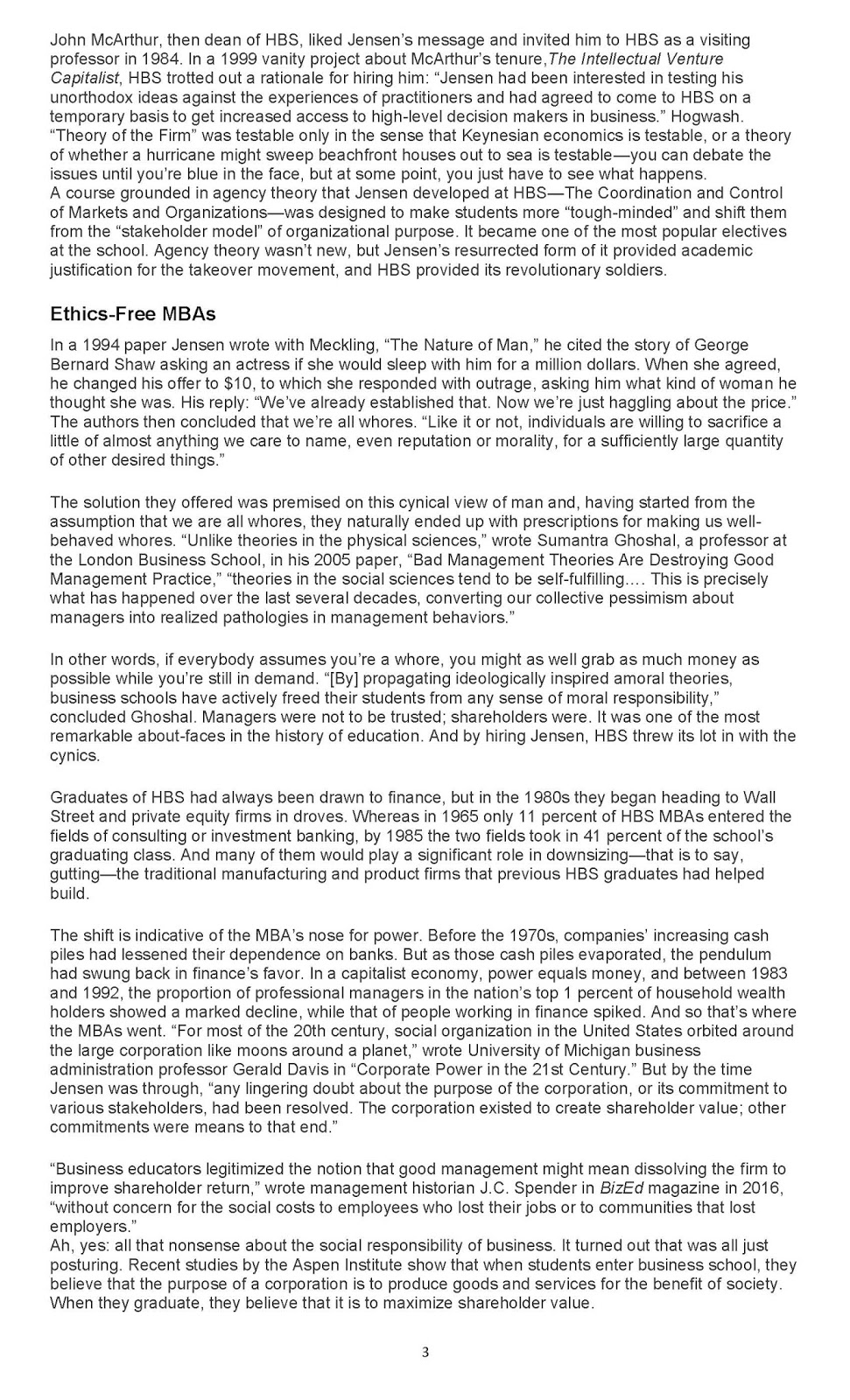
Harvard Business School and its immoral profit strategies

  • In the aftermath of the 2008 financial crisis USA was enraged because not a single Wall Street guy who got them into the mess was prosecuted. 
  • There are many financiers who could have been made to take the perp walk, there’s also a case to be made that the fault lies with those who laid the intellectual foundation upon which a market-driven financial crisis could happen in the first place.
  • Corporations are not institutions set up to be moral entities. They are institutions which really only have one mission, and that is to increase shareholder value.
  • By the late 1970s, HBS had proved itself a dependable supplier of prescreened and highly motivated graduates to big business. 
  • In the 1980s, HBS graduates weren’t going to big business anymore but were headed to Wall Street and consulting.
  • In the 1980s, HBS had abandoned its mission and threw its lot in with Wall Street. HBS had nurtured the professional manager from his birth and then helped to kill him.
  • “Theory of the Firm: Managerial Behavior, Agency Costs and Ownership Structure” laid the groundwork for the most radical change in the hierarchy of power in corporate America since the robber barons gave way to professional managers.
  • Managers had become too entrenched and lacked discipline and accountability. Managers weren’t going to voluntarily reform so the system had to be adjusted so that they would be forced to do so. No longer they would be judged by their board. The market was henceforth to be judge, jury and executioner.
  • Executive pay was largely tied to company size. The highest-paid CEOs ran the largest companies. But the unproductive diversification had resulted in excess capacity, flat or declining profits, and stagnant share prices. Companies sitting on large piles of cash suddenly became the target of hostile acquirers. The age of investor capitalism began, and its heroes were not CEOs but corporate raiders.
  • A wave of deregulation then created the active market for corporate control, with the new belief that the shareholder was supreme, absolving managers of responsibility to any one except shareholders. The bottom line was all that mattered.
  • A story was cited - George Bernard Shaw asking an actress if she would sleep with him for a million dollars. When she agreed, he changed his offer to $10, to which she responded with outrage, asking him what kind of woman he thought she was. His reply: “We’ve already established that. Now we’re just haggling about the price.”  
  • It was concluded that we’re all whores. “Like it or not, individuals are willing to sacrifice a little of almost anything we care to name, reputation or morality, for a sufficiently large quantity of other desired things.” Having started from the assumption that we are all whores, they naturally ended up with prescriptions for making us well-behaved whores.
  • Bad management theories are destroying good management practice. This is precisely what has happened over the last several decades, converting our collective pessimism about managers into realized pathologies in management behaviors.
  • If everybody assumes you’re a whore, you might as well grab as much money as possible while you’re still in demand. By propagating ideologically inspired amoral theories, business schools have actively freed their students from any sense of moral responsibility. And HBS threw its lot in with the cynics.
  • Graduates of HBS had always been drawn to finance, but in the 1980s they began heading to Wall Street and private equity firms in droves. 
  • In 1965 only 11% of HBS MBAs entered the fields of consulting or investment banking and by 1985 these two fields took in 41% of the school’s graduating class. And many of them would play a significant role in downsizing the traditional manufacturing and product firms that previous HBS graduates had helped build.
  • Before the 1970s, companies’ increased cash piles had lessened their dependence on banks. But as those cash piles evaporated, the pendulum had swung back in finance’s favor. 
  • In a capitalist economy, power equals money. Between 1983 and 1992, professional managers in the nation’s top 1% of household wealth holders showed decline, while that of people working in finance spiked. And so that’s where the MBAs went.
  • Any lingering doubt about the purpose of the corporation, or its commitment to various stakeholders was resolved. The corporation existed to create shareholder value; other commitments were means to that end.
  • Business educators legitimized the notion that good management might mean dissolving the firm to improve shareholder return, without concern for the social costs to employees who lost their jobs or to communities that lost employers.
  • All that is nonsense about the social responsibility of business. When students enter business school, they believe that the purpose of a corporation is to produce goods and services for the benefit of society. When they graduate, they believe that it is to maximize shareholder value.
  • During 1980s, the threat of being taken over and fired effectively created a market for corporate control, which helped executives stay focused.
  • High indebtedness engendered by leveraged buyouts forced executives to be much more focused on the operations of their companies. If and when executives did participate in LBOs by amassing their ownership stake, their incentives would then be directly linked to the company’s stock price following the argument that, takeovers and LBOs would cure the nation’s economic woes.
  • An a HBS article in 2012 pointed out that the rising tide didn’t lift all boats. In the name of beating foreign competition, completing (or avoiding) takeovers, and serving the interests of shareholders, it became acceptable to sell off businesses that didn’t fit the new corporate strategy and to lay off battalions of workers.
  • Corporate takeovers do not waste resources; they use assets productively. Shareholders gain when golden parachutes are adopted. Such blanket claims came with the good seal of approval of Harvard Business School.
  • Excessive CEO compensation is not the biggest issue. The relentless focus on how much CEOs are paid diverts public attention from the real problem - how CEOs are paid.
  • In 1992, CEOs of Fortune 500 firms made an average of $2.7 million. By 2000, it was up to $14 million. Stock options as a percentage of compensation rose from 19% in the 1980s to nearly 50% in 2000. What also increased is the short-termism and the tendency for executives to manage earnings, using aggressive accounting to give Wall Street analysts a smooth earnings trajectory on which to base their forecasts.
  • The compensation of America’s corporate executives shot up in the 1990s, regardless of their performance.
  • Corporations lost significant credibility in the wake of the 2007-10 financial crisis. There is no doubt that finance and financial markets are central to what public corporations do. What is less clear is that an ownership society is a workable model for prosperity and security.
  • In 1951, John D. Rockefeller said that the job of management is to maintain an equitable and working balance among the claims of the various directly affected interest groups - stockholders, employees, customers, and the public at large. Nowadays, many people forgot that.
  • In March 2009, Jack Welch the longtime CEO of General Electric said that “On the face of it, shareholder value is the dumbest idea in the world. Shareholder value is a result, not a strategy. Your main constituencies are your employees, your customers and your products. Managers and investors should not set share price increases as their overarching goal. Short-term profits should be allied with an increase in the long-term value of a company.
  • HBS students were all going to Wall Street, and Wall Street firms were all sending money back to HBS. The net effect of it all was that agency theory rendered business history irrelevant.
  • They had a tradition at HBS which could have said that this isn’t the way business should be operating. Instead, they just went with the flow. 
  • Shareholders are the owners of a company. They’re not, at least if by 'own' one means it in the way one can 'own' a car or an iPhone. We know that the value a company creates is produced through a combination of resources contributed by different constituencies. If the value creation is achieved by combining the resources of both employees and shareholders, why should the value distribution favor only the latter?
  • American managers loaded their companies with debt, they started paying themselves in equity and options, and they did everything they could to juice the value of that equity. And in doing so, they sacrificed long-term value for short-term gain, often engaging in outright fraud.
  • The wondrous world of hostile takeovers unleashed the insider trading. It was insider trading in the shares of Enron, that tipped investigators and number of HBS graduates were ensnared in the ensuing investigation.
  • The propensity of executives is to be overly optimistic about forecasts that support lofty share prices. If executives would present the market with realistic numbers rather than overoptimistic expectations, the stock price would stay realistic. But the scholars don’t yet know the real answer to how to make this happen. That’s called ethics and the Harvard Business School doesn’t know how to teach ethics as well as it knows how to teach financial engineering, and it never will.
  • In 2003, the HBS added a Leadership and Corporate Accountability course that sounds like: “decisions that involve responsibilities to each of a company’s core constituencies - investors, customers, employees, suppliers, and the public,” with discussions on insider trading rules, the fall of Enron, human character, employee responsibilities, labor laws, corporate citizenship, socially responsible investing and serving the public interest. But in this, its influence is akin to pushing on a string but no one knows how to kill the monster.

Sunday, 13 November 2016

Ethical corporate conduct flows from the top down

  • Culture flows top down from macro to meso, and then from meso to micro.
  • Similarly culture of a corporate unit will generally represent an adaptation to a particular environment of the institutional domain.
  • The spotlight on corporate corruption is more intense than it has ever been. Whether the activity under investigation is bribery, falsifying financial statements, policy breaches or money laundering, the general public is much more vocal in their demands for accountability, and governments continue to tighten laws pertaining to white collar crime.
  • The Occupy movement, student demonstrations and pipeline protests are making it clear companies face increased scrutiny on what companies are doing. In response, businesses must make sure they are conducting themselves ethically.
  • The bigger risks for many companies are not so much deliberate actions as grey zones. Our society has been complacent towards conduct that may not have been perceived as illegal, but has certainly been pushing the envelope.
  • A constant for all businesses is that corporate culture flows from the top down. If you have a culture of tolerance for this type of behaviour, employees, managers and even board members get accustomed to turning a blind eye and bending the rules.
  • The growing concern over white collar crime is putting increasing pressure on businesses of all sizes to put stringent compliance programs in place.
  • Officers and directors need to think about proactively reducing risks of white collar crime and taking swift and decisive action when issues arise. In that way, they can demonstrate to their employees and the outside world they have a strong culture of ethical conduct. This starts with a thorough review of their organizational policies and procedures.
  • Assessment comes down to looking at four basics: detection, prevention, investigation and remediation. In other words, it involves understanding what the problem is, how big it is, how to fix it and, most importantly, how to keep it from happening again.
  • A full-scale professional risk assessment is typically a one-time event, internal follow up is essential to ensuring that the organization’s processes are evolving and adapting to new risks that may arise.
  • Smaller organizations may not necessarily need a risk-mitigation strategy. There are simple and cost effective things you can do to cut risk, such as developing a clearly communicated code of conduct that outlines ethical business practices all the way from board members to warehouse employees, or providing a whistle blower line for employees to report unethical practices.
  • Experienced auditors can assess risk in terms of what kinds of payments are being made, the public officers involved and any history of fraud.
  • Whether looking to internal or external activities. Every board of directors or audit committee should be asking themselves: Have we done everything possible to identify any irregularities or illegal transactions an employee may have committed.
  • Engaging in an assessment is especially important for companies bidding on public contracts. Companies need to have a spotless reputation to be an official supplier to a government agency, so it pays to do your homework beforehand to identify weaknesses in controls.
  • Taking stock of your corporate culture is a matter of competitive survival and credibility. In the past, corporations may have swept situations under the carpet. Now, tolerance has moved to zero because there is much more of a public spotlight on these things. Boards are finally coming around to the idea that they have to be cleaner than clean.

Sunday, 10 July 2016

Vidura Neethi

Mahaatma Vidura was an incarnation of Yama or Dharma Raja born as son of a nobel & pious women by the grace of Bhagvan Veda Vyaasa. In Mahabharata, Vidur is shown as an ideal devotee, a high class hermit, straight forward and a good statesman. Vidura was also the was half-brother to Dhritarashtra and Pandu.  Vidura was a true Rishi & a well known scholar of all shastras.
  1. A man who is respected by good men, who is not proud, and who earns as per his capability such man acquires glory in short span of time.
  2. Advice only when requested.
  3. People who suffer sleeplessness are
    (i)   Lovers
    (ii)  People with no moral values
    (iii) People with skills lacking resources and
    (iv) People usurped the wealth of strong people through deceit.
  4. Leaders who delegate authority to unworthy people lose peace of mind.
  5. Success and Happiness
    (i)   Success of a person is judged by others
    (ii)  Happiness is felt by you.
    (iii) Only peace of mind gives you happiness
  6. One should identify tasks which require minimum resources and effort and will give maximum benefits and swiftly implement them.
  7. Impulsive decision should not be taken.
  8. Never divulge strategic initiatives prematurely to others.
  9. Treat other people the way he would like to be treated by them.
  10. Silence is preferred to indiscreet talking.
  11. Be well balanced in successes and failures.
  12. A person acquires qualities according to
    (i)   with whom he moves
    (ii)  under whom he serves and
    (iii) whom he keeps in heart as role model
  13. (i)  Old age destroys beauty
    (ii)  Temptation destroys patience
    (iii) Greed spoils malicious man
    (iv)  Anger destroys wealth
    (v)  One's good nature sours as a result of servicing the wicked
    (vi)  Lust destroys shame
    (vii) Ego destroys everything
  14. Never eat or travel or celebrate alone.
  15. Giving money to undeserving people and not giving to deserving people are the easiest ways to waste money.
  16. The man who is proud, who talks about big schemes even in poverty, and who desires money without hard-work  is nothing, but a fool.
  17. Speak politely and never entertain or tolerate the enemy.
  18. Those who forgive despite their strength & capabilities and who do charity even in poverty are two kinds of men who seek position higher than heaven.
  19. Aphrodisiac, greed, and anger are like doors to hell and prove corrosive to ones soul.
  20. Avoid stupid, lazy, rash, and bard people.
  21. A prosperous man must provide shelter to old members of family or a person of high clan facing troubles in life, a poor friend, and widowed sister.
  22. Gaining wealth, remaining healthy, having a beautiful wife with sweet voice, having obedient sons, and having education that earns you money are the six things that let you enjoy ultimate-happiness in this world.
  23. Absence of diseases, absence of debt, no compulsion to stay in foreign land, good relation with friends & relatives, having control on livelihood, and living a life free from fear are the six things that deliver ultimate joy to a man.
  24. An envying person, hater, dissatisfied, angry, suspicious about everything, and a person who lives on mercy of others; remain unhappy forever.
  25. The best policy for a wise man is to marry, friendship, and talk with people who are his equivalents.