Showing posts with label GDP. Show all posts

Saturday, 6 July 2019

Growth focused economy is unsustainable

Most world leaders seem to believe that economic growth is a panacea for many of society’s problems. There are many links between our society’s addiction to economic growth, the disturbing ecological crisis, the rapid rise of social inequality and the decline in the quality of democracy. All these are deeply interconnected processes.
  • Greater economic growth on its own does very little or nothing at all to enhance social well-being. 
  • Reducing income inequality is an effective way to resolve social problems such as violence, criminality, imprisonment rates, obesity and mental illness, children’s educational performance, population life expectancy, and social levels of trust and mobility.
  • Societies that are more equal do much better in all the aforementioned areas than more unequal ones, independent of their GDP.
  • Unchecked capitalism tends to increase inequality and undermine democratic practices. The focus of a successful social policy should be to reduce inequality, not to grow the GDP for its own sake.
  • Our frenetic economic activity has already transgressed ecological planetary boundaries. If current trends continue, humanity will soon face dire and dramatic consequences.
  • Constant economic growth is a biophysical impossibility in a limited biosphere, and the faster the global economy grows, the faster the living systems of the planet collapse. This growth increases inequality and undermines democracy, multiplying the number of social problems that erode human communities.
  • We have created a dysfunctional economic system of growing the pace of production and consumption, destroys the ecological systems upon which it depends. And when it does not grow, it becomes socially unsustainable. In a game with these rules, there is no way to win!
  • Breaking the spiral of socio-ecological disaster is easier than we think. We do not need a new planet to colonize, but only to change the way we frame things.
  • The economy is a subsystem of the ecology, not the other way around. If we begin to organize our priorities according to the biophysical reality rather than the market demands, it quickly becomes clear that our dominant economic system is absurd because it destroys the ecosystems that are the source of its wealth.
  • In a desirable economic model the goal is to serve the well-being of communities and ecosystems and not to accumulate capital. At a global level we cannot afford to grow at all since we need to reduce economic throughput to be sustainable. 

If the rich nations in the world keep growing their economies by 2% each year and by 2050 the poorest nations catch up, the global economy of more than 9 billion people will be around 15 times larger than it is now. If the global economy then grows by 3% to the end of the century, it will be 60 times larger than now. The existing economy is already environmentally unsustainable. It is utterly implausible to think we can “decouple” economic growth from environmental impact since technological advancement have only increased our impacts on the planet, not reduced them. The GDP – the monetary value of all goods and services produced in an economy – is a deeply flawed measure of progress.


Sunday, 14 April 2019

Poverty is not an original state

Most wealthy people believe that poor people today have it 'easy' because they can get government benefits without doing anything in return. This is an infuriatingly obtuse view of those who have not known or have long forgotten what poverty truly means. 'Easy' is a word not easily spoken among the poor. Things are hard, the times are hard, the work is hard, the way is hard. 'Easy' is for the willfully callous and the haughtily blind.

Poverty is not an original state, nor are the poor the victims of their own faults and weaknesses. Poverty is self-sustaining. Poverty creates a picture of aimlessness, uncertainty and hopelessness. Once a person is caught in its trap, it is hard to escape the cycle of poverty. It destroys self-confidence and the capacity to organize collective action and response. 

Poverty is a multidimensional phenomenon. Advising poor people to working harder is an useless advice because people are rarely compensated for hard work. They are compensated for skills and smart working. A poor person can't think or plan his old age years. Poverty restricts forward thinking and planning. The daily struggles of the poor constantly humiliate them. There is no possibility of poor people enjoying rights. In poverty there can be no control over one’s life chances or even everyday life.

Development fail to address poverty or to narrow the gap between rich and poor, but widens and deepens this division and ultimately creates poverty, as natural resources and human beings alike are increasingly harnessed to the pursuit of consumption and profit. The rich are great beneficiaries of poverty. It is very cheap to be rich in India. In a poor nation, the social elite can pass through life without facing any competition. The less democratic a nation, the safer it is for the rich.

The attitude we have is running away from the needy and not drawing near to them. Corruption directly brings underdevelopment and spawns poverty. In India poor people vote, and the elected become rich. It’s a government of the rich, for the poor to sustain the poverty. This sounds cynical, but hard facts vindicate the statement.

The global economy on a wildly unequal trajectory is absurd and unsustainable. For getting everyone above poverty line (> $5 per day) would take 100 years, require $1m GDP per person and per capita income about $100,000. As a result, ending poverty under the current model is slow, inefficient and runs into planetary problems. Already the present global economy is in ecological overshoot. A radical shift in distribution to favor the poorest is the only way to reconcile the twin challenges of halting catastrophic climatic change and ending poverty.

The wealth of the super rich in the world can eradicate global poverty TEN times!


In a country well governed, poverty is something to be ashamed of. 
In a country badly governed, wealth is something to be ashamed of - Confucius

If a free society cannot help the many who are poor, 
it cannot save the few who are rich - J F Kennedy

Sunday, 15 July 2018

Economic freedom, informal economy, ethics and corruption


Austrian-British economist Frederick Hayek foresaw more than 60 years ago, economic freedom is required in all aspects of economic life in order for countries to improve their economic efficiency and the living standards of their people. 
  • Corruption is a symptom of over regulation, lack of rule of law, a large public sector and not the root of the problem. 
  • Morality and ethics are hard to measure. Economic freedom removes opportunities for corruption and promotes ethics not just for its moral implications, but also because of its economic value.
  • Ethics is defined as 'rules of behavior based on ideas about what is morally good and bad'. In general, we call unethical those actions for which there is a social consensus that they are a bad thing. 
  • Corruption has several meanings and for most people corruption is something unethical, something considered a wrongdoing. A closer look at human behavior in economic life suggests that corruption does not reflect lack of ethics as it reflects a lack of economic freedom.
  • Economic freedom is defined as “the absence of government constraint or coercion on the production, distribution, or consumption of goods and services beyond the extent necessary for citizens to protect and maintain liberty itself.”
  • The Index of economic freedom provides a framework for understanding how open countries are to competition; the degree of state intervention in the economy, whether through taxation, spending or over regulation; and the strength and independence of a country’s judiciary to enforce rules and protect private property. 
  • Corruption does not always reflect inherent unethical behavior especially for those who are forced out of the formal economy into the informal economy through burdensome regulations, taxation, and weak property rights.
  • As economic freedom vanishes, the informal economy takes a larger share of GDP. The size of the informal economy in economically unfree and repressed economies is almost three times the size of the informal economy in free economies.
  • The economic repression has its perverse effects on the ethics of ordinary people and on the perpetuation of their poverty conditions. 
  • In most developed countries, people have a better standard of living due to credit access.  In USA, without credit, most people would not have a house, a car, a TV, a vacation, or many of the products that add comfort and convenience to my life. Credit makes it possible for middle-class people, to improve standard of living in many ways.
  • To have access to credit, you need to have income or property. To prove that you have income, you need a formal job, and to prove that you have property, you need a property title.
  • The availability of formal jobs depends on ease for people to invest and do business. The friendlier the business environment, the more formal jobs will be available. In most low to middle income countries, it is extremely difficult for small and medium investors to operate, both because of the regulatory environment and because of the lack of a strong rule of law. 
  • In developing economies, the problem with the legislation is that it assumes that all employees are equally good, equally responsible, and equally productive, which is not true. The burden of regulations compels small and medium businesses to create jobs in the informal sector, where the benefits are negotiable and tied to performance, and not forced by law.
  • The rules of the state creates perceived unethical behavior by private employers and employees when what is really in question is the ethics of such a regulatory burden.
  • If they do not have a formal job, poor people can still get access to credit if they have a property title to use as collateral. The poor own many things that they could use as collateral, but it is bureaucratically impossible for them to validate their property rights. As a result, they are unable to raise credit and their standard of living.
  • In the developing world many of the poor people have property but the bureaucracy they have to go through in order to get a property title is huge. The poor own many things that they could use as collateral, but it is bureaucratically impossible for them to validate their property rights. As a result, they are unable to convert what they own into capital and, therefore, raise their standard of living. For example, in Peru, “to obtain legal authorization to build a house on state-owned land took six years and eleven months, requiring 207 administrative steps in 52 government offices. To obtain a legal title for that piece of land took 728 steps.”
  • Informality is a response to economic repression, not to something inherently unethical in those who circumvent legislation. What is most unethical about informality is the condition in which the  government forces the poor to live. Informally employed people are condemned to a standard of living that is significantly lower than that of formally employed people, who have credit access. Informality creates a culture of contempt for the law and fosters corruption and bribery in the public sector as a necessary means to navigate the bureaucracy.
  • As economic freedom vanishes, corruption flourishes. The level of perceived morality in economically free countries is almost four times the level of perceived morality in the public sector in most unfree or repressed economies.
  • Weak rule of law adds to the level of corruption in the public sector as well as the amount of informal activity. A weak judiciary is a 'blind eye' on anything done outside the law. With a weak judiciary, corruption goes unpunished and informality flourishes.
  • In 2003, 108 of the 161 countries received bad scores in both regulation and property rights, undermining the efforts to improve the living standards of the poorest.
  • The unethical behavior stems from the environment and convoluted regulations and weak rule of law foster a culture of corruption and informality both in the private and public sectors.
  • In the public sector, convoluted regulations and weak rule of law provide ample opportunities for public officials to accept bribes without punishment. In the private sector, those two factors push some people to do business informally as a means to survive and others to profit far more than they would if the possibility of bribery did not exist. Both result is an increasingly unequal society, in terms of the opportunity to create wealth and improve living standards.
  • To fight corruption and informality, it is essential to understand that corruption is a symptom--of over regulation, lack of rule of law. A large public sector is not the root of the problem. The real problem is the government action/regulations causing undesired behavior of the private sector. The unethical/corrupt behavior of the private sector, leads to the government to press more on private-sector activities. The solution is to eliminate burdensome regulations so that unethical behavior does not occur.
Countries must advance economic freedom in all possible areas of the economy, with particular emphasis on regulations affecting small and medium business, in order for corruption and informality to decrease. Countries must also preserve the independence and effectiveness of the judiciary to punish corrupt actions. Economic freedom with a strong rule of law will foster a culture of investment, job creation, and institutional respect in massively improving the living standards of ordinary people.

Let no young man, choosing the law for a calling, for a moment 
yield to the popular belief  that lawyers are necessarily dishonest. 
Resolve to be honest at all events; and if, in your own judgment, you 
cannot be an honest lawyer, resolve to be honest without being a lawyer. 
Choose some other occupation, rather than one of which you do, 
in advance, consent to be a knave ... Abraham Lincoln

The observations in the article are highly theoretical but the reality in India is some what different. The most unethical, corrupt and tax evading people are rich, highly educated, well placed & well connected.  The poor people are ethical and law abiding. The middle classes are torch bearers of traditions although corrupt & unethical. The small bribe paid by a poor man for obtaining birth certificate etc is understandable, the corruption by businessmen in collusion with politicians & bureaucrats, escalating project costs siphoning of funds to tax havens etc burdening the whole nation is a criminal act and deserves harshest punishment. Corruption & lack of ethics is so rampant that today it hard to find and ideal person.


Monday, 9 July 2018

Income tax reduction doesn't impact economic growth


No one likes to pay taxes, particularly more taxes. Discussions about tax rates rouse emotions as discussions about where those taxes are spent. The influence of tax rates isn’t as significant as the emotional response to them might suggest. The basic question is: Do tax rates—by adding money when cut or subtracting money when raised—result in economic growth or contraction, meaning more or fewer jobs? The structure and financing of a tax change are critical to achieving economic growth. If the tax cuts are not financed by immediate spending cuts, they will result in an increased budget deficit, which will result in inflation and increased interest rates. The net impact on growth is either small or negative or uncertain. Base-broadening measures can eliminate the effect of tax rate cuts on budget deficits. They may also reallocate resources across sectors toward their economic use, increased efficiency and raising the overall size of the economy. All tax changes will not have the same impact on growth. Reforms that improve incentives, reduce subsidies, avoid windfall gains, and avoid deficit financing will have more auspicious effects on the size of the economy, but may also create trade-offs between equity and efficiency. 
  • The tax policy can influence economic choices, it is by no means obvious that tax rate cuts will ultimately lead to a larger economy in the long run. 
  • The income tax rate cuts would raise the after-tax income to working, saving, and investing, they would also lessens their need to work, save, and invest. The first effect raises economic activity, while the second effect reduces it.
  • Tax cuts financed by immediate cuts in unproductive government spending could raise output, but tax cuts financed by reductions in government investment could reduce output.
  • If they are not financed by spending cuts, tax cuts will lead to an increase in government borrowing, which in turn, will reduce long-term growth. 
  • The historical evidence and analysis suggest that tax cuts that are financed by debt for an extended period of time will actually reduce growth.
  • Tax reform is complex, as it involves tax rate cuts as well as base-broadening changes. Such changes should raise the overall size of the economy in the long-term, but the magnitude of the impact are uncertain. 
  • Broadening the tax base by reducing or eliminating tax expenditures raises the effective tax rate and hence will operate in a direction opposite to rate cuts and mitigate their effects on economic growth. But base-broadening has the benefit of reallocating resources to sectors that have the highest economic return, which should increase the overall size of the economy.
  • A well-designed tax policies have the potential to raise economic growth, but there are many stumbling blocks along the way and certainly no guarantee that all tax changes will improve economic performance. 
  • A tax change will be more growth-inducing to the extent that it involves (i) large positive incentive effects that encourage work, saving, and investment; (ii) small or negative income effects, including a careful targeting of tax cuts toward new economic activity, rather than providing windfall gains for previous activities; (iii) reductions in distortions across economic sectors and across different types of income and consumption; and (iv) minimal increases in, or reductions in, the budget deficit.
  • Debt-financed tax cuts will tend to boost short-term growth, but also tend to reduce long-term growth, if they are financed eventually by higher taxes. Second, revenue-neutral income tax reform can provide a modest boost to economic growth.
  • The tax rate on the average American was around 21% in 1947 and declined to around 15.5%, in 2015. The tax rates for the highest earners dropped from 86.45% in 1947 to 39.60% in 2015.  During this period US economy (GDP) grew from $243 billion in 1947 to $18,905 in 2017. Over that period, taxes increased and decreased; wages climbed and dropped; interest rates rose and fell; and so on. But GDP grew year after. It grew because something other than money drives the spirit.
  • Income beyond $250,000 per annum gets tossed into savings & investment account and gets utilized for vulgar spending like gambling, trading, holidaying, ornaments, real estate, vulgar homes, money laundering etc and taxing this money doesn't make any difference to anybody.
Tax cuts that target new economic activity, reduce distortions to the allocation of capital, and are not deficit financed are more likely to lead to economic growth. Advanced countries that decrease their tax rates do not experience less economic growth as changes to the top individual income tax rate are not associated with economic growth. Studies show that the US economy has not grown in conjunction with large changes to individual income tax policy. In summary, the impact of tax cuts on growth depends on how the tax cut is financed and the assumed international capital flows. Failure of capital to flow internationally reduces the likelihood of success of tax rate cuts.


The income tax created more criminals 
than any other single act of government ... Barry Goldwater

Almost all studies indicated that, income tax reduction has significant and negative impact on economic development. Hence income tax reforms aiming to reduce tax rates benefits only rich to become much richer and is in violation principles of democracy and equality. The present tax regime which taxes class four employees is ridiculous while almost all businessmen pays meager taxes that never exceed 10% of their real income, where as TDS deductions for salaried class starts at Rs.2.5 lakhs pa. The suggested rationalization of tax rates to be as under with stringent penalties for violations.
Since broadening tax base has evil aim of taxing the poor while doling out concessions to the rich with other hand and is unacceptable non-sense as it results in much work and little gain. Riches beyond certain point neither increases consumer spending nor capital accumulation but goes into unproductive spending & laundering that burdens the economy and abuses nature. While intelligence, talent & hard work must be rewarded, the high:low wage ratio of over 10,000 is untenable and must be brought to acceptable 200. Extreme poverty must be subsidized heavily and extreme wealth must be taxed heavily.


Friday, 23 February 2018

Dissenting Diagnosis: private medical sector's hard truths

Dr Arun Gadre and Dr Abhay Shukla, authors of the book
  • Traditionally, doctors have enjoyed great social prestige and the gratitude of their patients, but this has not spread to higher personal or professional standards or to the highest ethical standards.
  • Complaints about the state of medical care are increasing in today’ India: whether it’s unnecessary investigations, botched operations or expensive—sometimes even harmful—medication. But while the unease is widespread, few outside the profession understand the extent to which the medical system is being distorted. 
  • Dr Arun Gadre and Dr Abhay Shukla have gathered evidence from seventy-eight practising doctors, in both the private and public medical sectors, to expose the ways in which vulnerable patients are exploited by a system that promotes unscrupulous medical practices. At a time when the medical sector is growing rapidly, especially in urban areas, with the proliferation of multi-specialty hospitals and the adoption of ever-more sophisticated technologies, rational and ethical medical care is becoming increasingly rare. 
  • Honest doctors feel under siege, professional bodies meant to regulate the medical sector fail to do so, and the influence of the powerful pharmaceutical industry becomes even more pervasive. Drawing on the frank and courageous statements of these seventy-eight doctors dismayed at the state of their profession, Dissenting Diagnosis lays bare the corruption afflicting the medical sector in India and sets out solutions for a healthier future.
  • With testimonials from 78 doctors practicing in six states and across 23 fields of medicine (including traditional), the book spares no one. From big "hospital malls" right down to autorickshaw drivers (paid to direct patients to specific clinic), it claims, everyone is on the take.
  • According to  WHO about 3.5 crores of Indians are pushed below poverty line each year just on account of expenditure on private medical services since they can not access good quality public health care services. 
  • Regulatory bodies that exist today are inward-looking, closed committees, incestuous groups that lack openness and hence fail to check their own members. 
  • Doctors who were grounded in the idea of service have felt ground swept away under their feet, their traditions of 'keep the patient foremost' rapidly buried under the ruthless logic of 'keep profits foremost'. There has been decline of transparency in medical sector and over all position of  many doctors and their associations has been complicit silence or active support of the guilty.
  • Many private doctors often send patients with complicated illness or terminal diseases to government hospitals or AIIMS as dumping ground. And poor patients who can't afford expenses of private medical care also come to these institutions. That is why doctors from these institutions have significant knowledge. 
  • The rot is deepening with the increasing onslaught of big corporate hospitals, growing pressure from the pharmaceutical industry and massively expanding clout of medical equipment agencies.

SOME EXCERPTS
  • When a teenager’s family approached me for a second opinion about terminating an unwanted pregnancy, I discovered that the girl was not pregnant to begin with. The family was shown someone else’s blood work to convince them of the need for an abortion, says Pune-based gynaecologist, Dr Arun Gadre.
  • There’s a code of honour among doctors and while they may compete, publicly, one doctor will not criticise another. It is extremely hard for the families of patients to fight medical malpractices and get justice because they would simply not find a doctor to come forward and testify in court, as would be required.
  • Just as shopping malls have come up to sell groceries and consumer goods, corporate and large multi-specialty private hospitals have come up to sell medical services. Majority of these corporate hospitals are not owned by doctors. Seeing the large profits to be made in private medical sector, non-medical investors are pouring money into these private medical businesses to maximise returns on their investment.
  • While there do exist doctors practising ethically, they are far-far less compared to those who have fallen prey to unethical activities for whatever reasons; and the former are constantly being threatened and frightened into making way for the latter.
  • A senior pathologist explained to the authors: ‘Even my MBBS friends — who have now become consultants — do not refer patients to me because I don’t give them cuts.’
  • Learning from the lives of those among us who still practise rational and ethical medicine, and taking guidance from them, is one great way to start.
  • We have sunk to such depths that I have come to the conclusion that things will (now) improve simply because there is no way they can become any worse says a general surgeon.
  • The 'packages' offered by multispeciality corporate hospitals, incorporating a range of tests under 'master checkup', not only drains an individual of his hard-earned money but the collected samples go down the 'sink' as well. The sink tests essentially means samples collected from patients are just thrown into the wash basin without testing as doctors prescribe such tests, which by mutual understanding, are "not actually carried out" by the pathologist.
  • These corporate hospitals run on a perverted concept. Their only purpose is to satisfy the interests of their shareholders. The more profit the better. They go on prescribing needless investigations and surgeries.
  • The initial chapters contain information about things that most educated people have an inkling of: the nexus between pharmaceutical companies and corporate hospitals; the pressure on doctors to prescribe as many costly investigations and tests as possible, to earn a pre-specified revenue for their hospitals; the lack of transparency and the emotional exploitation of patients’ families in situations where every second counts and composed reflection isn’t possible.
  • It has become a common practice to bring expensive new medicines to market in place of useful cheaper medicines just to increase profits.
  • Many elderly persons who only need proper spectacles have been told to get operated for cataract (which they don’t even have), and they are told the charges are Rs.30,000-40,000. Those who have insurance fall into the trap and go in for the surgery. Those who don’t have insurance, if go for a second honest opinion, they might get saved!
  • Some hospitals where they don’t actually admit patients, but merely prepare the paperwork for insurance claim. The hospital, the patient and the TPA share the proceeds.
  • A senior super-specialist urologist had to leave a corporate hospital because its young MBBS CEO castigated him for not performing a particular operation for removal of a kidney stone where there was no need for any such procedure.
  • A person had to sell his apartment after a major corporate hospital came up with a bill of an astounding Rs 42 lakh for the treatment of his wife. "The actual expenditure cannot possibly even come close to this."
  • Medical Council of India (MCI), has turned a blind eye to the systemic assualt on ethics in the medical profession. Whatever actions the MCI ethics committee take in Delhi, the state councils defy.
  • With onslaught of technology, doctors lost their clinical sense. They increasingly depend on investigations rather on their experience and skills. Doing full body investigations routinely without any indications.
  • When the patient is young, and the disease is reversible - certainly doctor should use ventilator. But what is the point in pushing forward for a short while an old man's death with ICU and ventilator that too while doctor ruin him financially and increase his sufferings?
  • Modern medicine is not personalized medicine as it used to be but became an evident based medicine. Most diseases get cured with idiopathic treatment. If not then investigations were ordered on fifth day but in these modern days they are ordered on day one. 
  • If prescriptions of generic medicines is made mandatory, cost of medicines would become very low. It is a rare patient who gets away with one or two investigations. Most patients hold a list of unnecessary investigations.
  • Among other shocking revelations, the book describes how in the absence of serious ailments, a "pretense" of surgery is performed, a patient is given anesthesia and some stitches are put on the skin, to show that an operation has been done.
  • Dr Vijay Ajgaonkar, a senior Mumbai-based diabetologist, says “If you look at the issue objectively, it is not our role to make money by taking advantage of another person’s illness. But this is exactly what is happening. They put terminally ill 70 to 80-year-olds on ventilators, keeping the hospital meter running by unnecessarily using the ICU and ventilator.”
  • Doctors do not even record the patient's history properly, said Dr Punyabrata Goon, a General Practitioner in Kolkata. They just write out a list of investigations as they get a commission for doing that, he says. "Almost all the laboratories in our area give 50% commission and almost all the doctors accept these commissions. For many doctors, the money earned through commissions is much more than that earned from fees. In our area, the commission rates are: X-rays 25%, and 33% for MRIs and CT scans," he says.
  • Even a normal fever is shown as dengue or in worst case scenario.
  • A young doctor's lament, on him being pulled up by the CEO of a corporate hospital for "low conversion rate" of 15% as opposed to 40% fixed by the management is also recorded in the book. Conversion rate means out of the total number of patients seen by the doctor, the percentage which are advised to undergo surgery or procedures.
  • That malpractices in healthcare exist will come as no surprise to anyone who has dealt firsthand with the beast.
  • A young man says - I remember my dadi’s exasperated cackle when she was being sent home following a stint in Max Saket in late 2014: after five days in the hospital where a doctor would drop by once or twice a day, give a curt instruction and swish out in 30 seconds (having added Rs 900 to our already-sizable bill for each such “consultation”), she was discharged with a diagnosis of piles when, even in her groggy state, she knew it was no such thing; that her gastric problems were an effect of the blood-thinners she had been taking since her angioplasty. How she rolled her eyes and muttered as we put her on the stretcher for the ambulance. Sure enough, after she spent a very uncomfortable month at home, we were back in the hospital explaining her case all over again to a new set of smiling doctors who made the correct diagnosis this time – not so much because of competence, I suspect, but because there were only so many available possibilities.
  • The story about a speed-obsessed senior surgeon, for instance, who accidentally cut a major artery during a routine kidney operation, consequently had to remove the entire organ instead of just the stones – and later told the patient’s family that he had executed a heroic last-minute turnaround because the kidney was damaged beforehand. Another story is about a hospital that hid a deceased patient’s body to put pressure on the family since they hadn’t been able to pay the full bill.
Asia’s third-largest economy spends about 1% of its GDP on public health, compared with China’s 3% and the United States’ 8.3%. In European countries, the figure is even higher. Indian states manage their health budgets separately, but the overall direction in which the sector is moving is alarming. In 2015, India was ranked 112 in healthcare globally by WHO, which is tragic for an economy of this size. India has to step up expenditure on public health to at least to 5% and needs to regulate the sector.

It is better to deserve honors and not have them 
than to have them and not deserve them ... Mark Twain


Tagore Telugu Movie (2003) - Hospital Very Funny Scene


During mid 1970's, a colleague of mine visited an ophthalmologist who has sent him to a neurologist at KEM Hospital in Mumbai (then Bombay). He was diagnosed brain tumor and was admitted and emergency surgery was done within hours. He was a bachelor and had neither money nor a companion with him. His uninformed absence was noted in the office. After two weeks he walked into office and explained colleagues what has happened to him that made everyone dumbfounded. Gone are those days, where anyone could undergo brain surgery with zero expenditure and no one to attend him! 

The root causes of all these maladies are greed in all walks of life, capitation fees in private medical colleges and total disregard for ethics and values. Ethical & Moral education must be imparted right from childhood in addition to the western school syllabus. These days most doctors are non-merit & capitation fees paid students and their competence is hardly excellent. 

These days most doctors & hospitals are predators in the guise of saviors. Since we don't have choice, we should take care of ourselves.


Friday, 16 February 2018

Why do we need economic growth?

Most things don’t grow forever. If a person grew at the same rate for his whole life, he’d become gigantic. Yet most economists are united around the idea that the economy needs to grow, always. And at a high rate, for the good of the country and its people.
  • Economic growth is the increase in the goods and services produced by an economy, typically a nation, over a long period of time. It is measured as percentage increase in real gross domestic product (GDP) which is gross domestic product (GDP) adjusted for inflation. The economic growth every year is essential to a country’s stability and prosperity. But some economists argue that it makes more sense to focus on measures of well-being than growth.
  • Maximizing growth doesn’t necessarily help people, but also that rapid growth can itself come at a cost, such as when the pursuit of growth is used to push through policies that are expected increase the GDP but may have negative consequences for millions.The pursuit of growth can be quite dangerous. The welfare of a nation can scarcely be inferred from a measurement of national income.
  • For a developing economy where the basic need isn’t met and growth is necessary for more food. Economic growth in a developing economy can go a long way to improving living standards. When people are living in poverty, they experience a deprivation of basic human needs, such as food, shelter, education, basic health care. Economic growth can enable many of these basic needs to be met and this economic growth can radically increase living standards among those countries.
  • It's an election winner. Politicians see growth as very important. Elections are won or lost on the state of the economy. Look what happens if growth disappears and recession looms. People get very concerned about falling incomes and rising unemployment. 
  • If poverty is to be relieved and the rich are not to be made poorer, then growth is necessary. Making the poor richer is not easy and there are many political obstacles in the way. But at least growth makes it easier.
  • When real incomes are already quite high, economic growth can have a marginal impact on living standards. There is a strong diminishing marginal utility to extra income. 
  • Economic growth is driven by technological improvements, which reduce the costs of production and enable more to be produced. This technological progress in many ways feels an inevitability. How could you stop this technological progress? Technological improvements have particularly improved the productivity of agriculture and manufacturing. This means we can support ourselves with a smaller % of the workforce on agriculture and manufacturing. Many of new jobs are in service sector.
  • In theory, economic growth should enable people to work less, enjoy more leisure time and would enable to retire earlier, if they are able and willing.
  • Increased GDP offers the potential for higher living standards but certainly doesn’t guarantee it because of uneven distribution and how it is used. GDP measures activity in the economy, but there’s no way to know whether that activity is actually good for society. The BP oil-rig explosion, which killed 11, and the subsequent spill, which leaked 3 million barrels of oil into the Gulf, actually lifted GDP because of the amount of money spent cleaning it up.
  • Economists often say that without growth it will be impossible to address income inequality. But even with growth, there’s no guarantee that inequality will decrease. The economy’s current trajectory is of increasing inequality. Economic growth leads to the depletion of resources - a problem that's likely to get worse as world population and world consumption grows.
  • One of the biggest sources of rising expenditure in western economies is health care. There are simply more things that can be treated. Also, there is the irony of having to treat diseases of affluence (such as obesity, heart attacks, cancer etc).
  • Economic growth will not solve the fundamental problems of human psychology / behaviour. It can increase sense of inequality. Growth will not reduce the incentives to cheat and steal. It does not make people more charitable and good-natured.
  • Environmental problems facing humanity, economic growth could exacerbate these issues and reduce living standards.
  • Some of the most content people in the history of the world got by on a lot less. Some saints have argued they were much happier when they forsook their wealth.
  • Rather than worrying about increasing real GDP, we could spend time promoting greater social harmony.
  • The point is that life is a struggle for most people in developed economies, and technology and increased efficiency has not done much to fix that over the last 40 years. No doubt there are a few that have enjoyed increased leisure time, but at the expense of the masses.
Do we need economic growth? Not really. But, if managed well, it doesn’t have to do any harm and gives the potential to make improvements in our material well-being. Needless to say, economic growth is far from the panacea to make society better. It is a neutral component of human well-being. There’s nothing wrong with targeting economic growth as long as you are aware of its imitations. Governments and society need to be judged on so much more than simply whether their economies are growing.


We have to find a way to make the aspects of capitalism that serve 
wealthier people serve poorer people as well.

If money is your hope for independence you will never have it. 
The only real security that a man can have in this world is a reserve of 
knowledge, experience, and ability ... Henry Ford

Money has no utility to me beyond a certain point ... Bill Gates

For India with large number of unemployed youth, economic growth is the only way to create enough jobs and security. The present phenomenon of jobless growth is unsustainable. The current trends of economic growth are also associated with increased pollution, over exploitation of non-replenishable natural resources, destruction of ecology etc is a destructive growth. Additional wealth created is grabbed by top 10% wealthiest people. The disparity between rich and poor is widening. This kind of growth is absurd. In an ideally developed world all people should be equal, even though perfection is unachievable. We need to grow to accommodate ever rising population.


Thursday, 15 February 2018

Why the fuss about Fiscal Deficit?

  1. Budget deficit =      total expenditure – total receipts
  2. Revenue deficit =   revenue expenditure – revenue receipts
  3. Fiscal Deficit =       total expenditure – total receipts except borrowings
  4. Primary Deficit =    Fiscal deficit- interest payments
  5. Effective revenue Deficit = Revenue Deficit – grants for creation of capital assets
  6. Monetized Fiscal Deficit =  part of the fiscal deficit covered by RBI borrowing

The Golden Rule of fiscal policy is that the government should borrow only to invest that benefits future generations and not to fund current spending, maintaining inter-generational equity. Hence, the best way is to spend the borrowed money is for projects like infrastructure. The policy suggestion is that government’s budget should have no revenue deficit, a situation where the government’s day to day earnings are not enough to finance its day to day activities.
  • Overseas investors and rating agencies relies a lot on this number to judge the health of the country's economy.
  • Fiscal Responsibility and Budget Management (FRBM) panel has recommended a fiscal deficit target of 2.5% of the GDP for fiscal 2022-23. The panel suggested 'escape clause' in case of over-riding consideration of national security, acts of war, calamities of national proportion and collapse of agriculture severely affecting farm output and incomes. Also, "far-reaching structural reforms in the economy with unanticipated fiscal implications" too can trigger deviation, not exceeding 0.5%, from the targets.
  • This forces the government to walk the tightrope every time the budget comes, as it also has to attend to social sector needs and create enough stimulants for the growth engines of the economy to keep running.
  • Any slip on fiscal deficit discipline puts the government at risk of inviting the wrath of the global rating agencies, whose outlook often determines the volume of investment flows into the domestic economy and markets. 
  • Any government's move to go for additional market borrowing will be seen as a ‘negative’ that could widen the fiscal deficit. 
  • A small fiscal deficit is a good idea but the problem is when the deficit swells and becomes untenable. In a high fiscal deficit environment, government borrowing can crowd out* bank credit, thereby forestalling any chance of capex revival.
    *is the high level of public borrowings that reduces the borrowing opportunity of the private sector.
  • Fiscal deficit is met through borrowing by the government from the open market at competitive rate of interest, which increases the overall interest rate in the economy. It also adds to the burden on the future generation violating the principle of inter-generational equity.
  • Surging oil prices mean a higher import bill for India and that will translate into higher expenditure. The faltering tax receipts, which are yet to shake off the twin impact of the GST and demonetisation will also widen fiscal deficit.
  • Share sale in PSUs is not easy with the market outlook not that promising, limiting the government’s ability to mop up much revenue from that avenue.
  • Credit growth in the economy is burdened with huge NPA loads forcing banks remain extra cautious in extending credit to industry. 
  • Some economists and industry veterans say there is nothing so sacrosanct about this 'fiscal deficit' number and the government can always relax it a bit and work on it later on. It would be unwise to cut back on government expenditure, only to contain fiscal deficit, as long as that extra expenditure of the government is for investment and not for consumption.
  • Ex-RBI Governor Raghuram Rajan opposed the higher fiscal deficit view for stimulating economic growth citing the dismal scenario of the Brazilian economy. He warned that the enormous costs of becoming an unstable country far outweigh any small growth benefits that can be obtained through aggressive policies. 
  • Higher inflation remains the biggest headwind in deficit dynamics. Retail inflation @ 5.21% in Dec 2017 was much above RBI’s comfort zone of 4%. RBI’s stand is that higher fiscal deficit will bring more inflation and may distort economic activities in general.
  • This year, loans repayment & interest payouts will take up 32% of the centre’s earnings, pensions and subsidies 23%, state grants 23% and defence expenditure 16%. These repetitive expenses will effectively mop up 94% of the total budget receipts. That leaves little room for allocations to new ideas or schemes. Higher fiscal deficit indicates the fragile state of the Centre’s finances, and its control over interest, pension and subsidy expenses indicating extremely limited elbow room in deciding on its budget allocations. 
  • The other problem with the expenditure pattern is that the bulk of the budget spending goes into consumption or maintenance expenses, with very little spent on creating new assets.

The analysis tells us that for government to be really able to launch bold new schemes or make a difference to citizens’ welfare, it needs to clean up its finances first — pare down debt, save on interest payouts, reduce pensions and subsidies and raise asset creation. It must also ensure that its receipts grow at a far faster pace than expenses in future, so that the debt can be paid down. Therefore, the success or failure of the annual budget exercise really has to be measured on the progress in these parameters over the years.


Govt breached fiscal deficit target of 3.2% (actual 3.5%) in the current year 2017-18, same as previous year. The budget for 2018-19 projected fiscal deficit target at 3.3% of GDP against the earlier target of 3%. The reason for breaching current year target is mainly due to demonetisation and GST resulting in lower revenues and higher expenditure. 2018-19 being an election year, the budget is not so conducive for higher revenues and govt populist expenses are likely to go uncontrolled. Rising NPAs are big drag on economy. Oil prices surge will result in lower GDP growth and higher inflation thus widening fiscal deficit. Modi has learnt in very hard way not to play gimmicks with economy with reckless adventures but people of India paid the price for no fault of theirs.


Wednesday, 31 January 2018

Helicopter money

The Bank of Japan is getting flak for not announcing it as part of its recent stimulus package. ‘Helicopter Money’ is an idea that is doing brisk rounds in global economic circles.

What is it? 
Helicopter money is an idea mooted by Milton Friedman in his paper ‘The Optimum Quantity of Money’ in 1969 for governments looking to lift their economies out of a slump. “Let us suppose that one day a helicopter flies over this community and drops an additional $1,000 in bills from the sky, which is, of course, hastily collected by members of the community. Let us suppose further that everyone is convinced that this is a unique event which will never be repeated.” Friedman’s theory was that the lucky citizens, thrilled with the windfall, would rush to spend. Higher money supply with no immediate change in output, would lift inflation. And improved consumer confidence would eventually prompt manufacturers to increase output and create more jobs, thus giving the economy a steroid shot to get it going.

Why is it important? 
In a bid to stimulate growth and fight deflation, governments have effected cuts in interest rates, turned to negative rates and unleashed many rounds of the infamous QE or Quantitative Easing. But GDP growth rates, whether in the US or Eurozone and Japan remain stubbornly low. Hence the recourse to more direct methods, like helicopter money.

Putting cash directly into the hands of consumers, it is hoped, will quickly kick-start a virtuous cycle of consumption that can boost up GDP. This is something that indirect QE, which transferred liquidity to banks in order to step up lending, couldn’t achieve. 

Of course, helicopter money, in today’s sophisticated world may not really have Phillip Hammond or Janet Yellen scattering bagfuls of cash from a helicopter. Instead, the British or American governments may decide to give tax refunds or tax credits or even make direct cash transfers to identified citizens. Some devious economists have even suggested pre-loaded smart cards with a certain amount of cash. If citizens don’t spend it within the specified time, the cash will simply disappear!

Why should I care? 
Sounds like a great idea! So when will the Indian government take to helicopter money to boost the economy? Alas, with the RBI watching over inflation and deficits like a hawk, this isn’t likely anytime soon. But we Indians can take comfort from the fact that we thought of helicopter money long before others did. MGNREGA paid cash to rural folk for 100 days of guaranteed work. In cases where that money went into benami accounts, that’s a form of helicopter money. On a more serious note, the excise duty cuts on cars and consumer goods announced in 2008-09 after the global credit crisis were a version of helicopter money too.

What about Pay Commission payouts? Well, strictly speaking, that cannot be termed helicopter money as it is recurring, and paid as reward for work. But these payouts can certainly serve the purpose of helicopter money.

The bottomline 
Helicopter money sounds wonderful, but it works only when people spend the money. Question is - will they hoard it?


While the developed countries have been fixated during the last decade on ways to put more money in people's pockets to stimulate demand, India without any due diligence decided to go the other way, and freeze out a bulk of its citizens' purchasing power by demonetisation. What was supposed to be a surgical strike against tax cheats and counterfeit currency became an attack on the large informal economy that ran on cash and carpet bombed the whole economy. The evil thinking was that about Rs.5,00,000 crores would not get deposited in banks by the people holding unaccounted money and the bonanza would be used recapitalize the banks saddled with NPA's. But in the end, almost all of the cash came back. There was absolutely no need to demonetize the economy in order to recapitalize banks. It's no coincidence that a new GST, implemented was supposed to create a common nationwide market by removing a complex web of local taxation. But when it became operational in July 2017, the single market became a side show, and the tax itself became an enforcement mechanism debacle. Like in the West, where a decade of monetary adventurism has altered people's portfolio choices and made risky assets frothy, India has reached the same end point, by flying the money helicopter in reverse. Unlike quantitative easing, which is a reversible stimulus for the demand side of the economy, India's cash ban and now the GST are seeking to permanently alter the supply side. An ebullient stock market is merely betting this experiment will succeed. But increasing the speed in wrong direction and expecting desired results is insanity.


Sunday, 28 January 2018

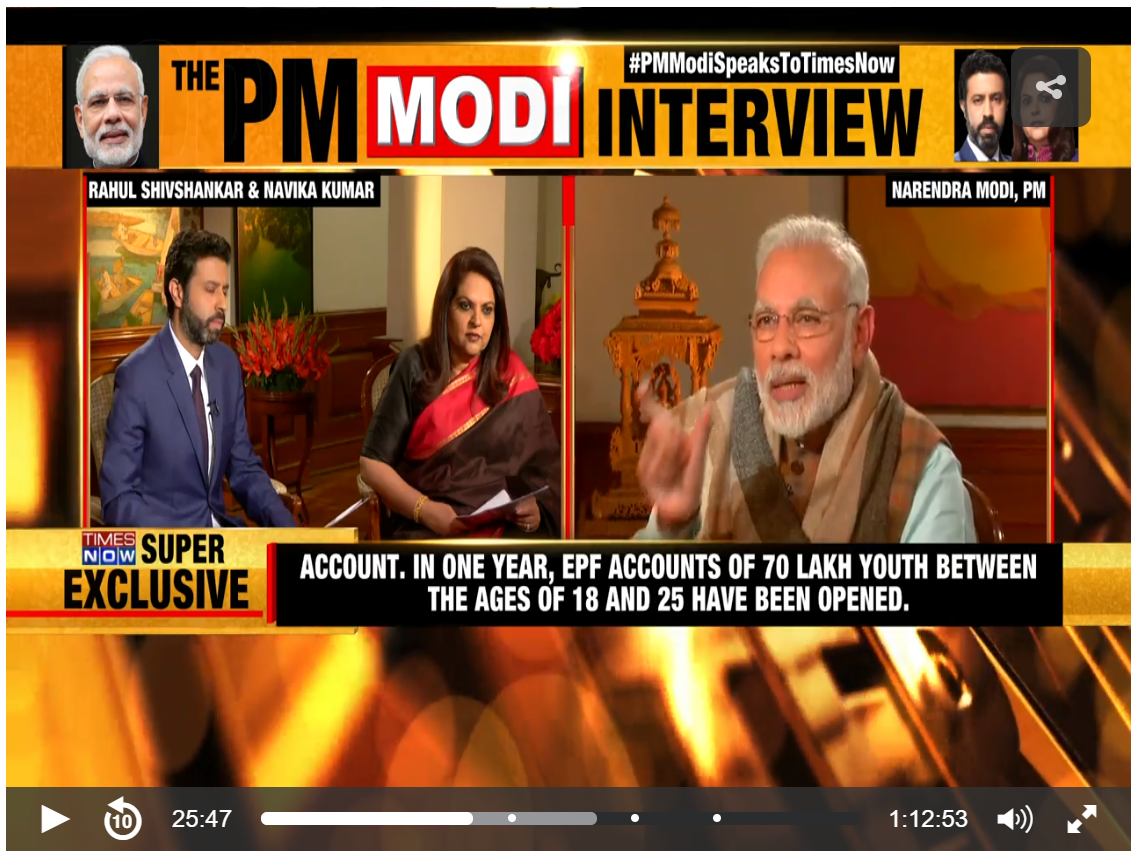
70 lakhs jobs in 2017 - a blatant bluff


Prof Pulak Ghosh and Dr Soumya Kanti Ghosh created a minor storm when they claimed that 70 lakh new ‘payroll’ jobs will be created in India in the organised sector in 2017-18. They reported that the EPFO manages a corpus of over Rs 11 lakh crore for its 550 lakh subscribers. According to the authors, 45.4 lakh new subscribers in the age band 18-25 years had enrolled under the EPFO in 2016-17 and started making their monthly contributions to the Fund. They also found that 36.8 lakh new subscribers in the same age band had enrolled between April and November 2017 and, therefore, they estimated that, for the full year 2017-18, 55.2 lakh new subscribers would be enrolled.
  • Seventy lakh new jobs is a claim that will take one’s breath away. The total ‘payroll’ stock as on March 31, 2017, was 919 lakh. It has taken the country 70 years to create a ‘payroll’ stock of 919 lakh jobs but, miraculously, in just 12 months, the country will generate 70 lakh new ‘payroll’ jobs — that is nearly 7.5 per cent of the current stock!
  • By comparison, China with a GDP five times that of India, adds about 150 lakh jobs a year.
  • If organised sector that employs 20 or more persons can generate 55 lakh new jobs in a year that qualified for enrollment under the EPFO, then we can declare that India has truly and comprehensively slain the demon of unemployment!
  • If we assume that for every ‘payroll’ job counted by the authors there will be another job created in the informal sectors, then the count will rise to 140 lakh in 2017-18. According to the Ghoshs’ report, 150 lakh persons enter the labour force every year of which 66 lakh is skilled manpower. Soon, the problem will not be joblessness but lack of jobseekers!
  • The authors also pointed out that the limited data available in the public domain indicated that the number of contributing members in the EPFO grew by 7% in 2014-15 and 8% in 2015-16 but, according to the Ghoshs’ report, the number jumped by 20% in 2016-17 and by a further 23% up to December 2017.
  • The EPFO data indicates that the number of contributing members decreased from 4.62 crore in July to 4.38 crore in September this year (2017).
  • The PM Modi referred to the MUDRA scheme and said “over 31 million loans have been sanctioned to entrepreneurs. Even if conservatively each enterprise creates one sustainable job, this initiative itself amounts to 31 million new jobs.” Alas!
  • It seems Modi is intentionally confusing by mixing up self employment' as jobs and misleading. While a 'job' is certain, regular and reasonably secure, self employment is not. What we are talking about is jobs in formal sector.
  • If we equate self employed, under employed and casual employed as job holders, then there is neither unemployment nor joblessness.
  • Labour participation rate is a ratio of all adults willing to work, whether employed or unemployed, to the total population. This ratio was 48% in Jan 2016. It fell to below 45% in Nov 2016. Now it reached 43% in July 2017. Most Indians choose not to work. Low labour participation rate hinders economic growth. Labour participation rate in China is 71%. The world average is 63%. Other major countries are Indonesia with a labour participation rate of 67%, Pakistan (54%), Nigeria (56%), Bangladesh (62%) and Philippines (65%).
  • The 70 lakh jobs claim, as claimed by Modi, is not only a misleading boast but also a blatant bluff.

PM Modi’s recent assertion that a person earning Rs 200 a day by selling pakodas is also employed. The fact that the prime minister actually celebrates this kind of ’employment’ as a major success of his Mudra scheme is even more worrisome. It is not a pride that millions are managing to eke out a meagre income. Instead it should be seen as a sign of under-employment.

India is witnessing jobless economic growth during the past three years and the government doesn't know how to create jobs and hence making all false claims and propaganda. Demonetization and GST's faulty roll out have had destroyed informal sector employment. MNREGA was able to provide just 50 days of work against guarantee of 100 days. Mudra loans aimed at promoting  micro enterprises averaging Rs.43,000 is just useless and serves very little purpose. We all know that politicians speak lies, nothing but lies but we do expect Prime Minister to be truthful to the nation.


Monday, 25 December 2017

How much is enough?

  • "How much is enough?" is a good question. Anyone involved in capitalism and markets will find this question uncomfortable. It is a qualitative question and is about how money makes us feel about spending, saving and giving and values we stand for.
  • Enough is the quality of having everything you need and want but nothing in excess and nothing that burdens you. 
  • Income to meet the expenses of frugal living, a home, a car, insurance for health & life, provision for children education and their well being, provision for health shocks, leisure, passions and retirement - is what is enough. 
  • The best thing one can do to children is to give roots & wings. And the worst thing is to give them a mountain of wealth under which they will get buried never knowing what they are and what they wanted to be in life.
  • Our culture is geared towards endless consumption and upgrades. Reasonable wealth is comfort. Meaningful testament to a life is well spent.
  • While personal debt is bad, public debt is necessary not only for prosperity but to avoid economic disasters. A good economy must serve the needs of many instead of the few.
  • A great economist told students that the capitalist system was capable of delivering such a sustained and steady increase in output that workers would eventually have all the material goods they could possibly want. They would need to toil for only 15 hours a week and could then spend the rest of the time enjoying themselves. Capitalism was a means, a rather distasteful means, to this end.
  • Capitalist economies are efficient, but workers were unsatiated by any material possessions, and devote any of their time to their pleasures. The new servant class which emerged and served the needs of neo rich were paid little more than subsistence wages.
  • Modern world is characterised by insatiability, an inability to say enough is enough, and the desire for more and more money. Economics, a narrowly focused discipline in which there is no distinction between wants and needs, has driven to the end of a cul-de-sac. 
  • The short-term need to get the economy moving again should not deflect policy-makers from reforms that will lay the foundations of a saner, more stable world.
  • Progress should be measured not by the traditional yardsticks of growth or per capita incomes but by the seven elements of the good life: health; security; respect; personality; harmony with nature; friendship; and leisure. 
  • Job security is much weaker and the pressure on the environment has increased.
  • There is more to life than gross domestic product. Growth at all costs has become enshrined as the goal of economic policy. We live in a country divided into workaholics who have more money than they know what to do with and millions of unemployed and under-employed citizens struggling to make ends meet on the proceeds of work in the informal economy.
  • In the middle, there are the debt slaves worried about the mortgage and often one pay packet away from penury. We ought to be able to do better than this. They favour a society with liberalism, social democracy and the good society is within reach.

A little house well filled, little wife well willed and 
little land well tilled are the greatest riches ... Shakespeare 

Money has no utility to me beyond a certain point ... Bill Gates

The fortunate man is he who, born poor, or nobody, works gradually up to 
wealth and consideration, and, having got them, dies before he finds 
they were not worth so much trouble ... Charles Reade


Earnings beyond certain point usually result in gaudy life style - excessive spending, amassing wealth, paying excess amounts for services without much substance. These activities contributes to increase in consumption and wastage, emissions and abuse of nature. Every luxury looses its vigor after 20 uses. You begin to own many things and eventually things will own you. Display of wealth or possessions is not only vulgar but also reflects low self esteem, make others feel jealous, lose real friends and win false acquaintances. They become more and more insensitive and end up knowing the price of everything and the value of nothing. 

Warren Buffet believes that setting up his heirs with a lifetime supply of food stamps just because they came out of the right womb can be harmful for them and is an antisocial act. The perfect amount to leave children is "enough money so that they would feel they could do anything, but not so much that they could do nothing." Bill and Melinda Gates are giving a $10 million only for each of their three children with a remark "It will mean they have to find their own way in life". 

Friday, 8 December 2017

Development and poverty

POVERTY
  • Poverty is present everywhere. Manifestation of poverty is a challenge.
  • Poverty and development are two sides to a coin. Where there is poverty, there may not be development.
  • Poverty is not only a lack of money to take care of basic necessity of life it creates a picture of aimlessness, uncertainty and hopelessness in the mind of the poor. 
  • An unhealthy or poor population produces less and may be forced into practices damaging the environment. It is the poor people who suffer most acutely from lack of development. 
  • The poor are anxious about the future in regard to the national political life, degradation of the environment, the high rise of inequality among people coupled with mass unemployment.
  • The high level of selfishness in the society with people looking only to their needs and fearful of others. Corruption is endemic. Crime rate is high and the future of generation yet unborn is clouded with uncertainty.

DEVELOPMENT
  • Development is often socio-economic, political, science and technology biased. 
  • The concept of development is a complex one. Its difficulty is not only in terms of definition or description but also in terms of measurement. 
  • Lack of infrastructure, deep seated corruption, various forms of conflict, bad governance and poor healthcare facilities cannot promote a healthy population committed to work for progress and development.
  • GDP as the measurement does not say anything about the distribution of total income of its country. It does not capture the totality of the development situation of the country.
  • The people are both the means and the end of economic development.
  • Human beings are at the center of concerns for sustainable development. 
  • They are entitled to a healthy and productive life in harmony with nature.
  • Development cannot be merely economic development or GDP as important as that may be. 
  • Development must include the conditions of reality that allow people to take their destiny into their own hands, individually and collectively involving economic, social, political, psychological, environmental, cultural, religious and international dimensions. 
  • Development is the ability and capability of the people to procure sufficient natural resources to meet the basic needs of all in a self-reliant manner.
  • The situation of the bottom forty percent of society is often bypassed by development and government.
  • Human welfare is the ultimate end of development not economic indices.
  • The welfare of the human person in its totality is the good health of a person and his skills cultivated through educational programmes as his endeavours add to the wealth of his nation.
  • Development strategy should be people centred and community participation must be evident. Any project that people/community cannot identify with will collapse. 

SUSTAINABLE DEVELOPMENT
  • World Commission on the Environment and Development (WCED) defines sustainable development as ‘development that meets the needs of the present without compromising the ability of future generations to meet their own needs.’
  • WCED posits that the present generation has been reckless and wasteful both in its exploitation and use of natural resources by pursuing a series of socio-economic and industrial policies which endangers global environmental security. It condemned the inequalities with and among nations and called for a restructuring of contemporary economic relations to guarantee an equitable distribution of national and international wealth.
  • The International Economic System (IES) is primarily profit orientated. Consequently, everything could be sacrificed on the altar of profit to the detriment of development of peoples and individuals, the often stated corporative responsibility of multinationals.
  • Can accountability and transparency be found in their political intercourse?
  • Poor countries are without development and citizens may not be able to compete with others because of lack of necessary capital, the technical-know-how and expertise. Symbiotically, without development poverty may not be eradicated. The solution to the dilemmatic situation is to confront the reality of poverty and challenges of development simultaneously, nationally and internationally.

There is no humiliation more abusive than hunger ... Pranab Mukherjee


Any kind of development that don't benefit bottom 40% of people, environmentally sustainable and generate mass employment is not a development at all. The trickle down theory, the standing rationale for our economic reforms, doesn't not address the aspirations of the poor people and eliminate poverty is unacceptable nonsense. Health, drinking water, sanitation, education, skill development and empowerment with adequate capital are essential for poverty eradication and meaningful development of poor people especially in rural India. Govt spending meager 2.27% on healthcare and 3.70% on education in the current budget against a minimum of 5-6% indicates empathy deficit towards the poor people of India. Even these meager allocations are towards high end spending rather than improving PHCs and schools. Hyped disruptive economic reforms Demonetisation & GST continuum have impacted poor most with loss of livelihoods and incomes and driven towards desperation and our rulers thought fit to turn a Nelson's eye.

Sunday, 3 December 2017

Fortis charges over Rs 15 lakh to treat child with dengue

 
  • Every person, especially who is doling out lakhs of rupees to hospital, is entitled to know the details for all such payments prior to payment and and justification thereof and whether the treatment is being done in right direction or not.
  • Self certification that there is no negligence, no over billing done, all protocols followed etc are unacceptable when parents/children/relatives of the patient are kept in dark about the condition of patient deteriorating and at the end patient dies.
  • Isolating the patient in ICU in the name of 'infection control' is another reason for trauma.
  • The underlying reason is the greed of the corporate hospitals having invested crores of rupees in the hospital & its facilities and doctors who spend millions for acquiring their medical degree and post graduation degrees etc.
  • Teaching, Medical and Justice dispensation are noble professions, and doctors and hospitals must follow ethics under all circumstances. Immorality and corruption in these professions are contemptible. Justification that their degradation is in line with general degradation of society as such, is unacceptable nonsense.
  • Corporate hospitals & doctors charging exorbitant amounts resulted in abnormal premiums being paid by all insurers.
  • Prima facie, 660 syringes and 2700 gloves indicates the whole bill is cooked up and the patient might have passed some days before. Only a thorough criminal investigation will bring truth to the forefront.

An elite class that is free to operate without limits - whether limits imposed 
by the rule of law or fear of the responses from those harmed by their behavior - 
is an elite class that will plunder, degrade, and cheat at will, and act endlessly 
to fortify its own power ... Glenn Greenwald


In the absence self discipline and adherence to ethical practices, robust consumer protection laws, active consumer awareness and ruthless law enforcement mechanisms, emulating liberalization and promoting private sector and destroying public sector is grossly injurious to semi literate societies like ours. Today, the condition of government hospitals and schools doesn't enthuse anyone to avail its services. Arogyasri, Tuition fee reimbursement etc seemingly does good for common man but in reality it fills coffers of corporate hospitals and fulfill greed of doctors while depriving precious funds for government colleges and hospitals. The realistic solution would be strong govt and non-profit trust hospitals virtually competing with corporate hospitals. Govt must increase its spending from present 1.2% of GDP to at least 5% of GDP on health care and also spending on school education from present 2.5% to over 5% of GDP, of course with transparency and accountability and corruption eliminated. This requires political will and administrative honesty apart from public patronizing. 

Wednesday, 29 November 2017

Banks NPAs & Recapitalisation

  
  Banks NPA's & NPA Ratios in June 2017

  • As in June 2017, Banks NPAs are Rs.829,338 crores and NPA ratio is any where up to 24%. As on date  NPAs are in excess of  Rs.11,00,000 crores.
  • Steadying a tottering financial system is never a graceful exercise, as American and European authorities discovered after the financial crisis. Without reform, another recapitalization is meaningless.
  • The recently announced Rs.211,000 crores Banks Recapitalisation by central govt has three components:
    (i)   Budgetary support Rs.18,000 crores only.
    (ii)  PSU banks will need to go raise Rs. 58,000 crore from the market.
    Who will buy? May be cash rich public sector industries will be coerced to buy them. 
    (iii) The government will issue “Bank Recapitalization Bonds” for Rs. 1,35,000 crore which will be used to buy more shares in public sector banks. But these have to bought by the banks themselves. 
    All these bonds have to be paid back in the future along with the interest by the central government. In effect, nation's future money is being pumped into today's banks recapitalisation.
  • Effectively all 21 ailing banks will get additional cash of Rs.76,000 crores only, in next two years.
  • Despite the roundabout method of recapitalisation, getting money into the banking system is a good policy. Having fresh equity makes it easier for them to acknowledge past mistakes and move on. Govt need to pump in ~Rs.75,000 crores every year over next few years from budget to make PSU banks vibrant.
  • But every NPA has to be booked entirely by from Bank's equity only. Writing off NPAs will result in capital erosion to that extent. NPAs exceeding 10% will erode equity completely.
  • Public sector banks have frozen up on lending because their capital to loan ratios will not allow any more.
  • Since banks needs to have 10% of every loan from its equity, larger equity base will be helpful to some extent in resuming lending business.
  • But banks recapitalisation helps adequate equity in books to resume lending of consumer deposit money.
  • Any deposits withdrawal run by public will be disastrous for banks, with inadequate cash and massive deposits to service.
  • But the banks lending money to its promoter (government) by buying bonds for funding additional equity acquisition of the same bank might be legal but is grossly unethical.
  • With 80% NPAs irrecoverable, Banks would never initiate hard steps for recovery of these NPAs with massive haircuts contracting their equity.
  • But when will they earn profits and cover up irrecoverable NPAs? With reforms and tight future lending and banks managed professionally without political influences and temptation of corruption, it would easily take over 10 years. Until then it is just hollow talk only.
  • This Banks Recapitalisation exercise (equal to 1% GDP) may not increase fiscal deficit in  books, but will damage economy the way its corresponding fiscal deficit would have done or even more. 
  • The best way and the only way is that banks take over NPA companies and liquidate them in auction and book losses. With what ever is left out they should draw their operations afresh and move on carefully. Any other way will be round about and postponing eventualities, achieves nothing and wastage of time & money.
  • While national debt may create some assets, it also means that the present government is creating liabilities for unborn citizens reducing their ability to produce and makes them poorer.

Banks NPA situation was equally bad and needed recapitalisation ever since Modi became PM 3+ years ago. Instead of doing the right things for vibrant economy, Modi focused on vanity and spectacularity of new schemes and none of them have done any good for the economy. In fact reckless reforms like Demonetisation & GST have destroyed all sectors of economy. The only way our economy can grow and stabilise is with improving agriculture viability that enables rural spending and consumption and support the economy. But Modi & Jaitley are known for their tinkering the economy with disastrous effects only. Today, public deposits in banks in excess of Rs.1 lakh per customer are highly unsafe with RBI insurance covering up to Rs.1 lakh only!