Showing posts with label globalization. Show all posts

Tuesday, 3 September 2019

Recession

The inequality generated by decades of neoliberalism and the resentment it has caused across the world have in recent times led to uncertainties that only intensify the fear of recession.
  • Growth is decelerating worldwide, including United States which is experiencing 50-year low unemployment rate. China lost momentum with industrial growth at a 17-year low. Prospects for the third quarter are gloomy as well.
  • The performance of major economies affects the rest of the world economy. For example, depressed Chinese demand caused the fall in Thailand’s second quarter growth rate to the lowest since 2014. 
  • Scattered talk has given way to widely expressed fears of an impending recession affecting financial investment behavior, with investors dumping stocks and shifting to government bonds, resulting in a slump in stock markets.
  • The deeper malaise is the depressed demand due to extreme inequality in assets and incomes that has resulted from decades of neoliberal growth across the developed world. Globalization moved productive activities to cheap labor locations had depressed wages across countries with large profits for a few and tax concessions for the rich have accentuated inequality.
  • Incomes in the top percentile have exploded, those in the middle and lower ranges have  stagnated sapping consumption demand. Growth came by finding ways of stimulating demand not depending on current income, but driven by credit. That, beyond a point, is not sustainable and the fear of another recession is likely.
  • The USA-China trade war and other countries responding with similar measures, the world is faced with a proliferation of beggar-thy-neighbor policies that makes a bad situation worse. The unknown consequences of Brexit cannot be anything but adverse. These uncertainties intensifies the fear of recession.
  • The challenge for capitalism was finding an alternative way of reviving demand depressed by underlying inequality. In the past the states used to step in to lift economies out of recession with their spending for a short a time. With neoliberalism that has shrunk the revenues of the state and public spending being is mostly debt-financed, this option was shunned. The only way to drive private demand is with credit in the form of near zero interest rates and getting central banks to hugely increase liquidity in the economy.
  • Capitalism’s current predicament arises because this policy has not worked, though it has been experimented with very low interest rates and in some countries even have turned negative. While this policy has not delivered growth, it has encouraged speculation financed with cheap credit. This has led to accumulation of corporate debt as firms borrowed mainly to speculate in financial markets and pay off their rich shareholders with costly share buybacks resulting in asset price inflation and financial fragility. But with low growth central banks were compelled to continue this policy regime.
  • But as the threat of recession looms, erstwhile advocates of fiscal prudence and austerity such as the IMF are calling for adding fiscal stimuli to the policy mix. Infrastructure upgrades, expanding public housing stocks and targeted tax cuts should all be considered. This is the recipe for a return to more robust growth and inflation.
The recession threat is immediate and policy is likely to respond too slowly. If the recession does set in, it can be devastating. In 2008 China, Germany and India were affected less and this time they are among the countries whose performance could drive the recession. Corporate debt often denominated in foreign currencies at high levels, a recession would find many debtors defaulting on payments and forced to sell assets. That could result in asset price deflation and will have reverberations in an over-committed financial sector. Only a set of freak occurrences can prevent another recession.

Monday, 10 June 2019

Uneconomic growth

Growth is uneconomic when it increases environmental and social costs by more than it increases production benefits. The cost associated with economic growth arises as a result of  the social and environmental sacrifices made necessary by that growing encroachment on the eco-system. David Suzuki argued that ecologies can sustain 1.5-3% of economic growth per year and any higher growth will necessarily cannibalize the natural capital of soil or forest. But when growth becomes uneconomic we must find new answers to these problems. 
  • Historically economic growth was the answer given to the major problems raised by Malthus (overpopulation), Marx (unjust distribution), and Keynes (unemployment).
  • Globalization is the current ideological commitment to global economic integration via free trade and free capital mobility. Consequently many tractable national problems like overpopulation, unjust distribution, and unemployment, are converted into one intractable global problem, in the name of “free trade,” and in the interests of transnational capital.
  • Growth in GNP is so favored by economists that they call it economic growth. GNP is supposed to grow forever. There are costs incurred by GNP growth. These costs are depletion, pollution, ecological disruption, sacrifice of leisure time, disutility of some kinds of labor, destruction of community in the interests of capital mobility, takeover of habitat of other species, and running down a critical part of the inheritance of future generations.
  • The law of diminishing marginal utility of income tells us that we satisfy our most pressing wants first, and that each additional unit of income is dedicated to the satisfaction of a less pressing want. So the marginal benefit of growth declines. 
  • The law of increasing marginal costs tells us that we first make use of the most productive and accessible factors of production and only use the less productive factors as growth makes it necessary. Consequently, marginal costs increase with growth. 
  • When rising marginal costs equal falling marginal benefits then we are at the optimal level of GNP, and further growth would be uneconomic.
  • The only limit to economic growth is technology, and there is no limit to technology, ergo no limit to economic growth. Therefore the very notion of “uneconomic growth” makes no sense. Growth does not increase the scarcity of anything, rather it diminishes the scarcity of everything! How can one possibly oppose growth? 
  • Growth that relies entirely on exploiting increased knowledge rather than exploiting increased resource consumption may not qualify as uneconomic growth.
  • Economists agree that GNP was not designed to be a measure of welfare; it measures only activity. Nevertheless they assume that welfare is positively correlated with activity, so that increasing GNP will increase welfare. This is equivalent to believing that the marginal benefit of GNP growth is greater than the marginal cost. The empirical test results turn out not to support the belief.
  • Measures of welfare are difficult and subject to many arbitrary judgments. The empirical evidence that GNP growth has increased welfare is weak. Impact on welfare via policies that increase GNP growth are weak and nonexistent. 
  • Economists habitually argue that we need not worry about global warming because the only climate-sensitive sector of the economy is agriculture, and agriculture accounts for only 3% of GNP. These economists evidently don’t need to eat! 
  • Overpopulation would be cured by the demographic transition. When GNP per capita reaches a certain level children become too expensive in terms of other goods forgone and the birth rate automatically falls. Is it necessary for Indian per capita consumption to rise to the Swedish level for Indian fertility to fall to the Swedish level, and if so what happens to the Indian ecosystem as a result of that level of total consumption?
  • Unjust distribution of wealth between classes would be rendered tolerable by growth, the rising tide that lifts all boats, to recall another slogan. Yet growth has in fact increased inequality both within and among nations. To make matters worse, even the metaphor is wrong, since a rising tide in one part of the world implies an ebbing tide somewhere else.
  • The assumption that growth is economic, that it is making us richer rather than poorer. But now growth is becoming uneconomic. Uneconomic growth will not sustain the demographic transition and cure overpopulation. Neither will it help redress unjust distribution, nor cure unemployment. Nor will it provide extra wealth to be devoted to environmental repair and clean-up. Indirect growth based solutions to the big problems no longer work.
  • We now need more direct and radical solutions to the problems of Malthus, Marx, and Keynes: population control to deal with overpopulation; redistribution to deal with excessive inequality; and measures such as a public employer of last resort, and ecological tax reform to raise resource prices relative to labor. These must be national policies. Many nations have made progress in controlling their population growth, in limiting domestic income inequality, and in reducing unemployment. 
  • Global economic integration by free trade and free capital mobility effectively erases the policy significance of national boundaries. Nations can no longer internalize environmental and social costs in the interests of resource efficiency and social justice, because capital is free to produce elsewhere and still sell its product in the market whose social controls it just escaped. Capital escapes higher wages and taxes of any kind, in particular taxes aimed at re-distributive policies that redress excessive inequality and poverty.
  • Globalization refers to global economic integration of many formerly national economies into one global economy, mainly by free trade and free capital mobility, but also by easy or uncontrolled migration.
  • Whether capital moves to overpopulated low-wage countries, or poor workers move to the high-wage country, the result is the same -- a competitive bidding down of wages to the detriment of countries that have followed a high-wage policy by limiting their numbers and by more equally distributing their wealth.
  • The laboring class in the low-wage country gains in terms of number employed, though not usually in terms of increased wages because of the virtually unlimited supply of cheap labor resulting from past and present demographic growth. The capitalist class in the high-wage country gains from lower wage costs at home as well as abroad. 
  • The big losers are workers in the high-wage countries. With low wages now a competitive advantage in attracting capital, we might expect policies aimed at increasing the supply of labor in previously high-wage countries.
  • Globalization operates by standards-lowering competition to bid down wages, to externalize environmental costs, and reduce social overhead charges for welfare, education, and other public goods. It is far worse than an unrealistic global dream -- it actively undercuts the ability of nations to continue to deal with their own problems of overpopulation, unjust distribution, unemployment, and external costs. It converts many relatively tractable national problems into a single intractable global problem.
Globalization via export-led growth is the new philosopher’s stone of the IMF-IBRD-WTO alchemists. Nations can all turn their lead into gold by free trade. With the revival of alchemy comes a return to the logic of Mercantilism: wealth is gold, and the way for countries without mines to get gold is to export more goods than they import, and receive payment for the difference in gold -- the alchemy of trade. The way to export more than you import is to reduce wages, and to externalize social and environmental costs, because that keeps prices of your exports competitive. Low wages also prevent your laboring class majority from buying imported goods and thereby dissipating the trade surplus. The way to keep wages low is to have an oversupply of labor. An oversupply of labor can be attained by easy immigration and high birth rates among the working class. Globalization requires, therefore, that for a nation to be rich, the working-class majority of its citizens must be poor, increase in number, and live in a deteriorating environment! Behind these absurdities is the further contradiction that under globalization it no longer makes sense to speak of  “nations” (only corporations); nor of “citizens” (only employees).

Globalization is accelerating the shift to an era of uneconomic growth, a time when, as John Ruskin foresaw, “That which seems to be wealth may in verity be only the gilded index of far-reaching ruin.”


Sunday, 11 February 2018

Modi at Davos and Budget


WILL THE REAL MODI PLEASE STAND UP?
  • Depending upon the audience Modi takes different avatars.
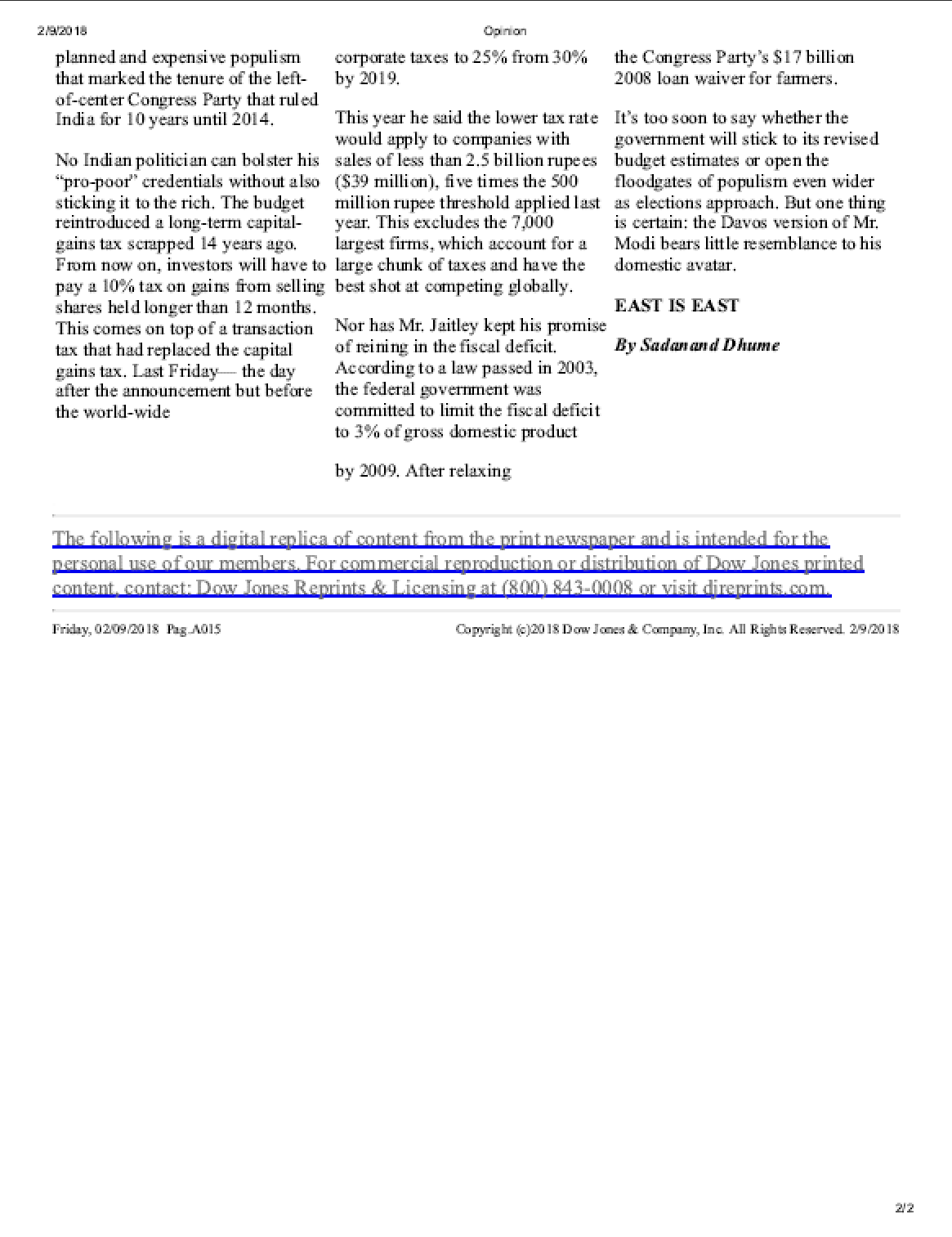
  • In Davos last month, Modi defended globalization and warned against protectionism but his last week's budget did not suggest pro business statesman, but a protectionist strongman familiar in poor countries.
  • The last budget before 2019 elections squelches any hope that Modi would push long pending market friendly reforms.
  • But the budget confirms his re-election plans i.e. grand pro-poor gestures avoiding any pro-rich plans. 
  • Modicare plan for 50 crore poor people, even though with initial allocation of a pittance of Rs.2,000 crores, devastated Bombay Stock Exchange wiping out investor health by more than Rs.5 lakh crores on a single day.
  • Faced with failure of 'Make in India' to boost employment, government hiked import tariffs to coerce companies to build mobile phones, auto parts, toys etc in India.
  • These protectionist policies, which failed in the past, will only ensure Indians pay high prices for shoddy goods and firms getting more interested in manipulating duties than satisfying customers.
  • FM Arun Jaitley's initial promise for lowering corporate taxes by 2021 appears unrealistic with economy growing at mere 6.5%.
  • In the last 4 years, Modi failed to privatize a single public sector enterprise even though Air India privatisation is in process.
  • ONGC buying out HPCL is only Government exiting business falls short of privatization. 
  • No Indian politician can bolster his 'pro-poor' credentials without also sticking to the rich.
  • According to the law passed in 2003, central government is committed to limit the fiscal deficit to 3% of GDP by 2009 whereas budget 2018 indicates fiscal deficit at 3.3%.
  • Some analysts argue that budget could have been even worse.
  • It is too soon to say whether government will stick to its budget estimates or open its populism gates even wider as elections approach. 
  • But one thing is certain: Davos version of Modi bears little resemblance to his domestic avatar.

Modi doesn't do what he talks and doesn't talk what he does

Politics without principle, progress without compassion, wealth without work, 
learning without silence, religion without fearlessness and worship without awareness 
will destroy human race ...  Anthony de Mello

For every politician winning election, at any price, is foremost. Anything else secondary. Therefore Modi will do anything including destruction of economy or arousing communal passions or declaring war on Pakistan or anything for winning 2019 general elections. But one thing is certain. He will give nothing really to the poor. He rather believes in fascist Mussolini type spectacular announcements  followed up by relentless media campaign and propaganda. Lacking humility, honesty, integrity and morality, he is dangerous for Indians and its democratic polity.


Monday, 21 August 2017

India's Freedom & Liberalisation

  • India was at a crossroads 70 years ago when it made choices that were enshrined in the constitution, so that its workers and peasants were freed from class and caste oppression.
  • Nehru said at the midnight when India woke up to freedom. To bring freedom and opportunity to the common man, to the peasants and workers of India; to fight and end poverty and ignorance and disease; to build up a prosperous, democratic and progressive nation, and to create social, economic and political institutions which will ensure justice and fullness of life to every man and woman.
  • The zamindars and landlords finding that open defense of landlord's interest was no longer feasible, switched over to communalism for their class defense.
  • Pakistan's falsity of religion-based nationalism and a state was founded on theocracy. It was one area where the Hindu right-wing emulates its sworn enemy and India was sought to be converted into a theocratic state called Hindu Rashtra. 
  • M.S. Golwalkar, RSS supreme leader for more than 30 years minced no words: The non-Hindu peoples in Hindusthan must either adopt the Hindu culture and language, must learn to respect and hold in reverence Hindu religion, must entertain no ideas but those of glorification of the Hindu race and culture…. In one word, they must cease to be foreigners, or may stay in the country, wholly subordinated to the Hindu nation, claiming nothing, deserving no privileges, far less no preferential treatment—not even citizen’s rights.
  • It is no accident that the Hindutva forces had nothing to do with anti-colonial struggle and independence. Infact, the RSS chief M.S. Golwalkar had so little sympathy for the anti-colonial struggle that he thought that the British would have to be invited back shortly after Independence in order to govern India. Today they laud Ambedkar today for sheer opportunistic reasons.
  • The first major victim of this narrow cultural nationalism of the Indian right-wing was the Father of the Nation. After being driven to the margins of Indian politics in the wake of Mahatma Gandhi’s assassination, the right wing RSS and its latest political incarnation, the BJP, is at the helm of India, now.
  • The slide started post-Nehru and was complete in 1991, when the Congress went back on its promises and ushered in the neoliberal order. The Congress ceased the cause of workers and peasants ostensibly called national interest, but in reality for the material prosperity of the merchants and manufacturers. Now with the BJP unburdened by the legacy of any egalitarian struggle, the free people of India are under the onslaught of neoliberalism and rabid communalism.
  • Ambedkar argued that the political equality, guaranteed by the constitution, would get jeopardised if there was no corresponding movement towards social and economic equality. The first setback to independent India's was its inability to carry out any significant land redistribution. The top 15 per cent of landowners continued to hold the same percentage of land area as before. Dalits, the landless class, who had been denied the right to own land under the old system continued to remain landless and therefore both socially and economically disempowered. By the end of the 1950s, Jawaharlal Nehru was worried about growing wealth and income inequality in the country, he has to set up the Mahalanobis Committee to inquire into it.
  • The per capita annual foodgrain availability, which had been around 200 kgs at the beginning of the 20th century in “British India” declined to 148.5 kgs during the 1939-44 and even lower to 136.8 kgs in 1945-46, was pushed up close to 180 kgs by the end of the 1980's. It has since declined, over the neoliberal period, reaching 163 kg for the years 2012-14.
  • The spontaneity of capitalism was breaking the bounds set by state control. And soon it was to jettison the institute a regime of neoliberalism, under which the domestic corporate-financial oligarchy got closely integrated with globalised finance capital.
  • The economic travails of the dirigiste regime arising from the sluggish growth of the home market owing to growing economic inequality, its loss of social support among the people for the same reason, and the big bourgeoisie’s wish to break out of it has contributed towards effecting a transition from dirigisme to neoliberalism.
  • Neoliberalism greatly accentuated the increase in economic inequality, though it accelerated the growth rate in the tertiary sector. The acceleration in growth rate was resolved through larger exports of services, larger elite consumption of luxury goods, and the effects of asset price bubbles. The top 1 per cent of households in India currently owns 60 per cent of the country’s total wealth puts India with the fastest increases in asset inequality.
  • The process of primitive accumulation of taking over of peasant's land 'for a song' for corporate projects and squeezing the peasants through higher input prices, by withdrawing subsidies and the drying up of institutional credit, but without commensurably higher output prices. These output prices, especially of commercial crops are allowed to fluctuate widely with world market prices. Even phenomena like Demonetisation and the GST are also mechanisms for imposing primitive accumulation upon the petty production sector. 
  • A tragic consequence of this primitive accumulation at the expense of peasant agriculture has been the suicides of over three lakh peasants over the last two decades. And large numbers of peasants have left agriculture and migrated to cities in search of jobs, which are not being created to an adequate extent despite the apparently high GDP growth. The net result has been a proliferation of casual employment, intermittent employment, part-time employment and disguised unemployment. The growth in the casualisation of employment and privatisation of public sector units have weakened trade unions. While capital is international, workers are still organised along national lines, making national unions ineffective.
  • The middle-class segment that has done well out of globalisation, owing to the outsourcing of services from the metropolis, and owing to the rise in the share of surplus which supports a range of activities from finance to advertising, has expectedly belonged to the upper castes which have been privileged enough to acquire the skills to make use of the opportunities that have been opening up. Since these beneficiaries attribute their own success not to their privilege but to their talent, the inevitable conclusion is drawn that those who are excluded from such jobs are untalented. An impression spreads that children from the oppressed castes do not make it because they lack talent, which boosts casteist prejudice.
  • Development in India started on a wrong foot by eschewing land redistribution and the pursuit of capitalist development contributed to growing socio-economic inequality, that got a free run under neoliberalism. The adherents of Hindutva in power this social counter-revolution is being carried forward with a vengeance. India is not a fascist state, but the growing socio-economic inequality is destroying the constitutional provision of political equality.
  • Fascism arises when the system besieged by crisis is challenged by a threat from the revolutionary forces whom fascism is used for eliminating. Fascism grows when the system is at a dead end and when the working-class movement is not in a position to mount a challenge. That is when large sections of the people flock to fascist movements, not because it provides a credible way out, but because it projects a messiah, it resorts to flamboyant but meaningless rhetoric, it appeals to unreason, and it holds not the system but the “other” (the Jews or the Muslims or whatever) as responsible for the travails of the people.
  • It may seem intriguing that neoliberalism has reached a dead end, Modi promises even greater neoliberal reforms while a Trump rails against neoliberalism. But this contrast between two current manifestations of fascism arises because neither has a coherent programme anyway for overcoming the crisis and the frustration gripping the people. Both are essentially purveyors of unreason for whom the economic agenda as a thought-out rational programme is incidental.
  • The corporate-financial oligarchy adopts the fascist movement, finances the fascist movement, and promotes the fascist movement, which exists independently of it. Fascism provides “stability” and also an ideal ideological prop for neoliberal capitalism. Fascists in government represent, in the Indian context, an alliance between corporate capital and Hindutva. The fact that capital is globalised while the state remains a nation state entails that even a fascist nation state must abide by the wishes of globalised capital (to prevent capital flight) and this fact restricts its ability to overcome the crisis.
  • At peril are the gains and achievements made by the movements for national independence, socialism and social justice. India is once again is at crossroads where the choices it made 70 years ago are being undermined.
The left and democratic forces can have an alternative agenda that promotes equality, that strengthens democracy, and is willing to withdraw from the neoliberal regime. They should for instance have an agenda of introducing a set of universal, justiciable economic rights, to supplement the political rights that the constitution guarantees. These can include the right to food, the right to employment, the right to publicly-funded free and universal quality health care, the right to publicly funded free and universal quality education up to a certain level, and a right to adequate old-age pension and disability benefits. The implementation of these rights together would cost less than 10 per cent of the GDP annually, which the country can easily afford. 

There comes a time in the life of every nation when it stands at the 
crossroads of history and must choose which way to go ... Lal Bahadur Shastri

Globalization benefits just minuscule percent of population to prosper, who are rich, educated and with access to power & resources. Trickle-down theory that says benefits for the wealthy trickle down to everyone else is unacceptable nonsense. In a large populous country like India, where most people are illiterate & poor, governments ignoring their welfare and chasing money making machines is nothing but abuse of principles of democracy and Constitution of India. Globalization is a concept propounded by developed & educated western countries to expand their reach for marketing their products and services rather than extending helping hand for upliftment of suffering masses in the world. India blindly embracing it for monetary gains, is not only height of insanity but also detrimental to its large segments of population. Development is not facilitating educated and/or rich people to prosper but enhancement of living standards of all classes of people simultaneously.

Friday, 21 October 2016

Poverty


  • About 21,000 people die every day of hunger or hunger-related causes, according to the United Nations. This is one person every four seconds. Sadly, it is children who die most often.
  • Yet there is plenty of food in the world for everyone. The problem is that hungry people are trapped in severe poverty. They lack the money to buy enough food to nourish themselves. Being constantly malnourished, they become weaker and often sick. This makes them increasingly less able to work, which then makes them even poorer and hungrier. This downward spiral often continues until death for them and their families.
  • UN promoted “Food for work” programs where the adults are paid with food to build schools, dig wells, make roads, and so on. This both nourishes them and builds infrastructure to end the poverty. For children, there are “food for education” programs where the children are provided with food when they attend school. Their education will help them to escape from hunger and global poverty.
  • Poverty is defined as per capita daily spend of less than $16 in USA.
    For India it is less than $1.25, as defined by world bank.
  • Over the past three decades, China has successfully led the greatest poverty alleviation program in the history of the world. During that time, an estimated 500 million Chinese were lifted out of extreme poverty. This remarkable success was achieved, in part, through the recognition of land rights. It was Mao’s disastrous collectivization of farmland into huge communes that led to China’s greatest famine. And it was Deng Xiao Ping’s dismantling of the communes and establishment of the household responsibility system that led to China’s first great lurch toward prosperity and stability. An estimated 88 million farming families have gained legally secure land tenure. Consistent GDP growth of over 10% for a decade is another contributing factor.
  • A vast majority of the global poor live in rural areas and are poorly educated, mostly employed in the agricultural sector, and over half are under 18 years of age. 
  • Access to good schools, healthcare, electricity, safe water and other critical services remains elusive for many people, often determined by socioeconomic status, gender, ethnicity, and geography.
  • Poverty in the abstract doesn’t challenge us, it makes us think, lament, but when you see poverty in the flesh of a man, woman or child, this challenges us.  The attitude we have is running away from the needy and not drawing near to them.
  • After 2030, negative impacts of climate changes could threaten farming and food systems in every region of the world. Agriculture has always been the interface between natural resources and human activity. Today it holds the key to solving the two greatest challenges facing humanity: eradicating poverty, and maintaining the stable climatic corridor in which civilisation can thrive.
  • In USA, approximately 50 million Americans (one out of six) were listed as food insecure (defined as people who either do not have enough or are at real risk for not having enough food for their family). This despite the fact that America looses/wastes almost 100 billion pounds of food a year, or about one pound per person per day.
  • In the emerging economies, however, progress continues to elude a large number of people living in extreme poverty.
  • 35% of Indians are below official poverty line.
Poverty in India:
  • India spends only 1% of its GDP on health (3-4% is considered bare essential).
  • 70% population live in villages. 
  • 50% of Indians don’t have proper shelter.
  • 70% don’t have access to decent toilets.
  • 35% of households don’t have a nearby water source.
  • 85% of villages don’t have a secondary school.
  • Over 40% of these same villages don’t have proper roads connecting them.
  • Urban poverty in India is a direct effect of rural migrations fleeing poverty. 
  • Unlike China, India neglected improving agriculture productivity which could have alleviated rural poverty.
  • With so much emphasis on service sector, the jobs created in that sector were just 2 million despite its contribution to GDP at 50%. This resulted in complaints that globalization and modernization benefited only the rich.
  • India's globalization has just left its rural poor on their own without any social safety nets.
  • India's market liberalization resulted in market forces investing in profitable areas leaving plenty excluded. 
Burden of Poverty:
  • Poverty is broadly the gap between one’s needs and the resources available to fulfill them. That is, people in poverty are those who feel “poor,” who feel they have less than they need.
  • Social and economic resources shape the health of individuals and populations. 
  • Lacking money or time can lead one to make poorer decisions, possibly because poverty imposes a cognitive load that saps attention and reduces effort.
  • The poor often behave in less capable ways, which can further perpetuate poverty.
  • Poverty, and its related concerns, places an undue burden on an individual’s limited mental resources, leaving less for other tasks. 
  • Poor are less capable not because of inherent traits, but because the very context of poverty imposes load and impedes cognitive capacity. 
"In a country well governed, poverty is something to be ashamed of. 
In a country badly governed, wealth is something to be ashamed of." - Confucius

My View:
Poverty is just a matter of bad luck. It is like a man fallen into a ditch. Unless external help is extended he can't over come it. It is the primary duty of every government, organisation and every human being to help poor people over come it. Hatred towards poor is not only uncivil but also despicable.Poverty unattended will surely breed undesirable violence, crime and diseases. In the words of John F. Kennedy "If a free society cannot help the many who are poor, it cannot save the few who are rich.".