Showing posts with label Dalits. Show all posts

Wednesday, 22 May 2019

Caste consciousness

Caste system is a phenomenon related to Hinduism in particular. On the basis of caste, it is fixed at the time of a person’s birth that whether she/he would have higher or lower status in social hierarchy. Castes were first classified according to their occupation. But due to access to wealth, power, and privilege, Brahmins and Kshatriyas started to use religious sanctions to monopolize their position. 

Caste system in India is so rigidly deep-rooted in its socio-cultural and religious life. But in reality it is no God-send virtue to be followed by the people. It has had several exploitative and discriminatory effects on our social order throughout the ages. As a by-product, caste system has given several other social ills to the society such as untouchability.

A Brahmin’s caste pride comes with humiliation for other castes is both the base and superstructure of Indian society. Blindness to caste does not take away the social, political and economical privileges one gets because of one’s accident of birth in a particular upper caste. Anyone belonging to a hierarchically privileged caste is bound to get the advantages of his caste location, willingly or unwillingly, consciously or unconsciously.

To be born in a privileged caste is not anyone’s fault but to refuse to even acknowledge unearned benefits’ accruing due to one’s caste and thereby claiming that the very mechanism that enforces them is absent in one’s life is not right. For the people belonging to the marginalized lower strata of this system, caste is about humiliation, deprivation, oppression and imposed identity.

To be oblivious to caste and indifferent to the caste associations of friends, employees and associates, is no longer enough in today’s caste-conscious India. Caste blindness is an affectation available only to the privileged; the lower castes cannot afford to be indifferent to caste.

Caste discrimination affects millions people and involves massive violations of civil, political, economic, social and cultural rights. Caste systems divide people into unequal and hierarchical social groups. Those at the bottom are considered ‘lesser human beings’, ‘impure’ and ‘polluting’ to other caste groups and subjected to untouchability practices. Untouchables, known as Dalits are often forcibly assigned the most dirty, menial and hazardous jobs, and many are subjected to forced and bonded labor. Due to exclusion, they have limited access to resources, services and development, keeping most of them in severe poverty.

Caste consciousness is not so rigid in Indian diaspora as in India. They have caste feeling but not use it in day to day practices but use it flexibly without causing any harm or ill treatment. Caste identity has been central to the ways in which Indians overseas organised their society. They still look to marry within caste and endorse caste system. People change their names and surnames to get away from low-caste identity. Caste is something that is embedded in the psyche of a person. So, as long as a person's cultural roots are present in a society with caste system embedded in it, this practice is bound to continue. Thus, a second generation emigrant is to have lesser belief in the caste system and so on. Thus caste consciousness is very much present in much of the Indian diaspora.

Although India has a more rigid mechanism of caste system, the struggle of BR Ambedkar was able to grant the lower castes with the incentive of reservation, which is mostly absent in other countries. In Oct 2018, Kerala government has appointed 54 non-Brahmin priests including 7 dalits to the Cochin Devaswom Board. Earlier, 36 non-Brahmins, including six Dalits, were appointed to the Travancore Devaswom Board.

The Constitution mandates that no citizen shall, on grounds only of caste or race, be subjected to any disability and restriction. Nehru had hoped caste would disappear from India’s consciousness. Law can only provide protection from exploitation but it cannot bring attitudinal change in so-called upper castes. The young and modern generation is perhaps the only hope in bringing about the real meaning of social justice in our country.

Wherever a Hindu goes he takes his caste along with him .. Dr Ambedkar 


Wednesday, 15 May 2019

Fake news

Fake news is a type of yellow journalism or propaganda that consists of deliberate disinformation or hoaxes spread via traditional news media or social media. Digital news has brought back and increased the usage of fake news, or yellow journalism. The news is then often reverberated as misinformation in social media but occasionally finds its way to the mainstream media as well.
  • Fake news was not a term many people used four years ago, but it is now seen as one of the greatest threats to democracy and free debate. Fake news is not a new phenomenon. Misinformation has been used by governments for ages to control public opinions for generations.
  • The rampant misuse of social media platforms to spread fake news has been a global cause for concern for misinformation shared through WhatsApp messages influences the voters.
  • Social media giants like Facebook, Twitter and Google are also under intense pressure to do everything they can to prevent their platforms being misused and manipulated, and to stop the spread of fake news.
  • Fake news does not make a person change his beliefs. Fake news only reinforces the existing political ideas and beliefs and brings out the worst impulses within us.
  • Fake news is only a catalyst, the demon is within ourselves. 
  • People tend to assume new technologies will make it harder to manipulate the truth. In reality, new technologies — from photography to the Internet — open up new avenues for faking.
  • In India three major factors drive political behavior: security, public goods and economic patronage. Security issues is not just threats of violence against your family or caste, but also about your civil rights, access to police and legal institutions. The lack of people from lower castes in courtrooms and police station has always been a barrier for dalits to get justice.
  • There are lot of poor, upper caste people who are not getting any govt benefits. They feel aggrieved and that is where the fake news comes in. Political parties like the BJP are using this predisposed belief of being 'left out' to get people to vote for them.
  • BJP is pushing extremely violent messages in their WhatsApp groups, because those things work in getting their voters to the polling booth. They are targeting people who are going to vote for BJP anyway. On the other hand Congress and other parties, which are trying to stitch together much larger coalitions, have a much harder job. 
  • With increased accessibility to smartphones and internet, the dissemination of fake messages has become more decentralised and harder to monitor. The government is freaking out because they can no longer control it.
  • At present the BJP has the first mover's advantage. BJP is more organised and can influence people -- at least motivate their own voter to go to the polls by sharing something racist or bigoted. Every political party is trying to do the same thing. Once they catch up, the influence of fake news will wear out. 
  • Pushing fake news for power & profit, promising to tickle the soured and stale addictions many have developed to deflection, deception and denial is the domain of disreputable organizations. 
  • Purveyors of deflection, deception and denial play on people's weaknesses, their cultivated thirst for contentious reporting, their inability to apply critical thinking and practice the proven ability to evaluate their sources of media before positions are assumed and actions are taken. All of this dysfunction, based on faulty information provided/collected.
  • Nations have been compromised and wars, some of them world wars, are started when propaganda is permitted to advance, unchecked. Lying for a profit is right up there with prostitution, drug running and gun trafficking in terms of profitability and this harmful practice has been around just as long. 

Monday, 25 June 2018

Cow vigilantism makes India vulnerable to violence

A 45-year-old man was beaten to death and another was injured allegedly over rumors of cow slaughter in Hapur district of western UP on June 18, 2018 evening. The family of the dead man, Qasim, a 45-year-old cattle trader, says that he had set out when he heard about the possibility of cattle being on sale, and the next thing they heard was that a mob had set itself upon him, killing him. Sameyddin’s relatives say he had been out getting grass for his cattle when he spied the mob attack on Qasim — he tried to run to safety, but was beaten up nonetheless. 
  • The objective of 'cow vigilantism' seems more to target Muslim traders and citizens than rescuing cows. 
  • Gandhi wrote: “As I respect the cow, so do I respect my fellow-men be a Mahomedan or a Hindu. Am I, then, to fight with or kill a Mahomedan in order to save a cow? In doing so, I would become an enemy of the Mahomedan as well as of the cow. Therefore, the only method I know of protecting the cow is that I should approach my Mahomedan brother and urge him for the sake of the country to join me in protecting her.”
  • Gandhi urged for persuasive approach, the Hindu right believes in creating a climate of fear and intimidation.
  • The Hindu right has campaigned for cow protection as a Hindu-Muslim issue, as if Muslims took to beef eating only to humiliate Hindus. 
  • Muslims eating beef is not with any intention of humiliating of Hindus.
  • Dalits too eat beef and this is a Dalit issue as well. Only Hindu upper castes are worried about cow slaughter. 
  • Despite vigilante violence, Muslims have conducted themselves with remarkable dignity, showing their unwavering trust in India’s constitutional polity. Dalits, on the other hand, came together in massive protest after the Una flogging, forcing the PM Modi to make a statement on August 6, 2016. 
  • When Mohammad Ali Jinnah campaigned for Pakistan, Muslim settlement in “geographically contiguous areas” was a favourable factor for Muslim separatists to argue for their cause. 
  • B.R. Ambedkar could not make a similar case for a Dalit homeland because he did not have the argument of “geographically contiguous areas”. Hence, he upheld the message, “educate, organise and agitate”. The Dalit uprising post-Una is a glorious tribute to that message of Ambedkar.
  • The Muslim food habits, particularly beef eating, could be a major impediment to harmonious life in a free India was foreseen by Muslim separatists. Jinnah made a categorical argument that a separate homeland was necessary on account of Muslim food habits, among others. 
  • Not convinced by the assurance that Indian Muslims, as a religious minority, would get all the freedom that they could possibly enjoy in future Pakistan, Jinnah gave a new twist to his campaign by saying, “Musalmans are a nation according to any definition of a nation, and they must have their homelands, their territory, and their state”, and opposed the tag of Muslims as religious minorities. 
It would undermine Indian democracy if the cow vigilante violence against Muslims serves to project those fears of Jinnah and other Muslim separatists as legitimate. The continuation of vigilante violence would only make India even more vulnerable to violence.


Whether the lynchings are due to fear of kidnappings or deliberate acts by cow protection vigilantes, the authorities should not treat the crime of murder and the allegations that enrage a mob with the same equivalence. Murder is murder, but the killing of another human being by a murderous crowd out to enforce mob justice or avert an imagined crime takes an extraordinary toll of the civilities of wider society. The police must make it clear, by word and action, that murder and mob violence will be strictly dealt with. The apathy of UP Police by apologizing first and then arresting just two people, so far indicates their unwillingness to do what is right.


Emotional Speech by Asaduddin Owaisi on Hapur Mob Lynching

Wednesday, 23 May 2018

Delhi archbishop warns of threat to India's secular fabric


The archbishop of Delhi has called for a prayer campaign until the next general election in an unprecedented political intervention, citing a threat to the country’s secular fabric, triggering angry reactions from the ruling Hindu nationalist party. "We are witnessing a turbulent political atmosphere which poses a threat to the democratic principles enshrined in our Constitution and the secular fabric of our nation," Archbishop Anil Couto wrote in a letter issued this month to all parish priests and religious institutions in the archdiocese of Delhi.
  • Christians constitute less than 3 percent of Hindu-majority India’s 1.3 billion people. India is officially secular, but four-fifths of its population profess the Hindu faith.
  • The BJP said the letter was akin to calling people to vote along communal lines, and that it was unfortunate. The next election has to be held by next May.
  • The Archbishop’s secretary, Father Robinson Rodrigues sad that such prayer campaigns took place before every general election, but the exercise was being politicised this time.
  • The spokesman for the Delhi Catholic Archdiocese, Father Savarimuthu Sankar, said the archbishop only called for a prayer campaign not an election campaign. He said the letter, the first of its kind from Archbishop Anil Couto since he was installed in 2013, was prompted by continued violence against Christians over the past four years and following attempts to bring back to Hinduism people who converted to Christianity. We try to influence at least those people who are educated, who are balanced. So far we have been saying these are fringe elements who are behind the attacks. But there is a danger that fringe elements may become the mainstream. To some extent they are succeeding also.
  • Responding to questions about the letter, Minister of Home Affairs Rajnath Singh told reporters that minorities are safe in India and that no one is allowed to discriminate on the basis of caste and religion. Between 2014 and 2015, Couto and other Christians in the national capital region of Delhi told Rajnath Singh how violence had picked up after Modi came to power, detailing at least five cases of attacks on churches in New Delhi following which extra police had been deployed to protect 240 churches in the capital.
  • The prayer for our nation says, “Let the dreams of our founding fathers and the values of our Constitution – equality, liberty and fraternity – be always held in highest esteem. Let the people of all castes and creeds, all denominations and persuasions live in harmony and peace steering far away from hatred and violence." The prayer also focuses on the poor and the marginalised, saying, “Let the poor of our country be provided with the means of livelihood. Let the dalits, tribals and the marginalised be brought into the mainstream of nation building. Let justice and integrity prevail in every sphere of our life.”
  • The prayer further says, "Protect our legislature as a place of discerning minds. Raise our judiciary as the hallmark of integrity, prudence and justice. Keep our print, visual and social media as the channels of truth for edifying discourses. Protect our institutions from the infiltration of the evil forces.” 

While the letter and prayer has no inflammable content, the underpinning is very clear that minorities have apprehensions about their safety, rights and privileges compromised. They are all living with their mouth shut for the last 4 years, with fear gripping them choking. Now that Modi & BJP got weakened, vulnerable and uncertain of wining no more elections owing to his worst performance in all fronts, it is natural that all suppressed sections of people will speak out their mind ventilating their grudge reflecting their anger. With minorities at 20%, dalits at 18% thoroughly alienated, there is no way BJP can win 2019 general elections unless oppositions parties fail to put up common candidates. But with Karnataka episode, Modi has himself united all the opposition parties, underwriting his own defeat. 


Saturday, 12 May 2018

Karnataka elections: Why BJP will lose?

This Karnataka poll is significant for both BJP and Congress party, ahead of general elections next year. The state is the last major bastion of the opposition Congress party, which India's ruling BJP wants to break into.
  • Loss in this election would spell disaster for the Congress party, which rules only Karnataka, Punjab, Mizoram and Puducherry. 
  • The BJP and its allies are in power in 22 of India's 29 states.
  • This election is also a crucial for the BJP, which has won in Karnataka only once before. The party has a limited or zero presence in the four other southern states, where it is unlikely to contest an election without a regional ally.
  • BJP is saddled with corruption tainted CM candidate BS Yedurappa and mining don Gali Janardhana Reddy. Without BSY & GJR, in 2013, BJP's popular vote share has plummeted from 33% to 20% compared Congress party's 37%.
  • BJP is also saddled with bad performance of PM Modi at centre in the last 4 years. He has not a single worthwhile achievement to campaign in this election. Modi focused only on wrong doings of Congress during past 70 years, which are unverifiable and distorted as well and no one is buying his arguments. In fact he has become a laughing stock.
  • With BSY and GJR back into BJP fold, BJP needs vote swing of +4% to get a simple majority (112/222) in the Assembly to oust Congress. And Congress needs a vote swing of +3% to retain the simple majority (114/222) in the Assembly. 
  • As things stands, BJP's task seems to be uphill where as Congress has to sweat a lot. This is reflected by the fact that Rahul Gandhi has spent full one month in Karnataka campaign and PM Modi has to spend full two weeks.
Modi not forming Cauvery water board, despite Supreme Court judgment, has angered 6% Tamil voters in Karnataka. Similarly not extending legitimate financial support and special category status to AP as per AP Reorganization Act 2014 has alienated 6% Telugu voters in Karnataka. With Muslims at 14%, Christians at 4%, Dalits at 18% - altogether anti-BJP / anti-Modi voters are huge 48% stand disgusted with BJP/Modi. With no Modi/BJP wave, Modi's negative performance etc how BJP will win Karnataka election, is a million dollar question.

While Rahul Gandhi's election speeches are some what dignified, Modi's speeches are third class and speaks very poorly of his stature as PM. The fact that Modi is scared of losing Karnataka election to Congress & Rahul Gandhii, with tremendous negative vibrations in Hindi heartland states UP, Bihar, MP, Rajasthan etc is reflected by his bankruptcy of ideas and vulgarity of speeches indicating his desperateness and fear of losing 2019 general elections. In any case, I don't see any way BJP can get even 70+ seats in Karnataka and that leaves simple majority to Congress and the JDS (self proclaimed king maker) with 30+ seats, remaining irrelevant. This victory of Congress party in Karnataka is not attributable to Siddaramaiah who was facing some kind of anti-incumbency but to the much bigger anti-incumbency of Modi in entire India. He has no respect for any other person, institution or democracy or any thing. Other than winning elections with rhetoric, money power and bull power, Modi hasn't done anything good to India. In an in depth analysis, one will discover tremendous damages to society. With Modi's reckless adventures leading to suffering of millions of farmers, poor people, unemployed youth, small businessmen etc during the past 4 years and with no regret by him so far, Modi is unfit to rule and must be consigned to trash bin. This will start with Karnataka elections and will end with General elections 2019. 

Tuesday, 29 August 2017

Nandyal bypoll result - Jagan lives in denial

  • The Nandyal by-election was projected to be seen as a referendum on the three years of the AP's TDP chief minister Chandrababu Naidu's rule.
  • 25 years ago, the TDP under NT Rama Rao conceded a walkover in Nandyal for the Lok Sabha bypoll, enabling Telugu bidda PV Narsimha Rao win the seat after becoming prime minister. 
  • In 2014, YSRCP's Bhuma Nagi Reddy won defeating TDP's Silpa Mohan Reddy by a slender majority of 2% votes. 
  • In an extremely unethical political situation, Late Bhuma Nagi Reddy's nephew is pitted as TDP's candidate against YSRCP's Silpa Mohan Reddy after a spate of defections and, AP Speaker doing nothing about the defections, and due to death of TDP's Bhuma Nagi Reddy.
  • The established norm is that when an MP or MLA dies mid-term, the party holding the seat is allowed a no-contest, with the other party not putting up a candidate. Nandyal is a peculiar situation, where both the YSRCP and the candidate's family (of TDP) asked each other to back off, making a contest inevitable.
  • Naidu has taken the by-election very seriously. He has involved all party seniors, and has campaigned extensively himself, making it a prestigious battle. The TDP chief has personally reached out to different community leaders, distributing sops to the electorate to ensure victory for the ruling party.
  • Naidu even issued a subtle threat to those who wouldn't vote for the TDP, saying he will have nothing to do with those villages. He said, "You take pension doled out by my government, walk on the roads laid by my administration, take ration and use the glow of the streetlights erected by us. Why wouldn't you vote for us?"
  • Naidu keeping BJP state leaders out of election campaign and avoiding Muslims wrath, who are 20% of voters, was a good strategy that paid off.
  • Nandyal is the first political test for Nara Lokesh, Naidu's son, party general secretary and the state IT minister. It is one thing to lure Opposition MLAs to the ruling camp by using political clout, and quite another to win an election. The victory proved Lokesh's credentials as a politician. 
  • For the YSRCP, Nandyal was the best chance to show anti-incumbency. Its loss is likely to result in more migrations from YSRCP to TDP in the next two years. 
  • While TDP is largely seen as a Kamma dominated party, YSRCP has a larger Reddy community presence. In the Reddy vs Reddy fierce battle, YSRCP's defeat confirmed weakened Reddy community support to YSRCP that Jagan enjoyed in the past. 
  • Nandyal has voters of 20% Muslims & 10% Vysyas and large Dalits as well. TDP victory is seen as its patronization by Muslims, Vysyas & Dalits apart from Reddys as well.
  • The Nandyal defeat is severe setback for Prashant Kishore, YSRCP strategist for 2019. Kishor was introduced to the party three months ago, with Jagan saying that Kishor will help them in 'Mission 2019'. It is rumored that Kishor charged Jagan hefty fees of Rs.50 crores.
  • Nothing will change for the people of Nandyal. Politics in India, especially that in the Rayalaseema region of AP, is practised that members of one or two families are allowed hegemony over a constituency for decades. Nandyal is no exception as the leaders move from one party to another and their support base moves with them, like a herd.
  • Both TDP & YSRCP are believed to have spent about Rs.500 crores and vote-for-cash is rumored between Rs.2,000 & Rs.5,000. 

If we don't learn on our own, adversity will teach us lessons 


Since 2004 Nandyal was bastion of Reddys from Congress & later YSR Congress. With this bypoll TDP regained its lost hold after two decades. Extending - it indicates erosion of Jagan's grip in Rayalaseema due to his arrogance and vulgar abuses. Roja filled up where ever there were gaps in abuses. Even after, Jagan lives in denial and will only ruin himself and YSRCP. Now Jagan will have uphill task to hold his folks together with 2019 indications clearly favoring TDP & Chandrababu Naidu. The highlight of this TDP's win is that it fought out alone without involving BJP leaders in campaigning and soliciting support of Pawan Kalyan, whose support probably might have helped TDP winning over YSRCP in 2014 general election with slender majorities in many constituencies.

Monday, 21 August 2017

India's Freedom & Liberalisation

  • India was at a crossroads 70 years ago when it made choices that were enshrined in the constitution, so that its workers and peasants were freed from class and caste oppression.
  • Nehru said at the midnight when India woke up to freedom. “To bring freedom and opportunity to the common man, to the peasants and workers of India; to fight and end poverty and ignorance and disease; to build up a prosperous, democratic and progressive nation, and to create social, economic and political institutions which will ensure justice and fullness of life to every man and woman.”
  • The zamindars and landlords finding that open defense of landlord's interest was no longer feasible, switched over to communalism for their class defense.
  • Pakistan's falsity of religion-based nationalism and a state was founded on theocracy. It was one area where the Hindu right-wing emulates its sworn enemy and India was sought to be converted into a theocratic state called Hindu Rashtra. 
  • M.S. Golwalkar, RSS supreme leader for more than 30 years minced no words: “The non-Hindu peoples in Hindusthan must either adopt the Hindu culture and language, must learn to respect and hold in reverence Hindu religion, must entertain no ideas but those of glorification of the Hindu race and culture…. In one word, they must cease to be foreigners, or may stay in the country, wholly subordinated to the Hindu nation, claiming nothing, deserving no privileges, far less no preferential treatment—not even citizen’s rights.”
  • It is no accident that the Hindutva forces had nothing to do with anti-colonial struggle and independence. Infact, the RSS chief M.S. Golwalkar had so little sympathy for the anti-colonial struggle that he thought that the British would have to be invited back shortly after Independence in order to govern India. Today they laud Ambedkar today for sheer opportunistic reasons.
  • The first major victim of this narrow cultural nationalism of the Indian right-wing was the Father of the Nation. After being driven to the margins of Indian politics in the wake of Mahatma Gandhi’s assassination, the right wing RSS and its latest political incarnation, the BJP, is at the helm of India, now.
  • The slide started post-Nehru and was complete in 1991, when the Congress went back on its promises and ushered in the neoliberal order. The Congress ceased the cause of workers and peasants ostensibly called national interest, but in reality for the material prosperity of the merchants and manufacturers. Now with the BJP unburdened by the legacy of any egalitarian struggle, the free people of India are under the onslaught of neoliberalism and rabid communalism.
  • Ambedkar argued that the political equality, guaranteed by the constitution, would get jeopardised if there was no corresponding movement towards social and economic equality. The first setback to independent India's was its inability to carry out any significant land redistribution. The top 15 per cent of landowners continued to hold the same percentage of land area as before. Dalits, the landless class, who had been denied the right to own land under the old system continued to remain landless and therefore both socially and economically disempowered. By the end of the 1950s, Jawaharlal Nehru was worried about growing wealth and income inequality in the country, he has to set up the Mahalanobis Committee to inquire into it.
  • The per capita annual foodgrain availability, which had been around 200 kgs at the beginning of the 20th century in “British India” declined to 148.5 kgs during the 1939-44 and even lower to 136.8 kgs in 1945-46, was pushed up close to 180 kgs by the end of the 1980's. It has since declined, over the neoliberal period, reaching 163 kg for the years 2012-14.
  • The spontaneity of capitalism was breaking the bounds set by state control. And soon it was to jettison the institute a regime of neoliberalism, under which the domestic corporate-financial oligarchy got closely integrated with globalised finance capital.
  • The economic travails of the dirigiste regime arising from the sluggish growth of the home market owing to growing economic inequality, its loss of social support among the people for the same reason, and the big bourgeoisie’s wish to break out of it has contributed towards effecting a transition from dirigisme to neoliberalism.
  • Neoliberalism greatly accentuated the increase in economic inequality, though it accelerated the growth rate in the tertiary sector. The acceleration in growth rate was resolved through larger exports of services, larger elite consumption of luxury goods, and the effects of asset price bubbles. The top 1 per cent of households in India currently owns 60 per cent of the country’s total wealth puts India with the fastest increases in asset inequality.
  • The process of primitive accumulation of taking over of peasant's land 'for a song' for corporate projects and squeezing the peasants through higher input prices, by withdrawing subsidies and the drying up of institutional credit, but without commensurably higher output prices. These output prices, especially of commercial crops are allowed to fluctuate widely with world market prices. Even phenomena like Demonetisation and the GST are also mechanisms for imposing primitive accumulation upon the petty production sector. 
  • A tragic consequence of this primitive accumulation at the expense of peasant agriculture has been the suicides of over three lakh peasants over the last two decades. And large numbers of peasants have left agriculture and migrated to cities in search of jobs, which are not being created to an adequate extent despite the apparently high GDP growth. The net result has been a proliferation of casual employment, intermittent employment, part-time employment and disguised unemployment. The growth in the casualisation of employment and privatisation of public sector units have weakened trade unions. While capital is international, workers are still organised along national lines, making national unions ineffective.
  • The middle-class segment that has done well out of globalisation, owing to the outsourcing of services from the metropolis, and owing to the rise in the share of surplus which supports a range of activities from finance to advertising, has expectedly belonged to the upper castes which have been privileged enough to acquire the skills to make use of the opportunities that have been opening up. Since these beneficiaries attribute their own success not to their privilege but to their talent, the inevitable conclusion is drawn that those who are excluded from such jobs are untalented. An impression spreads that children from the oppressed castes do not make it because they lack talent, which boosts casteist prejudice.
  • Development in India started on a wrong foot by eschewing land redistribution and the pursuit of capitalist development contributed to growing socio-economic inequality, that got a free run under neoliberalism. The adherents of Hindutva in power this social counter-revolution is being carried forward with a vengeance. India is not a fascist state, but the growing socio-economic inequality is destroying the constitutional provision of political equality.
  • Fascism arises when the system besieged by crisis is challenged by a threat from the revolutionary forces whom fascism is used for eliminating. Fascism grows when the system is at a dead end and when the working-class movement is not in a position to mount a challenge. That is when large sections of the people flock to fascist movements, not because it provides a credible way out, but because it projects a messiah, it resorts to flamboyant but meaningless rhetoric, it appeals to unreason, and it holds not the system but the “other” (the Jews or the Muslims or whatever) as responsible for the travails of the people.
  • It may seem intriguing that neoliberalism has reached a dead end, Modi promises even greater neoliberal reforms while a Trump rails against neoliberalism. But this contrast between two current manifestations of fascism arises because neither has a coherent programme anyway for overcoming the crisis and the frustration gripping the people. Both are essentially purveyors of unreason for whom the economic agenda as a thought-out rational programme is incidental.
  • The corporate-financial oligarchy adopts the fascist movement, finances the fascist movement, and promotes the fascist movement, which exists independently of it. Fascism provides “stability” and also an ideal ideological prop for neoliberal capitalism. Fascists in government represent, in the Indian context, an alliance between corporate capital and Hindutva. The fact that capital is globalised while the state remains a nation state entails that even a fascist nation state must abide by the wishes of globalised capital (to prevent capital flight) and this fact restricts its ability to overcome the crisis.
  • At peril are the gains and achievements made by the movements for national independence, socialism and social justice. India is once again is at crossroads where the choices it made 70 years ago are being undermined.
The left and democratic forces can have an alternative agenda that promotes equality, that strengthens democracy, and is willing to withdraw from the neoliberal regime. They should for instance have an agenda of introducing a set of universal, justiciable economic rights, to supplement the political rights that the constitution guarantees. These can include the right to food, the right to employment, the right to publicly-funded free and universal quality health care, the right to publicly funded free and universal quality education up to a certain level, and a right to adequate old-age pension and disability benefits. The implementation of these rights together would cost less than 10 per cent of the GDP annually, which the country can easily afford. 

There comes a time in the life of every nation when it stands at the 
crossroads of history and must choose which way to go ... Lal Bahadur Shastri

Globalization benefits just minuscule percent of population to prosper, who are rich, educated and with access to power & resources. Trickle-down theory that says benefits for the wealthy trickle down to everyone else is unacceptable nonsense. In a large populous country like India, where most people are illiterate & poor, governments ignoring their welfare and chasing money making machines is nothing but abuse of principles of democracy and Constitution of India. Globalization is a concept propounded by developed & educated western countries to expand their reach for marketing their products and services rather than extending helping hand for upliftment of suffering masses in the world. India blindly embracing it for monetary gains, is not only height of insanity but also detrimental to its large segments of population. Development is not facilitating educated and/or rich people to prosper but enhancement of living standards of all classes of people simultaneously.

Thursday, 17 August 2017

Modi, the greatest liar


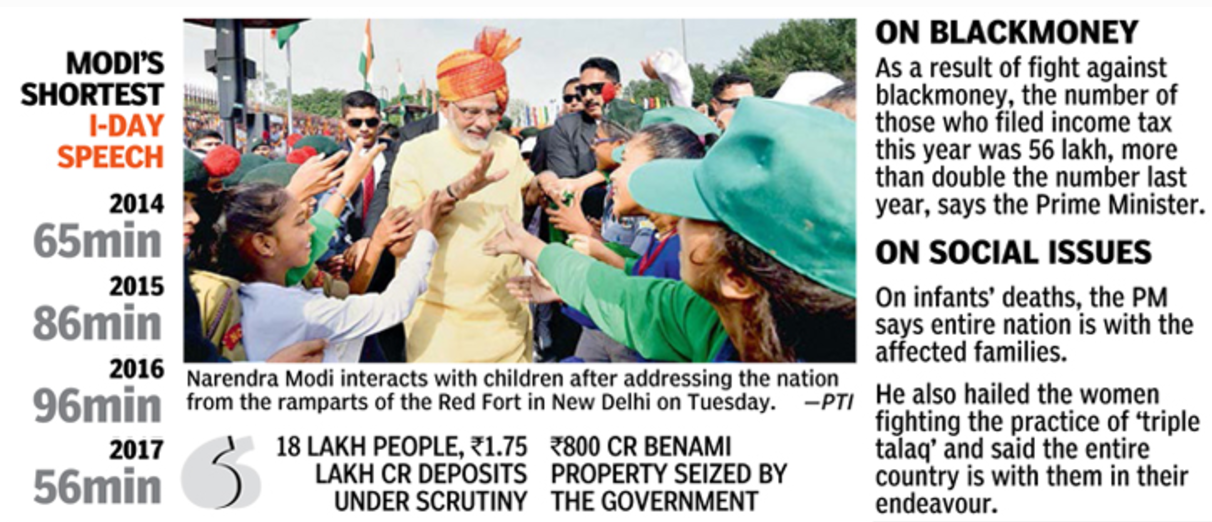
  • Modi's claim of 56 lakh new IT payers is not necessarily the result of demonetization and more over 90% of new IT payers are in the  income range of Rs.2.50-Rs.2.70 lakhs/annum yielding revenue of just over Rs.100 crores. Where as demonetization costed the nation over Rs.150,000 crores, at the least.
  • Modi announced Rs.80,000 crore Kashmir package in Nov 2015 and so far nothing has been spent in Kashmir except on army expenses. The voter response dwindling from 64% in 2014 elections to less than 7% in recent Srinagar bye poll (and 2% in re-poll in some parts) speaks volumes about Modi's failure in Kashmir so far.
  • Modi must realize that Kashmir problem is not just law & order problem which can be solved by army nor an economic package will buy peace there. But the solution lies in removing the alienation of people in Kashmir through political engagement and deliberation.
  • The fact that LS & RS with combined strength of 790 and 14.23% Muslim population their representation should have been 112. The present strength is just 23 (under 3%). 
  • As on date, BJP Muslim MP's in LS are NIL and in RS are just 2.
  • The appearance of schoolgirls on the streets joining the teenage boys throwing stones at the security forces shows that the familial and social norms have broke down.
  • Even after SC ended armed forces immunity under AFSP Act in 2016, to day in Kashmir in every 8th household an able bodied youth is missing (presumed killed by security forces in fake encounters) and in every 5th household a woman is raped by security forces (mostly unreported due to social pressures) and not a single case has been filed against the security personnel and expecting people of Kashmir trust our law enforcers is height of insanity. 
  • Today half of our military totaling 7.50 lakhs is enagaged in Kashmir with a population of under 10 million (96% Muslims) and reported number foreign militants are less than 150.
  • Without initiating establishment of 'rule of law' and engaging people politically how Modi will resolve Kashmir issue and make it a 'paradise once again' is shallow and his speech a blatant lie. 
  • If nothing is done to resolve Kashmir's burning problem except application of brute military might which will not solve the problem and in due course of time we may end up loosing Kashmir forever.

Power is domination, control, and therefore any selective form of truth is a lie.
à°ªామరజనొà°šితమగు à°«్à°°à°²్లదనముà°²ు పలుà°•ుà°Ÿà°•ు à°ª్à°°ాà°˜్à°¨ుà°²ంà°—ీà°•à°°ింపరు.


Modi with his oratory skills, rhetoric, hammering out selective truths and publicizing failures as successes is virtually destroying India economically & politically. First two years he spent time touring the world delivering mesmerizing speeches. In third year he unleashed war on people by quack advised demonetization which hurt the poor most and resulted in destruction of agriculture, construction and informal sector while stated objectives eluded. Then he found GST which would project him as bold financial reformer and rolling it out hurriedly in mangled form without sufficient preparation had impacted small businesses greatly. GST, a novel reform, is expected to impact economy for about two years and there after benefits starts accruing. Both these must have costed nation about Rs.300,000 crores, the exact figures will never be known. All his independence day speech contents are selective truths and blatant lies. Among all politicians, at least Prime Minister should be truthful to nation. All his Red Fort speeches are either selective truths or blatant lies. India belongs to all Indians not just majority Indians.

Monday, 14 August 2017

Hamid Ansari, Vice President's speech at NLSIU convocation

Hamid Ansari, Vice-President's speech at the 25th annual convocation of the
National Law School of India University in Bengaluru on August 7, 2017

In his final address as vice-president, Hamid Ansari spoke at the 25th annual convocation of the National Law School of India University in Bengaluru. In his speech, he said the challenge was to reiterate and rejuvenate secularism's basic principles, including freedom of religion and tolerance. The function was presided over by Chief Justice of India, Jagdish Singh Khehar. 

Here is the full text of the speech Ansari gave on 6 August, 2017:

It is a privilege to be invited to this most prestigious of law schools in the country, more so for someone not formally lettered in the discipline of law. I thank the Director and the faculty for this honour.

The nebulous universe of law and legal procedures is well known to this audience and there is precariously little that I can say of relevance to them. And, for reasons of prudence and much else, I dare not repeat here either Mr. Bumble’s remark that ‘the law is an ass’ or the suggestion of a Shakespearean character who outrageously proposed in Henry VI to ‘kill all lawyers.’ Instead, my effort today would be to explore the practical implications that some constitutional principles, legal dicta and judicial pronouncements have for the lives of citizens.

An interest in political philosophy has been a lifelong pursuit. I recall John Locke’s dictum that ‘wherever law ends, tyranny begins.’ Also in my mind is John Rawl’s assertion that ‘justice is the first virtue of social institutions’ and that ‘in a just society the liberties of equal citizenship are taken as settled and the rights secured by justice and are not subject to political bargaining or to the calculus of social interest.’ To Rawls, the first task of political philosophy is its practical role to see, whether despite appearances on deeply disputed questions, some philosophical or moral grounds can be located to further social cooperation on a footing of mutual respect among citizens.

The Constitution of India and its Preamble is an embodiment of the ideals and principles that I hold dear.

The People of India gave themselves a Republic that is Sovereign, Socialist, Secular and Democratic and a constitutional system with its focus on Justice, Liberty, Equality and Fraternity. These have been embodied in a set of institutions and laws, conventions and practices.

Our founding fathers took cognizance of an existential reality. Ours is a plural society and a culture imbued with considerable doses of syncretism. Our population of 1.3 billion comprises of over 4,635 communities, 78 percent of whom are not only linguistic and cultural but social categories. Religious minorities constitute 19.4 percent of the total. The human diversities are both hierarchical and spatial.

It is this plurality that the Constitution endowed with a democratic polity and a secular state structure. Pluralism as a moral value seeks to ‘transpose social plurality to the level of politics, and to suggest arrangements which articulate plurality with a single political order in which all duly constituted groups and all individuals are actors on an equal footing, reflected in the uniformity of legal capacity. Pluralism in this modern sense presupposes citizenship.’

Citizenship as the basic unit is conceptualized as “national-civic rather than national-ethnic” ‘even as national identity remained a rather fragile construct, a complex and increasingly fraught ‘national-civic-plural-ethnic’ combinations.’ In the same vein, Indianness came to be defined not as a singular or exhaustive identity but as embodying the idea of layered Indianness, an accretion of identities.

'Modern democracy offers the prospect of the most inclusive politics of human history. By the same logic, there is a thrust for exclusion that is a byproduct of the need for cohesion in democratic societies; hence the resultant need for dealing with exclusion ‘creatively’ through sharing of identity space by ‘negotiating a commonly acceptable political identity between the different personal and group identities which want to/have to live in the polity.’ Democracy ‘has to be judged not just by the institutions that formally exist but by the extent to which different voices from diverse sections of the people can actually be heard.’ Its ‘raison d’etre is the recognition of the other.’

Secularism as a concept and as a political instrumentality has been debated extensively. A definitive pronouncement pertaining to it for purposes of statecraft in India was made by the Supreme Court in the Bommai case and bears reiteration:

‘Secularism has both positive and negative contents. The Constitution struck a balance between temporal parts confining it to the person professing a particular religious faith or belief and allows him to practice profess and propagate his religion, subject to public order, morality and health. The positive part of secularism has been entrusted to the State to regulate by law or by an executive order. The State is prohibited to patronise any particular religion as State religion and is enjoined to observe neutrality. The State strikes a balance to ensue an atmosphere of full faith and confidence among its people to realise full growth of personality and to make him a rational being on secular lines, to improve individual excellence, regional growth, progress and national integrity… Religious tolerance and fraternity are basic features and postulates of the Constitution as a scheme for national integration and sectional or religious unity. Programmes or principles evolved by political parties based on religion amount to recognizing religion as a part of the political governance which the Constitution expressly prohibits. It violates the basic features of the Constitution. Positive secularism negates such a policy and any action in furtherance thereof would be violative of the basic features of the Constitution.’

Despite its clarity, various attempts, judicial and political, have been made to dilute its import and to read new meaning into it. Credible critics have opined that the December 11, 1995 judgment of the Supreme Court Bench ‘are highly derogatory of the principle of secular democracy’ and that a larger Bench should reconsider them ‘and undo the great harm caused by them' This remains to be done; ‘instead, a regression of consciousness (has) set in’ and ‘the slide is now sought to be accelerated and is threatening to wipe out even the gains of the national movement summed up in sarvadharma sambhav.’

It has been observed, with much justice, that ‘the relationship between identity and inequality lies at the heart of secularism and democracy in India.’ The challenge today then is to reiterate and rejuvenate secularism’s basic principles: equality, freedom of religion and tolerance, and to emphasize that equality has to be substantive, that freedom of religion be re-infused with its collectivist dimensions, and that toleration should be reflective of the realities of Indian society and lead to acceptance.

Experience of almost seven decades sheds light on the extent of our success, and of limitations, on the actualizations of these values and objectives. The optimistic narrative is of deepening; the grim narrative of decline or crisis.

Three questions thus come to mind:
  • How has the inherent plurality of our polity reflected itself in the functioning of Indian democracy?
  • How has democracy contributed to the various dimensions of Indian pluralism?
  • How consistent are we in adherence to secularism?
Our democratic polity is pluralist because it recognizes and endorses this plurality in (a) its federal structure, (b) linguistic and religious rights to minorities, and (c) a set of individual rights. The first has sought to contain, with varying degrees of success, regional pressures, the second has ensured space for religious and linguistic minorities, and the third protects freedom of opinion and the right to dissent.

A question is often raised about national integration. Conceptually and practically, integration is not synonymous with assimilation or homogenization. Some years back, a political scientist had amplified the nuances:

‘In the semantics of functional politics the term national integration means, and ought to mean, cohesion and not fusion, unity and not uniformity, reconciliation and not merger, accommodation and not annihilation, synthesis and not dissolution, solidarity and not regimentation of the several discrete segments of the people constituting the larger political community…Obviously, then, Integration is not a process of conversion of diversities into a uniformity but a congruence of diversities leading to a unity in which both the varieties and similarities are maintained.’

How and to what extent has this worked in the case of Indian democracy with its ground reality of exclusions arising from stratification, heterogeneity and hierarchy that often ‘operate conjointly and create intersectionality’? 

Given the pervasive inequalities and social diversities, the choice of a system committed to political inclusiveness was itself ‘a leap of faith.’ The Constitution instituted universal adult suffrage and a system of representation on the First-Past-The-Post (Westminster) model. An underlying premise was the Rule of Law that is reflective of the desire of people ‘to make power accountable, governance just, and state ethical.’

Much earlier, Gandhi ji had predicted that democracy would be safeguarded if people ‘have a keen sense of independence, self respect and their oneness and should insist upon choosing as their representatives only persons as are good and true.’ This, when read alongside Ambedkar’s apprehension that absence of equality and fraternity could bring forth ‘a life of contradictions’ if the ideal of ‘one person, one vote, one value’ was not achieved, framed the challenge posed by democracy.

Any assessment of the functioning of our democracy has to be both procedural and substantive. On procedural count the system has developed roots with regularity of elections, efficacy of the electoral machinery, an ever increasing percentage of voter participation in the electoral process and the formal functioning of legislatures thus elected. The record gives cause for much satisfaction.

The score is less emphatic on the substantive aspects. Five of these bear closer scrutiny – (a) the gap between ‘equality before the law’ and ‘equal protection of the law’, (b) representativeness of the elected representative, (c) functioning of legislatures, (d) gender and diversity imbalance and (e) secularism in practice:
  • Equality before the law and equal protection of the law: ‘The effort to pursue equality has been made at two levels. At one level was the constitutional effort to change the very structure of social relations: practicing caste and untouchability was made illegal, and allowing religious considerations to influence state activity was not permitted. At the second level the effort was to bring about economic equality although in this endeavour the right to property and class inequality was not seriously curbed…Thus the reference to economic equality in the Constitution, in the courts or from political platforms remained basically rhetorical.’ 
  • Representativeness of the elected representative: In the 2014 general election, 61% of the elected MPs obtained less than 50% of the votes polled. This can be attributed in some measure to the First-Past-the-Post system in a fragmented polity and multiplicity of parties and contestants. The fact nevertheless remains that representation obtained on non-majority basis does impact on the overall approach in which politics of identity prevails over common interest.
  • Functioning of legislatures, accountability and responsiveness: The primary tasks of legislators are legislation, seeking accountability of the executive, articulation of grievances and discussion of matters of public concern. The three often overlap; all require sufficient time being made available. It is the latter that is now a matter of concern. The number of sittings of the Lok Sabha and the Rajya Sabha which stood at 137 and 100 respectively in 1953 declined to 49 and 52 in 2016. The paucity of time thus created results in shrinkage of space made available to each of these with resultant impact on quality and productivity and a corresponding lessening of executive’s accountability. According to one assessment some years back, ‘over 40 percent of the Bills were passed in Lok Sabha with less than one hour of debate. The situation is marginally better in the Rajya Sabha.’ Substantive debates on public policy issues are few and far in between. More recently, the efficacy of the Standing Committee mechanism has been dented by resort to tactics of evasion by critical witnesses. A study on 'Indian Parliament as an Instrument of Accountability' concluded that the institution is ‘increasingly becoming ineffective in providing surveillance of the executive branch of the government.
  • The picture with regard to the functioning of the Sate Assemblies is generally much worse.
  • Thus while public participation in the electoral exercise has noticeably improved, public satisfaction with the functioning of the elected bodies is breeding cynicism with the democratic process itself. It has also been argued that ‘the time has come to further commit ourselves to a deeper and more participatory and decentralized democracy - a democracy with greater congruence between people’s interests and public policy.’
  • Gender and diversity imbalance: Women MPs constituted 12.15% of the total in 2014. This compares unfavourably globally as well as within SAARC and is reflective of pervasive neo-patriarchal attitudes. The Women’s Reservation Bill of 2009 was passed by the Rajya Sabha, was not taken up in Lok Sabha, and lapsed when Parliament was dissolve before the 2014 general elections. It has not been resurrected. Much the same (for other reasons of perception and prejudice) holds for Minority representation. Muslims constitute 14.23 percent of the population of India. The total strength of the two Houses of Parliament is 790; the number of Muslim MPs stood at 49 in 1980, ranged between 30 and 35 in the 1999 to 2009 period, but declined to 23 in 2014.
  • An Expert Committee report to the Government some years back had urged the need for a Diversity Index to indentify ‘inequality traps’ which prevent the marginalized and work in favour of the dominant groups in society and result in unequal access to political power that in turn determines the nature and functioning of institutions and policies.
  • Secularism in actual practice: Experience shows that secularism has become a site for political and legal contestation. The difficulty lies in delineating, for purposes of public policy and practice, the line that separates them from religion. For this, religion per se, and each individual religion figuring in the discourse, has to be defined in terms of its stated tenets. The ‘way of life’ argument, used in philosophical texts and some judicial pronouncements, does not help the process of identifying common principles of equity in a multi-religious society in which religious majority is not synonymous with totality of the citizen body. Since a wall of separation is not possible under Indian conditions, the challenge is to develop and implement a formula for equidistance and minimum involvement. For this purpose, principles of faith need to be segregated from contours of culture since a conflation of the two obfuscates the boundaries of both and creates space to equivocalness. Furthermore, such an argument could be availed of by other faiths in the land since all claim a cultural sphere and a historical justification for it.
In life as in law, terminological inexactitude has its implications. In electoral terms, ‘majority’ is numerical majority as reflected in a particular exercise (e.g. election), does not have permanence and is generally time-specific; the same holds for ‘minority’. Both find reflection in value judgments. In socio-political terminology (e.g. demographic data) ‘majority’ and ‘minority’ are terms indicative of settled situations. These too bring forth value judgments. The question then is whether in regard to ‘citizenship’ under our Constitution with its explicit injunctions on rights and duties, any value judgments should emerge from expressions like ‘majority’ and ‘minority’ and the associated adjectives like ‘majoritarian’ and ‘majorityism’ and ‘minoritarian’and ‘minorityism’? Record shows that these have divisive implications and detract from the Preamble’s quest for ‘Fraternity’.

Within the same ambit, but distinct from it, is the constitutional principle of equality of status and opportunity, amplified through Articles 14, 15, and 16. This equality has to be substantive rather than merely formal and has to be given shape through requisite measures of affirmative action needed in each case so that the journey on the path to development has a common starting point. This would be an effective way of giving shape to Prime Minister Narendra Modi’s policy of Sab Ka Saath Sab Ka Vikas.

It is here that the role of the judicial arm of the state comes into play and, as an acknowledged authority on the Constitution put it, ‘unless the Court strives in every possible way to assure that the Constitution, the law, applies fairly to all citizens, the Court cannot be said to have fulfilled its custodial responsibility.’

How then do we go about creating conditions and space for a more comprehensive realization of the twin objectives of pluralism and secularism and in weaving it into the fabric of a comprehensive actualization of the democratic objectives set forth in the Constitution?

The answer would seem to lie, firstly, in the negation of impediments to the accommodation of diversity institutionally and amongst citizens and, secondly, in the rejuvenation of the institutions and practices through which pluralism and secularism cease to be sites for politico-legal contestation in the functioning of Indian democracy. The two approaches are to be parallel, not sequential. Both necessitate avoidance of sophistry in discourse or induction of personal inclinations in State practice. A more diligent promotion of fraternity, and of our composite culture, in terms of Article 51A (e) and (f) is clearly required. It needs to be done in practice by leaders and followers.

A commonplace suggestion is advocacy of tolerance. Tolerance is a virtue. It is freedom from bigotry. It is also a pragmatic formula for the functioning of society without conflict between different religions, political ideologies, nationalities, ethnic groups, or other us-versus-them divisions.

Yet tolerance alone is not a strong enough foundation for building an inclusive and pluralistic society. It must be coupled with understanding and acceptance. We must, said Swami Vivekananda, ‘not only tolerate other religions, but positively embrace them, as truth is the basis of all religions.’

Acceptance goes a step beyond tolerance. Moving from tolerance to acceptance is a journey that starts within ourselves, within our own understanding and compassion for people who are different to us and from our recognition and acceptance of the ‘other’ that is the raison d’etre of democracy. The challenge is to look beyond the stereotypes and preconceptions that prevent us from accepting others. This makes continuous dialogue unavoidable. It has to become an essential national virtue to promote harmony transcending sectional diversities. The urgency of giving this a practical shape at national, state and local levels through various suggestions in the public domain is highlighted by enhanced apprehensions of insecurity amongst segments of our citizen body, particularly Dalits, Muslims and Christians.

The alternative, however unpalatable, also has to be visualized. There is evidence to suggest that we are a polity at war with itself in which the process of emotional integration has faltered and is in dire need of reinvigoration. On one plane is the question of our commitment to Rule of Law that seems to be under serious threat arising out of the noticeable decline in the efficacy of the institutions of the State, lapses into arbitrary decision-making and even ‘ochlocracy’ or mob rule, and the resultant public disillusionment; on another are questions of fragility and cohesion emanating from impulses that have shifted the political discourse from mere growth centric to vociferous demands for affirmative action and militant protest politics. ‘A culture of silence has yielded to protests’ The vocal distress in the farm sector in different States, the persistence of Naxalite insurgencies, the re-emergence of language related identity questions, seeming indifference to excesses pertaining to weaker sections of society, and the as yet unsettled claims of local nationalisms can no longer be ignored or brushed under the carpet. The political immobility in relation to Jammu and Kashmir is disconcerting. Alongside are questions about the functioning of what has been called our ‘asymmetrical federation’ and ‘the felt need for a wider, reinvigorated, perspective on the shape of the Union of India’ to overcome the crisis of ‘moral legitimacy’ in its different manifestations.

I have in the foregoing dwelt on two ‘isms’, two value systems, and the imperative need to invest them with greater commitment in word and deed so that the principles of the Constitution and the structure emanating from it are energized. Allow me now to refer to a third ‘ism’ that is foundational for the modern state, is not of recent origin, but much in vogue in an exaggerated manifestation. I refer here to Nationalism.

Scholars have dwelt on the evolution of the idea. The historical precondition of Indian identity was one element of it; so was regional and anti-colonial patriotism. By 1920s a form of pluralistic nationalism had answered the question of how to integrate within it the divergent aspirations of identities based on regional vernacular cultures and religious communities. A few years earlier, Rabindranath Tagore had expressed his views on the ‘idolatry of Nation’.

For many decades after independence, a pluralist view of nationalism and Indianness reflective of the widest possible circle of inclusiveness and a ‘salad bowl’ approach, characterized our thinking. More recently an alternate viewpoint of ‘purifying exclusivism’ has tended to intrude into and take over the political and cultural landscape. One manifestation of it is ‘an increasingly fragile national ego’ that threatens to rule out any dissent however innocent. Hyper-nationalism and the closing of the mind is also ‘a manifestation of insecurity about one’s place in the world.’

While ensuring external and domestic security is an essential duty of the state, there seems to be a trend towards sanctification of military might overlooking George Washington’s caution to his countrymen over two centuries earlier about ‘overgrown military establishments which, under any form of government, are inauspicious to liberty.’

Citizenship does imply national obligations. It necessitates adherence to and affection for the nation in all its rich diversity. This is what nationalism means, and should mean, in a global community of nations. The Israeli scholar Yael Tamir has dwelt on this at some length. Liberal nationalism, she opines, ‘requires a state of mind characterized by tolerance and respect of diversity for members of one’s own group and for others;’ hence it is ‘polycentric by definition’ and ‘celebrates the particularity of culture with the universality of human rights, the social and cultural embeddedness of individuals together with their personal autonomy.’ On the other hand, ‘the version of nationalism that places cultural commitments at its core is usually perceived as the most conservative and illiberal form of nationalism. It promotes intolerance and arrogant patriotism’.

What are, or could be, the implications of the latter for pluralism and secularism? It is evident that both would be abridged since both require for their sustenance a climate of opinion and a state practice that eschews intolerance, distances itself from extremist and illiberal nationalism, subscribes in word and deed to the Constitution and its Preamble, and ensures that citizenship irrespective of caste, creed or ideological affiliation is the sole determinant of Indianness.

In our plural secular democracy, therefore, the ‘other’ is to be none other than the ‘self’. Any derogation from it would be detrimental to its core values.

Jai Hind.

Thursday, 20 July 2017

Hindu Raj: Ambedkar’s warning

  • Proponents of Hindu supremacy knew that democracy could be used to establish a Hindu Raj. They and their followers have sought to use the vote for ends of power using the Hindutva card.
  • If Hindu Raj does become a fact, it will, no doubt, be the greatest calamity for this country.… Hindu Raj must be prevented at any cost - wrote B.R. Ambedkar in 1946. He was against majoritarianism, which in the Indian context meant unbridled rule of the majority community, the Hindus.
  • Unfortunately for the minorities in India, Indian nationalism has developed a new doctrine which may be called the Divine Right of the Majority to rule the minorities according to the wishes of the majority. Any claim for the sharing of power by the minority is called communalism, while the monopolising of the whole power by the majority is called nationalism. Under these circumstances there is no way left but to have the rights of the Scheduled Castes embodied in the Constitution. 
  • In the forties, even Sardar Vallabhbhai Patel was sometimes accused of being soft on the Hindu Revanchists, who believe in and practised tit-for-tat in that turbulent and fateful period.
  • Patel’s retort to BM Birla on announcement of Independence: “I also feel happy that the announcement of June 3, 1947 at least settles things one way or the other. There is no further uncertainty. I do not think it will be possible to consider Hindustan as a Hindu state with Hinduism as the state religion. We must not forget that there are other minorities whose protection is our primary responsibility. The state must exist for all, irrespective of caste or creed.”
  • Ambedkar was perceptive. It is not necessary to declare India a Hindu state formally by amending the Constitution and making Hinduism the state religion. The same result can be achieved by administrative measures. The Supreme Court has held secularism to be part of the basic structure of the Constitution which cannot be discarded even by constitutional amendment.
  • Ambedkar thought that the elaborate constitutional provisions on administration would work. He told the Constituent Assembly on November 4, 1948, when he moved for the adoption of the Draft Constitution: “While everybody recognises the necessity of the diffusion of constitutional morality for the peaceful working of a democratic Constitution, there are two things interconnected with it which are not, unfortunately, generally recognised. One is that the form of administration has a close connection with the form of the Constitution. The form of the administration must be appropriate to and in the same sense as the form of the Constitution. The other is that it is perfectly possible to pervert the Constitution, without changing its form, by merely changing the form of the administration and to make it inconsistent and opposed to the spirit of the Constitution. Can we presume such a diffusion of constitutional morality? Constitutional morality is not a natural sentiment. It has to be cultivated. We must realise that our people have yet to learn it. Democracy in India is only a top-dressing on an Indian soil, which is essentially undemocratic”.
  • The leaders of the Congress sought to inculcate secularism right from the first Congress held at Bombay in 1885. S. Srinivasa Aiyangar, president of the 41st Congress in 1926, articulated the credo of secularism very ably. So did Vallabhbhai Patel in the presidential address to the 45th Congress at Karachi in 1931. Hindu-Muslim “unity can only come when the majority takes courage in both hands and is prepared to change places with the minority. That would be the highest wisdom.”
  • But by then, forces that did not share the Congress’ ideology, did not participate in the freedom movement and were charged with revivalist hate had come to the fore.
  • Nehru once remarked that Hindu communalism was the Indian version of fascism, and, in the case of the RSS, it is not difficult to perceive certain similarities. The leader principle, the stress on militarism, the doctrine of racial-cultural superiority, ultra-nationalism infused with religious idealism, the use of symbols of past greatness, the emphasis on national solidarity, the exclusion of religious or ethnic minorities from the nation-concept—all of these features of the RSS are highly reminiscent of fascist movements in Europe.
  • With an RSS pracharak, Narendra Modi, known for his antipathy towards Muslims, as Prime Minister, and Yogi Adityanath chosen by him as Chief Minister of India’s largest State, Uttar Pradesh, we have crossed the threshold to a Hindu state. The BJP’s presidential candidate, Ram Nath Kovind, is “deeply rooted in the ideological stream of the RSS”. A brand new rubber stamp has been manufactured for the Rashtrapati Bhavan, 25 years after the last rubber stamp, R. Venkataraman.
  • We now have a Prime Minister whose Hindutva puts Vajpayee’s Hindutva in the shade. Lynchings of Muslims has become common. So are cries for a Hindu state. Yogi Adityanath said on the Hindu Swaraj Diwas that no Indian should be hesitant about being proud of his or her Hindu identity.
  • The drive will pick up speed. Modi made blatantly communal speeches during the Uttar Pradesh election campaign, as 65 former civil servants recalled in their open letter. He will do worse for the Lok Sabha elections in 2019. He aims to claim that he has fulfilled the BJP’s triple demand. His Kashmir adventure had “solved” the problem. For a uniform civil code, no other Prime Minister has so relentlessly campaigned for a reform of Muslim law. As far as the Ram temple at Ayodhya is concerned, he will say: “have patience, I have crossed the threshold to a Hindu state in India. Can’t you see the dread on the faces of Muslims, Christians, Dalits and other minorities?
My View:
Democracy in its true spirit is rule by people. Among all models, the model of rule by majority is the most popular and probably the best. That doesn't mean that minorities can be thrashed out by majority. Rule of the law must prevail. This Hindutva philosophy will only lead to civil war, sooner or later. In a democracy, ruled by majority, it is the duty of majority to uphold the rights & dignity of minorities. Polarization of people on the lines of religion, caste or creed - is not democracy. It is only a distortion and perversion. In a society corrupted with religious extremism all constitutional provisions and laws of the land will not work properly and the country will be heading for anarchy. When constitution fails, it is mafia that rules and then nation will be heading for disintegration!

Wednesday, 21 June 2017

Modi's rule: Our democracy in peril

Modi's three year rule is characterized by ...
  • Disregarding democratic principles for economic progress and shunning democracy for majoritarianism.
  • With his anti minorities attitude and a Hindu hardliner, Modi can hardly be a true statesman.
  • There is a lot of difference between governing a state and an entire country full of diversity, which he doesn't realize.
  • People’s desires for economic progress have been channelized into the sentiment that democracy isn’t working for them. 
  • He is making people believe that shunning democracy and sacrificing a few democratic values paving way for authoritarianism is an easier way out.
  • Economic progress and diplomatic fanfaronade are made more important and fundamental rights, individual freedom and secularism have been reduced to useless hyperboles.
  • Dissenters have been pushed to the periphery and have been blamed as anti-nationals, for whom petty personal freedoms are more important than the nation’s glory. 
  • Complete faith has been bestowed into the PM and questioning him means going against the nation’s sentimentality. 
  • A brand new nationalistic discourse has been charted. You are either on the side of your nation or on that of abhorrent Islamic neighbor.
  • It has never been controversial to be secular in this country. While just a few years ago it was largely considered a virtue, secularism today stands abused and bastardized. 
  • The pride associated with being secular for over six decades since the inception of our Constitution has been reduced to the malicious fallacy of being minority appeasers.
  • He is not directly propagating chauvinist nationalism and aggressive jingoism, but he is basking in its glory.
  • He is hypersensitive to any criticism or even analytical critiques.
  • Today, the country is completely divided on communal lines with Muslims and Christians being considered enemies unless they bow down to majoritarianism. 
  • There has been rising violence and hooliganism against Muslims and Dalits in the name of cow protection. These are law and order problems unacceptable in any civilized society.
  • Dalits feel that discrimination against them has increased since Yogi Adityanath was appointed CM of Uttar Pradesh. 
  • When the PM and Yogi Adityanath do not wholeheartedly condemn atrocities against minorities, it gives a free hand to those who believe in an aggressive communal Hindu nationalistic ideology.
  • It is true that previous governments and political parties have exploited both Dalits and minorities, indulging in vote bank politics and have contributed little to their upliftment. Failures of the past do not justify wrongs of the present. National Commission for Minorities is not having a single member for months now. 
  • Modi puts his foot down against the Sangh Pariwar, occasionally. Modi praised Mother Teresa for serving the poor  “As Indians we feel proud about the canonization of Bharat Ratna Mother Teresa.” 
  • RSS Chief Mohan Bhagwat had in 2015 said that Mother Teresa converted people to Christianity in the name of serving humanity and demanded that the Bharat Ratna bestowed on the Saint in 1980 be withdrawn.
  • Last year Modi cited quotes from the Quran and said Islam was “a religion of peace”, is another example. But there has been no conscious effort on his part to keep the country’s secular fabric intact.
  • Neither can Islamic fundamentalism be controlled nor RSS’ dream of a Hindu Rashtra be realized by resorting to lawlessness and savagery. On the contrary, it could backfire and more people could get disillusioned and take recourse to Islamic fundamentalism.
  • There is contradiction between our Constitutional values of pluralism and equality and the concept of Hindutva. 
  • Indian’s dreams of development and progress and to making our country a fast-growing economy will be successful only only there is harmony.
  • It is an irony that while millions across the world are giving up their lives for democratic values, today a large number of Indians find no virtue in democracy. 
  • As Modi is confident of his victory in the 2019 general elections, it’s just a matter of time our democracy gets reduced to a farce.
My View:
Instead of engaging people of Kashmir valley with economic progress and politically, deploying half of Indian Army and their resistance of military atrocities reflected by stone throwing even by women and school girls doesn't august well with our democratic principles. Voter turnout in recent Srinagar Lok Sabha bye-poll from 64% in 2013 to under 7% is glaring and worrying example of total alienation of Muslims in Kashmir by Modi government. Unless some drastic steps are taken, which is unlikely by authoritarian Modi, it is matter of time we end up losing Kashmir forever. Modi's senseless demonetization busted all sections of people and GDP taking a big hit. Today's farmers unremunerative prices is attributed mostly to currency shortage, consequent to demonetization, still prevailing especially in rural India. And his farmer loan waiver loan announced for winning UP elections is resulting in announcing the same by all states, one after other. GST without enough lead time for preparation is likely to hit supply chain of most commodities resulting in lower GDP apart from higher inflation. Demonetization and GST roll out, without preparation and mitigation, and farmer loan wave offs , Modi in fact is destroying economy while talking of high speed reforms.

Sunday, 4 June 2017

Anti Slaughter Rules

  • The Government of India's innocuous sounding amendment, ‘Restrictions on sale of cattle’ promises to be the final death knell of cattle and buffaloes in India, and along with them, the destruction of what little remains of a dignified life and livelihood for farmers.
  • The rules defines ‘cattle’ to mean “cow, calf, bull, bullock, buffalo, heifer, steer and camel”.
  • The notification is another instance of the ‘mischievous and deceptive’ law-making practice involving camouflaging a controversial provision with seemingly progressive and innocuous provisions in order to deceive and mislead the general public.
  • The notifications breaks the steady supply of cattle to slaughter houses and operations and beef exporters.
  • The rules will hurt mostly Muslim traders who face mounting violence by increasingly assertive cow vigilante groups. Farmers will also be hit because they will be deprived of a traditional source of income from selling non-milch and old cattle. Farmers who can't take care of their cattle will have to pay for their upkeep in shelters.
  • The move introduces lots of paperwork for cow traders who are mostly poor and illiterate. Before the trade, both seller and buyer will have to produce identity and farmland ownership documents. After buying a cow, a trader must make five copies of proof of sale and submit them at the local revenue office, the local veterinary doctor in the district of the purchaser, animal market committee, apart from one each for seller and buyer. An insanity at its best!
  • Slaughtering means 'the act of killing or butchering of livestock for market';
    Cruelty means 'disposed to inflict pain or suffering'.
  • By equating ‘slaughter’ with 'cruelty' and criminalizing the trading of animals for slaughter at animal markets as an act of cruelty, the central government has enforced a country-wide ban on the slaughter of buffaloes and cattle, leather industry and the consumption of beef.
  • These new rules choke the free movement of animals via the markets undermining the freedom and rights of farmers, traders and all others whose livelihoods are linked to this production cycle that sustains cattle and buffaloes of this country.
  • It is pertinent to note that the Act does not prevent slaughtering of animals. The Act permits destruction or killing of animals for the purposes of food on the condition that such destruction was not accompanied by unnecessary pain and suffering. Slaughter houses which slaughters 90% of cattle, sources cattle from middlemen & animal markets which will now become defunct with this ban order.
  • The dairy farmer's life and livelihood are at stake because 40% of a dairy farm’s income is derived from the sale of unproductive cows & buffaloes.
  • The assumptions that (i) there is always a farmer ready to purchase another’s cow or bullock and (ii) a farmer will be willing to retain or buy an unproductive cow, buffalo or bullock are totally false. 
  • During drought times, everyone looks to sell their cows and bullocks for want of water and fodder and the farmers gets a reasonable price in the market because of traders involved in the trade of animals for slaughter.
  • Indian beef is in great demand in the world market because it is cheaper and India is the largest beef exporter.
    - Meat exports are over 1.3 million tonnes per annum of which 95% is beef..
    - Meat exports industry is Rs.27,000 crores pa.
    - Leather market is estimated at Rs.40,000 crores pa.
    - Dairying is Rs.80,000 crores pa.
    - Cattle trading is the livelihood of about 15 million Muslims.
    - About 35 million people depend on slaughtering, beef & leather industry.
    - In all, 50 million people are dependent on cattle related businesses.
    - Majority of rural population supplement their meager incomes with dairying.
    - Most workers in leather industry are Dalits.
    - Only 10% of buffaloes heads for slaughter houses.
  • The number of animals in milk - cows & buffaloes are about 100 million. Out of which approximately 10% i.e. 10 million unproductive cows & buffaloes are slaughtered every year. With this ban, who will provide grass & feed to this 10 million unproductive cows & buffaloes? There is no mention  about this in Modi's ban order.
  • Slaughtering and the markets for beef and leather, complements dairying. Farmers rear cattle for dairy or as work animals, and when they become non-productive, the have value for its beef and skin used for leather. Beef is a by-product of dairying and draught, is another aspect of livestock economy.
  • If today the slaughter of cattle and buffaloes is considered an act of cruelty, then it will be only a matter of time before the sale for slaughter of sheep, goats and poultry will also be forbidden. With the food preferences of the majority of citizens who eat meat and a massive number of livelihoods at stake, this highly contentious interpretation of cruelty needs to be interrogated and challenged.
  • While Europe, Australia, New Zealand and the US are waiting to dump large volumes of subsidized milk powder into India, and Indian dairy cooperatives fighting hard to stop this, it is extremely foolish of the government to literally kill dairying in the name of animal welfare.
  • Instead of creating 20 million jobs per annum, Modi is destroying informal sector which provides mass employment with his mindless and sadistic decisions.
  • This Modi's senseless order is not sustainable and will be revoked. The earlier is better to contain damages. Already Madras High Court has issued 'Stay Order' few days ago. 
  • This is another classic example of 'quack' advised policy decisions by Modi. No expert in the field of Animal Husbandry, Dairying or official in Ministry for Rural Development etc will recommend this type of insane decisions.
My View:
While ban on cow slaughter is understandable for Hindu religious sentiment reasons, altogether banning cattle slaughtering is utterly unwarranted. While cruelty is inhuman, slaughtering of cattle is not. Unproductive cattle, if not slaughtered and unfed will die in due course suffering hunger and pain. When the Act expressly permits slaughter of animals for food, rules imposing a ban on sale of cattle for slaughter is untenable. The Rules harm many by infringing their rights and benefit none, except certain animals, upon whom no explicit fundamental rights are conferred by the Constitution. Modi with his another quack advised cattle ban order has unleashed death warrant on Farmers and Muslims and is attempting forcing the nation to become vegetarian directly interfering with personal food choices of people and destroying millions of jobs. While the Centre is empowered to frame rules, implementation of the regulation of livestock falls under the State government’s ambit and rules can't violate the Act.