Thursday, 31 May 2018

BJP stares at by poll defeats


The results of the by-elections to the 11 assembly seats across 10 states came as a rude shock to the BJP-NDA. While NDA has managed to win only one seat in Uttarakhand only whereas Congress emerged victorious in four seats one each in Karnataka, Meghalaya, Punjab and Maharashtra. JMM won two seats in Jharkhand, SP & RLD won one each in UP, RJD won one in Bihar, TMC won one in West Bengal and CPM won one seat in Kerala.
  • At Jokihat (Bihar) RJD defeated JDU with huge margin. The Jokihat bypoll defeat has come as a jolt to JDU CM Nitish Kumar who dumped RJD and INC last year to join hands with BJP to form a new coalition government in Bihar.  
  • At Kairana (UP) Tabassum Hasan of RLD won against her BJP rival Mriganka Singh (daughter of deceased BJP MP Hukum Singh) with the support of INC, SP and BSP. This by-poll was pitched as another test of opposition unity against the BJP after SP-BSP combine defeaed BJP in its strongholds Gorakhpur and Phulpur in March 2018. In the Noorpur Assembly seat, which became vacant due to death of a BJP MLA in a road accident, the SP has won. These victories are likely to evolve template for joining of non-BJP parties 
  • In Maharashtra's Palus-Kadegaon assembly constituency, by-election was necessitated due to the death of Congress MLA Patangrao Kadam. His son Vishwajeet Kadam, INC candidate,  was elected unopposed. 
  • In Maharashtra's Palghar Parliamentary constituency the bypoll was necessitated following the death of sitting BJP MP after a heart attack. The by-election was contested by ruling BJP, its ally Shiv Sena, Bahujan Vikas Aghadi (BVA) and INC. In the multi cornered contest, BJP emerged victorious and retained the seat. This victory of BJP is the only  consolation to BJP facing several humiliating defeats. In the by-poll in Bhandara-Gondiya parliamentary constituency due to resignation of the BJP MP, INC supported NCP defeated BJP in straight contest. The bypolls to Maharashtra's LS seats are seen as a litmus test for the next general election. 
  • In Nagaland, parliamentary bypoll for the lone seat was due to the resignation of Neiphiu Rio to become NDPP CM, ally of BJP. BJP's ally and ruling NDPP's candidate Tokheho Yepthomi won over NPF candidate CApok Jamir.
  • In Jharkhand's Gomia & Silli assembly constituencies by-poll was necessitated due to the disqualification following conviction of JMM MLA's YP Mahto in a coal theft case and AK Mahto in a manhandling case. In the triangular contests, JMM retained both the seats defeating BJP & AJSUP.
  • In Meghalaya's Ampati by-poll that was necessitated due to former CM Mukul Sangma vacating Ampati seat as he had won two seats in the 2018 Meghalaya Assembly elections, retaining the Songsak seat. Congress had won the seat with margin of over 3,000 votes. With this win, Congress strength in the 60 member Meghalaya assembly is 21 surpassing ruling NPP's 20 seats.
  • In Uttarakhand's Tharali assembly constituency by-poll was necessitated due to death of BJP MLA and BJP retained the seat in the by-polls. 
  • In Karnataka's Bengaluru-RR Nagar assembly constituency, locked in triangular contest with BJP and JDS, INC emerged victorious. 
  • In Punjab's Shahkot assembly constituency, ruling Congress party wrested the seat from Akali Dal, due to the death of its MLA.
  • In West Bengal's Maheshtala assembly constituency, ruling TMC retained its seat by securing 104,814 votes against BJP candidate's 41,987 and INC backed Left Front candidate's 30,316 votes. 
  • In Kerala's Chengannur assembly constituency, CPM polled 67,303 votes defeating INC 46,347 and BJP's 35,270. 
As Ambedkar feared in 1948, every government with full majority in Parliament will invariably try to undermine constitution, abuse institutions to their selfish and short sighted ends with utter disregard to principles of democracy were proved to be true with Modi's dictatorial attitudes and abuse of authority and destruction of institutions surpassing Indira Gandhi's abuse in 1970's. India has progressed well during the coalition governments between 1992-2014 (22 years), despite some setbacks and slow speed compared to other 49 years, after independence in 1947. It is better to have strong states and regional parties and weak coalition government at centre driven by common minimum program of all states & parties with extra ordinary central powers only to deal with defense, external threats or natural calamities. Centre must be responsible to Parliament on continuous basis in letter and spirit of constitution while upholding principles of democracy.


The message is loud & clear. 
United Opposition Parties can and will win over lone BJP.


The BJP has set precedent through Karnataka governor, that largest single party should get first opportunity to form government with liberal grant of 15 days time (for horse trading and/or forging coalitions etc) to pass floor test. Now in these bypolls, INC with 21 seats emerged largest single party surpassing ruling NPP's 20 seats. Will Meghalaya Governor dislodge existing BJP supported NPP coalition government and offer INC to form government by virtue of its being largest single party and pass floor test in 15 days time? Let us see what Modi & BJP will do, who are notorious to twist every event to their advantage with no regard for 'rule of the law'. 

As things are unfolding, Modi, Amit Shah, BJP etc are now clueless of how to arrest the negative vibrations due to their misrule, wild economic reform adventures resulting in economic distress and headstrong arising out of victories in almost all the elections during the past 4 years. They can only be helped by divided opposition parties, which is unlikely because they have a common and most feared enemy in Modi.


Wednesday, 30 May 2018

Petrol prices cut by 1 paise!


After completion of polling in Karnataka, Petrol and Diesel prices were increased relentlessly every day during past 30 days. In the last fortnight Petrol price at Hyderabad was hiked from Rs.79.37 to Rs. 83.13 (an  increase of 4.7% in 15 days). Today oil companies have announced reduction of petrol by Rs.0.60 today and quickly corrected it to Rs.0.01 (1 Paise) citing clerical error is a cruel joke on consumers. While reduction was announced by Oil companies routinely, the correction announcement is suspected to be at the behest of government for unknown reasons. With large scale usage computers and other technologies, citing clerical error is unacceptable non sense. If it is true, that clerk and his superior officers should have got suspension orders right away but no such thing has happened. While oil prices fell by 70% between 2014-17, both central and state governments merrily increased excise duty and VAT and ensured that consumer got the benefit of 15% only while 85% of low price benefit was grabbed by them. Now in 2018, while oil prices have gone up from $30 to $84 per barrel, neither centre nor state(s) are prepared to reduce their taxes and provide relief to consumer. They are insensitive to the inflationary effects their action and inaction.  Ironically, leakages suggested that government is mulling excise duty cut on petrol & diesel and wants states also to cut their VAT and consumers were expecting some big relief, for which Modi & Jaitley were never known for. 


Wednesday, 23 May 2018

Modi squander's away low oil price advantage


  • Every $10 price variation in crude oil price, simply means for India as GDP 1% and loss/gain of 1 million jobs lost/added, without doing anything.
  • While UPA II under Manmohan Singh suffered above $100 per barrel oil price, Modi was gifted by God with $50 per barrel oil price regime. The difference simply means 5% GDP growth and 5 million jobs added without doing anything by central government. 
  • Modi retained 85% of lower oil rices to government by increasing excise duty while passing on benefit to consumer - limited to just 15%. This amounts to nearly Rs.7-8  lakh crores additional money with central government and no one knows where it has gone?
  • Modi and FM Jaitley also changed series for GDP growth calculations which has added another 2% totaling to 7% advantage.
  • Average GDP growth rate during the period of UPA Government (2004 to 2014) has been 7.7% despite two global slowdowns in this period.
  • It was 6.9% GDP growth rate, when Modi became PM in 2014. Year-on-year GDP growth was increasing when Manmohan Singh assumed office in 2004, but was falling after Modi took to the helm. Modi inherited a sluggish economy stricken by policy paralysis and corruption. 
  • FM Arun Jaitley, inherited a situation where there was little room left to increase public expenditure. Growth has slowed down but consumption hasn’t gone down, while demand is still there in the market the same was fulfilled by imports.
  • The Demonetisation and the GST rollout have caused major disruption, effecting GDP numbers.

The impact on GDP growth rate with variations in economic activity is never simple. Despite high oil prices, corruption, policy paralysis etc - UPA's economic performance was exuberant where as aided with low oil prices, Modi's reckless fiscal reforms boomeranged and almost destroyed economy. However Modi & Jaitley squandering away the huge savings due to low oil price regime, not solving any of the ailing sectors, their inaction leading to huge pile up of NPAs and banks pushed to brink of collapse etc are unpardonable. Neither Modi nor Jaitley has any depth of knowledge of economics nor have any good people to assist them and most of the time seemed helpless. Definitely we don't need helpless leaders!


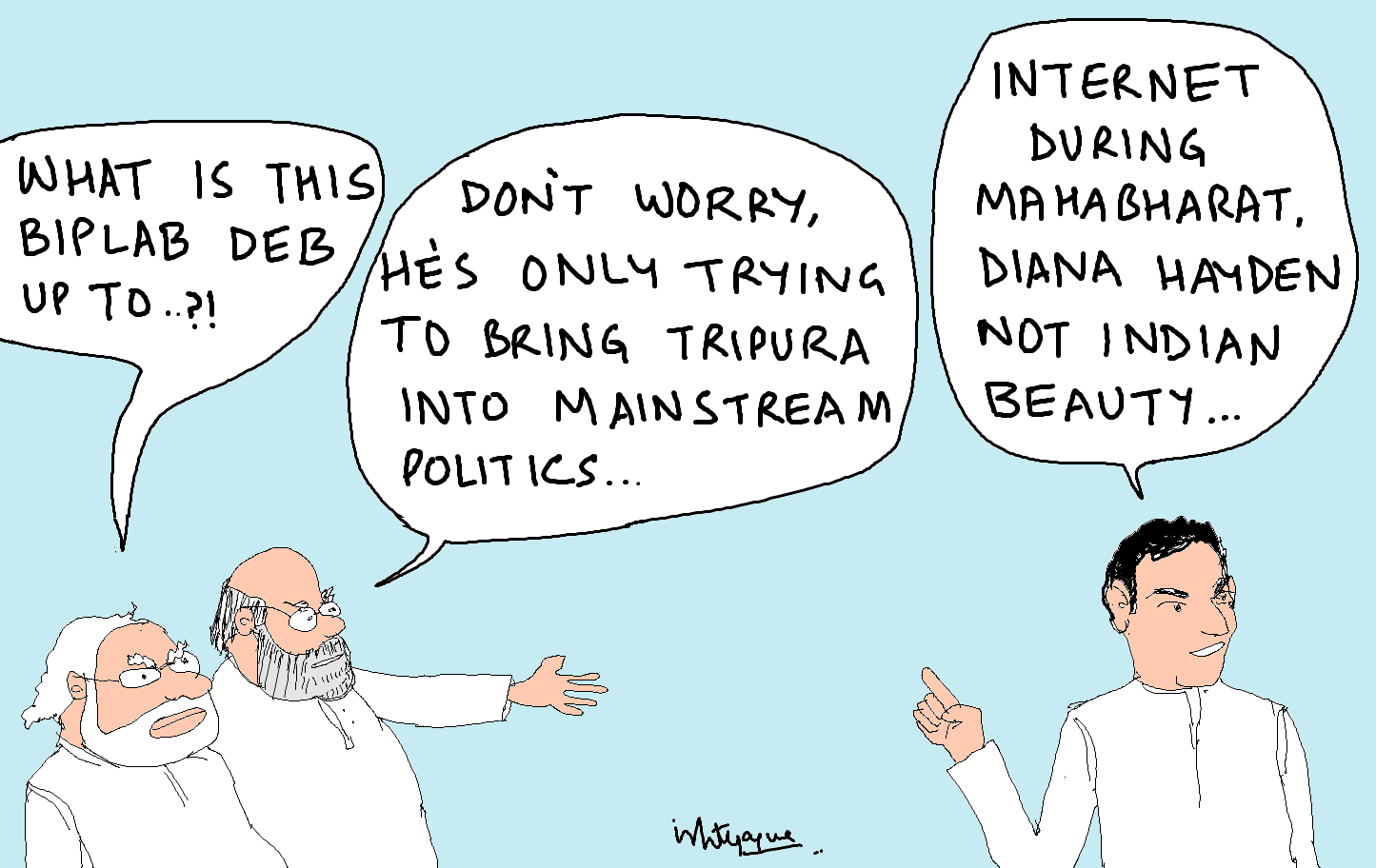
Cartoon of the Day


Delhi archbishop warns of threat to India's secular fabric


The archbishop of Delhi has called for a prayer campaign until the next general election in an unprecedented political intervention, citing a threat to the country’s secular fabric, triggering angry reactions from the ruling Hindu nationalist party. "We are witnessing a turbulent political atmosphere which poses a threat to the democratic principles enshrined in our Constitution and the secular fabric of our nation," Archbishop Anil Couto wrote in a letter issued this month to all parish priests and religious institutions in the archdiocese of Delhi.
  • Christians constitute less than 3 percent of Hindu-majority India’s 1.3 billion people. India is officially secular, but four-fifths of its population profess the Hindu faith.
  • The BJP said the letter was akin to calling people to vote along communal lines, and that it was unfortunate. The next election has to be held by next May.
  • The Archbishop’s secretary, Father Robinson Rodrigues sad that such prayer campaigns took place before every general election, but the exercise was being politicised this time.
  • The spokesman for the Delhi Catholic Archdiocese, Father Savarimuthu Sankar, said the archbishop only called for a prayer campaign not an election campaign. He said the letter, the first of its kind from Archbishop Anil Couto since he was installed in 2013, was prompted by continued violence against Christians over the past four years and following attempts to bring back to Hinduism people who converted to Christianity. We try to influence at least those people who are educated, who are balanced. So far we have been saying these are fringe elements who are behind the attacks. But there is a danger that fringe elements may become the mainstream. To some extent they are succeeding also.
  • Responding to questions about the letter, Minister of Home Affairs Rajnath Singh told reporters that minorities are safe in India and that no one is allowed to discriminate on the basis of caste and religion. Between 2014 and 2015, Couto and other Christians in the national capital region of Delhi told Rajnath Singh how violence had picked up after Modi came to power, detailing at least five cases of attacks on churches in New Delhi following which extra police had been deployed to protect 240 churches in the capital.
  • The prayer for our nation says, “Let the dreams of our founding fathers and the values of our Constitution – equality, liberty and fraternity – be always held in highest esteem. Let the people of all castes and creeds, all denominations and persuasions live in harmony and peace steering far away from hatred and violence." The prayer also focuses on the poor and the marginalised, saying, “Let the poor of our country be provided with the means of livelihood. Let the dalits, tribals and the marginalised be brought into the mainstream of nation building. Let justice and integrity prevail in every sphere of our life.”
  • The prayer further says, "Protect our legislature as a place of discerning minds. Raise our judiciary as the hallmark of integrity, prudence and justice. Keep our print, visual and social media as the channels of truth for edifying discourses. Protect our institutions from the infiltration of the evil forces.” 

While the letter and prayer has no inflammable content, the underpinning is very clear that minorities have apprehensions about their safety, rights and privileges compromised. They are all living with their mouth shut for the last 4 years, with fear gripping them choking. Now that Modi & BJP got weakened, vulnerable and uncertain of wining no more elections owing to his worst performance in all fronts, it is natural that all suppressed sections of people will speak out their mind ventilating their grudge reflecting their anger. With minorities at 20%, dalits at 18% thoroughly alienated, there is no way BJP can win 2019 general elections unless oppositions parties fail to put up common candidates. But with Karnataka episode, Modi has himself united all the opposition parties, underwriting his own defeat. 


Risk of doing nothing


Hardly a day goes by without a story that financial markets are in “bubble” territory. Stock markets around the world are at record highs and bond yields are at record lows. The former means that valuations are at the upper end of historic ranges. The latter has meant that many unusual things can be sold to investors anxious for yield. 
  • Investors remain nervous and many choose to hold significant amounts of cash. This appears to be a conservative strategy but in fact it is a rather risky one. The obvious problem is that with rates at record lows you receive virtually no interest on your capital.
  • The bigger problem is that with inflation running well above the level of interest rates the conservative strategy of putting money in the bank is actually destroying your purchasing power at an alarming rate. As inflation has been higher than the interest you have been receiving, your purchasing power has been declining.
  • Bank interest rates are likely take a long time before the bank rate gets above the inflation rate. Consequently this trend of real capital loss from holding cash will continue for years.
  • While we are conscious that there are fewer opportunities to find attractively valued investments, we continue to dedicate your resources to finding such opportunities.
  • Risks that affect investments are -- doing nothing risk, inflation risk, market risk, specific risk, currency risk, default risk, sector risk, liquidity risk, false confidence risk, duration risk and leverage risk.
A diversified equity portfolio, or a balanced portfolio of equities, corporate credit and government bonds, are expected to continue to provide investors with capital growth in real terms. In fact such portfolios may be less risky to your financial well-being than sticking your money in the bank.

The only certainty is uncertainty. There is no such thing as “risk free”. 
Even government and banks can or have the potential to default. 

Past performance is no guarantee of future results and the value of such investments and their strategies may fall as well as rise. Capital security is never guaranteed. Yields on investments may fall or rise on the performance of the investment and the financial markets.  As such no warranty can be given that the yields will consistently attain such levels over any given period.


Monday, 21 May 2018

DK Shivakumar: The man who checkmated Amit Shah in Karnataka


Tasked with keeping the flock together after the Karnataka Assembly Elections verdict revealed a fractured mandate, DK Shivakumar passed with flying colours on Saturday May 19, 2019.

The name of Doddalahalli Kempegowda Shivakumar is met with fear and awe in Karnataka in equal measure. The Congress’s master strategist, Vokkaliga strongman and former state Energy Minister will go down in history not only for engineering the loss of the Bharatiya Janata Party in the political thriller that followed the 2018 Karnataka verdict, but also for taking BJP National President Amit Shah head on and emerging victorious.  

Tasked with keeping the flock together after the Assembly verdict revealed a fractured mandate, DK Shivakumar could even be seen smirking by the time two-day Chief Minister BS Yeddyurappa said that he was stepping down. Shivakumar is credited with personally keeping the flock together, ferrying the MLAs to Hyderabad and back, and ensuring that the BJP didn't get through to the Congress-JD(S) combine.

However, this isn’t the first time he was tasked with the job. In 2002, when the then-Congress leader and Maharashtra Chief Minister Vilasrao Deshmukh was staring at a no-confidence motion, Shivakumar, a trusted aide of SM Krishna and the then-Karnataka Urban Development Minister, hosted the Congress MLAs at the now-infamous Eagleton Resort, and escorted them to Mumbai on the day of the trust vote, ensuring that they cleared it.

Less than a year ago, DK Shivakumar successfully prevented the horse-trading of 44 Gujarat MLAs ahead of the Rajya Sabha polls. This, just a week after there were Income Tax raids on 64 locations connected to him in a tax evasion case.

From his earliest days in Karnataka politics, Shivakumar has been an astute leader who has always played his cards well. When he filed his affidavit for the 2018 Assembly elections, he and his wife declared assets worth Rs 730 crore.

Born into an agricultural family, Shivakumar has been a member of the Congress since the beginning of his political career, after playing a leading role in the Youth Congress since his RC College days. He held the position of General Secretary of Karnataka State Youth Congress between 1983 and 1985. His first electoral success came when he was elected to the Zilla Panchayat in 1987.

At the age of 25, Shivakumar went up against seasoned politician HD Deve Gowda in Sathnur, where he lost by a slender margin. He contested again in the 1989 elections as an independent candidate and won. He became the youngest minister in the state just two years later, at the age of 30, where he served as a Minister of State under Chief Minister S Bangarappa from 1991 to 1992.

A seven-time MLA, Shivakumar was the campaign committee chairman – a post held by former Chief Ministers Siddaramaiah and SM Krishna earlier.

However, Shivakumar’s record is nowhere close to clean. He has been accused of illegal granite mining, encroachment of government land, tax evasion, Forest Act violations and corruption.

This record is said to be the reason former Chief Minister Siddaramaiah maintained his distance from Shivakumar when he came to power in 2013. The legislator from Kanakapura was then offered the Energy portfolio in 2014.

Politics

Even though Shivakumar has fought tooth and nail to install HD Kumaraswamy in the Chief Minister’s chair, there is no lost love between Shivakumar and the Gowdas. Both Vokkaligas, the battle has often been in Ramanagara district, the Vokkaliga heartland in Old Mysore. Shivakumar has gone head-to-head with former Prime Minister and veteran leader HD Deve Gowda in the past.

In the 2002 Lok Sabha bye-polls, Shivakumar lost to Deve Gowda. He then rose to fame during the 2004 Lok Sabha election, when he supported the candidature of newbie Tejaswini Sriramesh, a television journalist-turned-politician against Deve Gowda in Kanakapura. She went on to win by a landslide, and earned the reputation of being a giant killer. But it was Shivakumar, who was then the Urban Development Minister and Sathanur MLA – which was a part of the Kanakapura constituency – who earned the praise and trust of the Congress top brass by ‘discovering’ Tejaswini. 

He is also credited for the seven JD(S) MLAs rebelling against their party supremo and cross-voting in the 2016 Rajya Sabha polls.

The 2018 elections

A man with strategic prowess, D K Shivakumar has proven his mettle time and again, and has made clear that he intends to sit in the Chief Minister’s chair someday. With Shivakumar eyeing the post of Deputy Chief Minister for now, one will only have to wait and watch for what the Congress’ Chanakya does next.