In public conversations, 'law will take its own course' tag has almost become a cliche. Law taking its own course is the most favorable course any case can take for the benefit of the accused. Corrupt politicians often take refuge under this umbrella to lengthen the courtroom proceedings, buy time and bailout culprits. This terminology in blame game politics implies that who ever is guilty of an offence will get punished as per law. Law will take its own course is meant for the educated people who are afraid of the law, which is not to be crossed over under any circumstances. Upholding the majesty of law and the principle of equality of all before the law, however high or mighty the persons may be, is the bounden duty of the government. In India, we have the best drafted laws but the problem is that the law enforcing agencies doesn't work effectively and the common people are the worst hit. The law almost never takes its own course in India. The state is always up to mischief against the citizen and the judiciary usually does not resist it. The conduct of democracy rests on three core ideas – representation, rule of law and freedoms. A substantive idea of representation goes beyond the minimalist protocol of electing representatives. It includes an idea of representation of voiceless people who do not know how to speak to power, or who do not know how to use existing laws to protect their lands and forests from rapacious loot by crony capitalists. The second feature of democracy is the rule of law and the accountability of those who implement and use law. The rule of law aims to protect and preserve the rights of people, and if these rights are being infringed, to provide recourse and remedies. And finally, democracy functions through a range of freedoms – to speak, express, form associations, dissent, basically through a mobilization and institutionalization of demands, and a competition of ideas and agendas. Dissent is the safety valve of democracy. If not allowed, the safety valve will burst. This is not part of some revolutionary ethic but comes out of a standard understanding of the mechanics of liberal democracy. Truth is self-effulgent. If truth requires evidence, what will evidence that evidence? - Swami Vivekananda
Showing posts with label democracy. Show all posts
Showing posts with label democracy. Show all posts
Tuesday, 1 January 2019

Monday, 8 October 2018
Communism, Democracy & Socialism
- Communism and democracy are two different ideologies that have rendered great impact in the world. Communism can be termed as a socio economic structure that stands for the establishment of a classless, egalitarian and stateless society. Socialism is an economic system while communism is both an economic and political system. Communism is regarded as an extreme form of socialism.
- Democracy is a political system of governance either carried out by the people directly or by elected representatives.
- Communism is a political ideology that is based on a common ownership, mainly concerned with equality and fairness. In communism, the power is vested in a group of people who decide the course of action and decide on the activities of the public. They may interfere in the public life of others. On the other hand, democracy also stands for equality in the society, is governed by a group of elected people. Democracy is a rule by the people and the elected representatives are bound to fulfill the wishes of the society.
- In communism, the government has complete control over the production and distribution of goods and all the resources and is shared in the society equally. But in democracy, this aspect is not there.
- In communism, it is the society that holds the major resources and production. This prevents any single person or a group of people from raising to a higher position than others or becoming rich. In democracy, free enterprise is allowed, which means that people or groups can have their own businesses that can lead to rich and poor in society.
- Socialism supports the view that the goods and services produced should be dispensed based on the productivity of an individual. In contrast, communism believes that the wealth should be shared by the masses based on the needs of the individual.
- In socialism, personal properties can be kept, socialists make sure, however, that no private property will be used as an instrument for oppression and exploitation. Communism treats all goods and services as public property to be used and enjoyed by the entire populace.
- Democracy is based on the principle that all citizens have equal rights. In democracy citizens have certain liberties and freedoms that are protected by the constitution. In communism private ownership is not allowed whereas in democracy it is allowed.
Thursday, 6 September 2018
Dissent in a democracy
From being called as a largest democracy to improbable democracy, democracy in India has in general received a positive note. No freedom can be absolute, for frequently freedom of one limits freedom of another. Dissent is the most essential ingredient of a democratic society and right to disobey is a legitimate form of dissent.
- In liberal democracies citizens have not only got the right to express their views but also the right to protest and express dissent against prevailing procedure and laws, so long as they do not rely on violence or coercion.
- Despite India’s failure to promote rapid economic development and abolish abject poverty, the country can be justifiably proud of having sustained a democratic order.
- Resistance is a very old form of political action - much older than democracy itself. Resistance is a form of collective civil disobedience. It involves physical presence and solidarity; it appeals to moral law or human rights; it is usually illegal but non-violent; it is locally and communally based; its activists are angry citizens and lower-level officials.
- We should promote it and celebrate it - and recognize at the same time that it is only half a politics. Resistance is a defensive politics, but we also need a politics of offense - a politics aimed at winning elections and seizing power.
- The protest movement is generally directed against political system or class or segment of the society or an organization considered harmful to the interest of those who have been activated in launching such protest.
- The only movement which has been clear about its ideology is Naxalite movement.
- Mahatma Gandhi gave a more strident expression when he called upon the people to listen to their conscience and refuse to accept what is unjust and morally unacceptable. He asked those joining him in non-cooperation and civil disobedience to resist unjust laws, but be willing to suffer the consequence of their actions. It is morally required that one must be willing to accept punishment for breaking the law because rule of law deserves respect.
- It is one’s duty to infuse the legal with morally just. If self-critique and change could be ushered in through reasoned argument, then all forms of action outside the domain of constitutionally mandated institutions would be unnecessary.
- When reason fails to deliver and the quest for power and interests comes to dominate, maintaining the stability of a just constitution may require stronger action, including protests against institutionalized authority.
- It is with the help of protests that democracy grew and grew to give us this splendid shade under which most of us sit. It took decades of activism before women got the right to vote and before blacks became legally equal to the rest in America.
- Most of the protest movements in India have raised pertinent questions on the implementation of the directive principles of the constitution. The establishment’s general response to movements and their demonstrations is negative one. It treats movements and demonstrations as a law and order problem, instead of inquiring into their causes and seeking a solution through negotiations, and dispatches the police to suppress them. Adventures on the part of political establishment in India is its intolerant attitude towards protest and dissent.
One person’s anarchist could well be another person’s activist.
Wednesday, 23 May 2018
Delhi archbishop warns of threat to India's secular fabric


The archbishop of Delhi has called for a prayer campaign until the next general election in an unprecedented political intervention, citing a threat to the country’s secular fabric, triggering angry reactions from the ruling Hindu nationalist party. "We are witnessing a turbulent political atmosphere which poses a threat to the democratic principles enshrined in our Constitution and the secular fabric of our nation," Archbishop Anil Couto wrote in a letter issued this month to all parish priests and religious institutions in the archdiocese of Delhi.
- Christians constitute less than 3 percent of Hindu-majority India’s 1.3 billion people. India is officially secular, but four-fifths of its population profess the Hindu faith.
- The BJP said the letter was akin to calling people to vote along communal lines, and that it was unfortunate. The next election has to be held by next May.
- The Archbishop’s secretary, Father Robinson Rodrigues sad that such prayer campaigns took place before every general election, but the exercise was being politicised this time.
- The spokesman for the Delhi Catholic Archdiocese, Father Savarimuthu Sankar, said the archbishop only called for a prayer campaign not an election campaign. He said the letter, the first of its kind from Archbishop Anil Couto since he was installed in 2013, was prompted by continued violence against Christians over the past four years and following attempts to bring back to Hinduism people who converted to Christianity. We try to influence at least those people who are educated, who are balanced. So far we have been saying these are fringe elements who are behind the attacks. But there is a danger that fringe elements may become the mainstream. To some extent they are succeeding also.
- Responding to questions about the letter, Minister of Home Affairs Rajnath Singh told reporters that minorities are safe in India and that no one is allowed to discriminate on the basis of caste and religion. Between 2014 and 2015, Couto and other Christians in the national capital region of Delhi told Rajnath Singh how violence had picked up after Modi came to power, detailing at least five cases of attacks on churches in New Delhi following which extra police had been deployed to protect 240 churches in the capital.
- The prayer for our nation says, “Let the dreams of our founding fathers and the values of our Constitution – equality, liberty and fraternity – be always held in highest esteem. Let the people of all castes and creeds, all denominations and persuasions live in harmony and peace steering far away from hatred and violence." The prayer also focuses on the poor and the marginalised, saying, “Let the poor of our country be provided with the means of livelihood. Let the dalits, tribals and the marginalised be brought into the mainstream of nation building. Let justice and integrity prevail in every sphere of our life.”
- The prayer further says, "Protect our legislature as a place of discerning minds. Raise our judiciary as the hallmark of integrity, prudence and justice. Keep our print, visual and social media as the channels of truth for edifying discourses. Protect our institutions from the infiltration of the evil forces.”
While the letter and prayer has no inflammable content, the underpinning is very clear that minorities have apprehensions about their safety, rights and privileges compromised. They are all living with their mouth shut for the last 4 years, with fear gripping them choking. Now that Modi & BJP got weakened, vulnerable and uncertain of wining no more elections owing to his worst performance in all fronts, it is natural that all suppressed sections of people will speak out their mind ventilating their grudge reflecting their anger. With minorities at 20%, dalits at 18% thoroughly alienated, there is no way BJP can win 2019 general elections unless oppositions parties fail to put up common candidates. But with Karnataka episode, Modi has himself united all the opposition parties, underwriting his own defeat.
Sunday, 20 May 2018
Supreme Court saves democracy
The fast-changing political scenario in Karnataka, where BJP & Congress-JD(S) alliance were trying to outsmart each other in reaching the magical figure of 112, has not only kept the political pundits on tenterhook but the Supreme Court judges had also to go through the sleepless night and restive day in deciding their legal battle. The battle to form the government not only confined to political arena but also spilled over to the court with Congress-JD(S) alliance approaching the Supreme Court by first challenging Karnataka governor decision to invite the BJP to form government and again on appointment of pro-tem speaker. The court first ordered floor test for BS Yeddyurappa by Sat May 19, 2018 4PM and later ordered the proceedings to be video recorded and telecast live to bring fairness to proceedings.
- Had SC not intervened, BS Yedurappa would have successfully completed horse trading and won floor test in stipulated 15 days time. And BJP, Modi & Co would have resorted to high decibel campaign that JDS & Congress MLAs defecting on their own will, getting attracted to Modi & BJP's policies and so on. But SC reducing floor test time to just 35 hours preempted all BJP's evil undemocratic efforts of horsetrading of MLAs. And BS Yedurappa was compelled to resign and avoid floor test.
- SC deserves credit for upholding the democratic values. But yet another Institution, the Governor of Karnataka has been reduced to just another wagging tail of shameless BJP.
- Kudos to Justice A K Sikri (bench headed by him) and comprising Justice SA Bobde and Justice Ashok Bhushan, for fearlessly passing orders and saving democracy much to the discomfort of PM Modi and ruling party BJP.
- Utterly bitterly shame on BJP & Modi to have subverted the office of Governor and attempted horse trading to get themselves to power in Karnataka. Modi & BJP lost the right to talk about ethics now. The shameless Governor of Karnataka, Vajubhai Vala, must resign on his own or the President must sack him. Those who compel and impose fake nationalism were seen walking out when National Anthem was sung.
- The beauty of democracy is that whenever executive tends to misbehave autocratically, in violation of constitution, other institution(s) shall rise to fill the void and correct the coarse of events. Hence it is crucial to ensure independence of press & media and all its autonomous institutions.
Democracy is a device that insures we shall be governed
no better than we deserve ... George Bernard Shaw
In the 1996 general elections, the BJP emerged as the single largest party in the Lok Sabha and AB Vajpayee was sworn in as the 10th Prime Minister of India, but failed to muster enough support from other parties to obtain a majority. He resigned after 13 days, when it became clear that he could not garner a majority. He just needed 1 or 2 MP's to scrape through the floor test, which could have been easily managed, unethically. But Vajpayee preferred to stick to ethics and resigned after delivering emotional farewell speech in Lok Sabha. On the contrary, Yedurappa having failed in all his shameless unethical efforts to buyout any of the JDS or Congress MLAs, attempted to deliver emotional speech on May 19, 2018 in Karnataka Assembly, emulating Vajpayee, is ridiculed by one and all. Shameless Yedurappa, BJP and its leadership.
Thursday, 22 March 2018
The insanity of endless growth
Almost all governments, business, media and both the political ‘left’ and ‘right’ are busy extolling endless growth on a planet which is finite. Clearly endless economic growth is impossible, and its pursuit unsustainable and unethical and such destructive pursuit of the impossible is insane. Humanity is totally dependent on the biosphere and it is degrading. Hence society needs to realize that we are way past sustainable ecological limits.
Four Earths would be needed if everyone lived like Americans.
Growth mantra has simply made rich much richer while poor remained poor. The disparity between rich and poor has widened like never before. This trend can't go on forever. In order to retain our humanity in the face of ecological limits, we would have to confront inequality head on. If wealth were divided equally among the all the people in the world, the per capita material affluence would drop significantly. Global society has already entered the phase where the capacity to grow, to generate real new wealth, is declining. When growth stops, tensions mount. Only the tyrannical state, with its monopoly on violence, its enormous bureaucracies, its tentacles reaching into every facet of life, will have the power to save us from the stupidity called the freedom to grow forever.
- The most drastic effects of the rise of economic growth are the impoverishing of democracy, the loss of liberty, and the abandonment of equality. We must subject the economy to the ideals of democracy, liberty, equality, and unity. The drivers of free-market system are causing interrelated problems and if we are to turn our nation from this path of folly, we must first abandon the faulty assumptions that drive our thinking. The four pillars of capitalism - endless economic growth, ever-increasing productivity, accelerating technological advances, and self-interest must be abandoned. Economic insanity challenges people to stop looking for answers within the system and look instead to changing the system.
- The reality is that endless economic growth on a finite planet is unsustainable, especially if society has exceeded ecological limits. There are ‘limits of growth’; and the ‘endless growth mantra’ within society is unsustainable. The three main drivers of ‘unsustainability’ are overpopulation, over consumption and the growth economy.
- The ‘decoupling’ strategy by switching over to renewable sources of energy etc has its merits and limits, and at best a partial solution to the problem. The key social problem is denial of our predicament along with the contribution of anthropocentric modernism as a worldview that aids and abets that denial. At best attempts at decoupling slow down the rate at which things get worse. Talk of 100% decoupling is likely to be merely a wishful thinking.
- Human population growth and the concomitant increase in the consumption of resources would exceed planetary limits around the middle of the 21st century, causing societal collapse. The Global Ecological Footprint now stands at 1.6 Earths. The Living Planet Index has declined by 58% between 1970 and 2012. The species extinction rate is at least 1000 times normal. At least 60% of ecosystem services are degrading or being used unsustainably. We are bankrupting nature and consuming the past, present and future of our biosphere.
- Economic growth is seen as the panacea for almost all societal ills. Commitment to growth is being promoted in the guise of free trade, competitiveness, productivity – or even as sustainable development which is an oxymoron. Sustainable development requires a GDP growth rate of 5%, doubling output every 14 years. Economic growth can't be the cure for poverty, unemployment, debt repayment, inflation, population explosion, and so on.
- The idea of benefits of growth would trickle down and alleviate global poverty has failed. The verb ‘to grow’ has become twisted; its original meaning is to spring up and develop to maturity, a steady state. To grow beyond a certain point is disastrous. It is possible to develop scenario where full employment prevails, poverty eliminated, people have more leisure, and greenhouse gases drastically reduced, with low or no economic growth. It is a mistake to assume that economic growth is a necessity for full employment.
- Once we have exceeded ecological limits, growth will make us worse off with uneconomic growth. Products scarcity leads to advocacy of even more growth. This becomes a death spiral. Healing our world requires accepting the reality that the economy cannot grow forever.
- A dismissal of ecological limits and the rapidly worsening environmental crisis indicates many are still in denial of the insanity and unsustainability of endless economic growth. Many things change and solutions become easier if we change our worldview and ethics. Society needs to return to ecocentrism and adopt an Earth ethic and undertake the work of repairing the Earth and changing to a worldview of ecocentrism to step on the path to a sustainable future.
We have been locked into an insane growth fantasy for two centuries, but the past does not mandate the future. It is time now to grow up. We need to acknowledge the scale of the problem, abandon denial, and move towards a major shift in worldview. This is a big task, but also an exciting, positive challenge – one nobody should deny.
Four Earths would be needed if everyone lived like Americans.
All progress is precarious, and the solution of one problem
brings us face to face with another problem ... Martin Luther King, Jr.
brings us face to face with another problem ... Martin Luther King, Jr.
Growth mantra has simply made rich much richer while poor remained poor. The disparity between rich and poor has widened like never before. This trend can't go on forever. In order to retain our humanity in the face of ecological limits, we would have to confront inequality head on. If wealth were divided equally among the all the people in the world, the per capita material affluence would drop significantly. Global society has already entered the phase where the capacity to grow, to generate real new wealth, is declining. When growth stops, tensions mount. Only the tyrannical state, with its monopoly on violence, its enormous bureaucracies, its tentacles reaching into every facet of life, will have the power to save us from the stupidity called the freedom to grow forever.
Monday, 19 February 2018
Laws grind the poor, and rich men rule the law
The significant achievement of human civilization during past 300 years is the evolution of law in a structured manner and conceptualization and enforcement of 'equality before law'. It is the fact that the poor suffers in the hands of law, and the rich men enjoys the life without much botheration about law. A poor man getting into any problem cannot come out of the police station or court easily and jailed easily with no means to get a bail. Whereas a rich politician or businessman, in most situations, come out of the station very easily with the influence of money and muscle power avoiding jail with simple bail. Accused poor is always always convicted and the accused rich are mostly acquitted. This is what happening in our country.
- A law is made with the express intent to help people in getting justice through a legal system, thereby aiming to achieve the ‘greatest happiness of the greatest number’. But very often the law fails to serve this purpose.
- There just cannot be one law for the rich and connected, and another for the poor and unconnected. Everyone is entitled to be treated equally in his dealings with the public authorities.
- The innocent, simple, illiterate and the poor cannot access legal procedure because it is highly expensive, complicated and time-consuming to them. So they look upon law from a distance as a frightening scarecrow.
- On the other hand, some people in society like those strong, greedy birds, tame, twist or tarnish a law and use it for their own benefits. Some others follow suit and seize the opportunity, too. Thus the law is made into a no-more frightening, rather a tattered scarecrow.
- It is this second group that is mainly responsible for making many laws ineffective. Not only that, they make law an accomplice in fulfilling their greed for power and possessions.
- Our laws are adequate for the purposes intended. Our weak point is the enforcement part. We have a system, but we do not seem to be able to work the system according to the Rule of Law which posits three things: (1) that everyone is deemed equal before the law; (2) that the law is applied in its generality; and, (3) that the law is applied neutrally.
- Generality of laws, the Equality of everyone before the law, and the Neutrality of the law means that if any law is used to target a person, a group or a class of persons, then the Rule of Law is breached.
- The Commercial Division of High Courts Bill, 2009 has as its foundation a special provision with the objective of achieving quicker disposal by expert tribunals that involve a sum of Rs.5 crore or more. The idea is to facilitate their early disposal so that the rich who are involved in such disputes do not have to wait for too long for a final adjudication.
- Meanwhile, the poor person whose litigation mostly involves a value that is below Rs.5 crore has to wait for the outcome at the Munsiff’s Court, the District Court, the High Court, and the Supreme Court that take decades before a final judgment comes. Often it takes more than a generation.
- Obviously the rich are favoured by helping them achieve early finality while the poor and the middle classes have to hang on often for a life-time for an outcome.
- Democracy is fundamentally equality of the judicial process. To make the monetary value of a commercial dispute the basis of classification is undemocratic. Indian socialism and democracy are the victims of feudalism, capitalism and corporate control, even as the courts enjoy longevity without accountability.
- The legislation classifies litigation into two categories. The poor litigant will wait for the somnolescent process and leisurely pronouncement and the wealthy litigant will have his case speedily terminated. If this be the differentiation, it is horrendous and outrageous in a socialist democracy. Perhaps Oliver Goldsmith was right when he said “Laws grind the poor, and rich men rule the law.”
Let justice be done, though the heavens fall.
Be ye ever so high, still the law is above you ... Thomas Fuller
Friday, 9 February 2018
Modi, the worst PM

 |
| Deccan chronicle | Feb 9, 2018 | Page 10 |
- Modi forgot that he was in Parliament where he was duty bound to answer the questions / concerns raised by members unambiguously.
- On an election rally, the diatribe against Congress would have sounded fit but in Parliament, Modi’s outbursts sounded awkward and outlandish. The intensity of the denunciation hinted at feeling threatened. This speech coming in the aftermath of BJP's Rajasthan bypolls humiliating defeats in the hands of Congress and such a litany of charges had the air of a litany of woes.
- Suddenly blaming Congress for partition of India sounded desperately anachronistic. Highlighting imaginations again and again leads him to nowhere and reflects only loss of sanity of mind.
- Dissing the Congress was country’s favourite spectator sport in 2014 but such a litany now, when the country is not impervious to the slings and arrows is vulgar.
- He forgot that, in 2014 elections BJP's vote share was just 31.00% against Congress party's 19.31% even though seats won was 282 & 44 respectively.
- He lacked sense to treat opposition leaders with respect and his pretenses that he is the only patriot and all others as traitors holds no water and is unacceptable nonsense.
- Talking bad about Gandhi, Nehru, Indira Gandhi etc and praising Sardar Patel, Ambedker ... who are all dead long ago and most respected leaders in the world speaks very poorly about his education and character.
- Distorting history for political mileage is another worst aspect.
- He forgot that whole nation is watching live on TV and his histrionics are at their worst and BJP is bound to lose may votes in the forthcoming 2019 general elections. Elections can't be won projecting others in bad light, all the times.
- Above all, he has not answered any of the concerns expressed in parliament in gross violation of principles of democracy and constitution.
- With all round worst performance, there is no way he can win 2019 elections only on oratory skills and campaigning lies, abuses and arousing Hindutva passions.
- Recent Gujarat assembly elections, Rajasthan & West Bengal bye poll results clearly indicates that people of India can't be fooled all the times.
- In no uncertain terms Modi as PM betrayed people of India by abdicating his duties, not being truthful, transparent and accountable apart from squandering away public funds on reckless adventures.
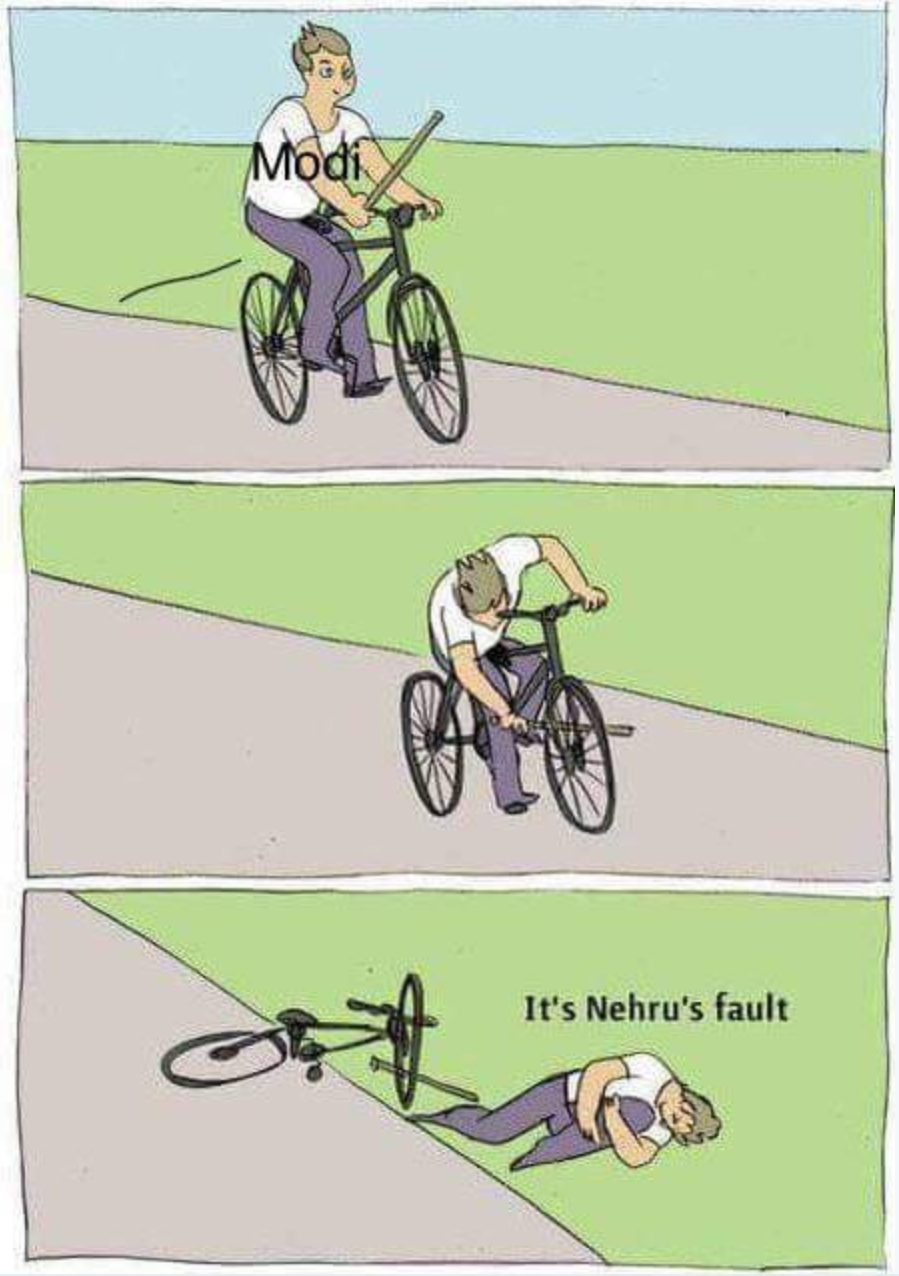
A company's CEO while handing over gave charge to his successor gave two sealed envelopes to be opened only when facing crisis. After first crisis the CEO opened first envelope which read 'blame the predecessor' and that worked. After second crisis he opened second envelope which read 'prepare two envelopes'.Modi doesn't know that Gandhi, Nehru & Patel were well in harmony. Gandhi chose Nehru as PM because he was young and popular with people of India where as Patel was old and having significant following in Congress. In addition Nehru had excellent relationship with Britain and many other countries and was truly secular where as Patel lagged these traits and has pro Hindutva inclinations and 19% of population of India are non-Hindus and their rights can't be undermined. And there is no reason to believe that Patel is taller than Nehru in any sense. Without doubt Nehru stands tallest among all the Congress leaders after Gandhi. Referring to past and belittling Nehru and his family at the fall of hat to gain political mileage and to cover his own failures works only one time but not after 4 years. Modi with worst performance as PM, not only made him self a laughing stock but effectively paved way for Rahul Gandhi to become PM in 2019, in just 4 years, which Sonia Gandhi couldn't achieve in 20 years.

Wednesday, 17 January 2018
Beware of those propagandist tricks
The daily belabouring of issues only creates a frenetic public parade of issues and allegations. But nothing is followed up to establish the truth.
- In a democracy, those who are spiritual have to be political. It suits the interests of the corrupt and oppressive players in politics to sustain the myth that politics is a truth, justice, welfare, den of scoundrels.
- Politics is sacred. A Swachh Bharat will be possible only through swachh politics.
- Commitment to truth is the core that spirituality and politics should share. Truth operates on the ground as justice. Justice addresses human dignity and welfare. Wherever truth is compromised, people’s welfare has suffered and oppression has bared its fangs.
- It is politics that contextualises commitment to truth and makes it concrete. Those who care for truth in politics remain continually vigilant against every measure, every propagandist trick, meant to hypnotise the masses.
- Commitment to truth creates a national culture marked by scientific temper and rational thinking.
- Capacity of the masses to think rationally can be disabled by a variety of factors such as lack of education, their inability to think rationally, their vulnerability to propaganda, the non-availability of relevant data, the creation of hype and waves, and so on.
- Democracy, especially, is under a duty to educate and empower citizens to think rationally and choose objectively. Oppressive regimes are averse to spreading education and free thinking.
- The dogmas of patriotism and nationalism are valuable to the extent of serving as catalytic agents to galvanise people’s energy for nation-building. But in the history, these concepts have been used mostly to spread hatred among nations and within them, between castes, groups, communities.
- Commitment to truth on the part of citizens requires that they see through the avalanche of issues. An illusion of upholding accountability is created by the daily belabouring of issues. A new issue is ushered even before the current one settles down. Nothing is followed up to the extent of establishing the truth of issues. Nothing changes.
- In a democracy, its citizens must remain in harmony with one another. They should never treat each other as enemies. Enmity is spread by vested interests to thrive by polarising citizens. The policy of ‘divide and rule’ never promotes people’s welfare.
- A democracy ought to take care of the majority that are poor. The fruits of development should be distributed preferentially among the poor.
- The oligarchic element lurks in every democratic polity should never be allowed to become powerful enough to scuttle democracy. The corporates of today are the successors of yesteryear oligarchs.
- The threat that the oligarchic elements hold out to democracy becomes ominous when the media play a partisan and propagandist role. When this process crosses the Lakshman rekha, it imperils democracy.
- The dogma of stability and its implications for the dynamic of democracy needs to be watched. Every centre of power is apt to deem itself to be the sole and legitimate custodian of national destiny. It views prospects for change with extreme intolerance. This keeps the dividing line between ‘freedom of choice’ and ‘sedition’ continually fluid. This brings ‘the right to choose’ under extreme stress and strain.
- The difference between a corrupt government and a tyrannical one is that the former knows itself to be a bird of passage and are fixated on reaping a bumper harvest in quick time. A tyrannical government is obsessed not with megabucks but with self-perpetuation. It substitutes the money with monopoly. The corrupt do not wish to be caught. The tyrannical do not wish to be shown the door. Both addictions harm democracy. And both skip on thin ice.
Tuesday, 26 December 2017
Why politicians lie?
- Politicians lie, or don’t tell the whole truth, because they have to. It is a global phenomenon.
- We all know that politicians tell lies. We expect them to stop once they hold office. No longer. In campaigns, and in office, politicians and their aides or supporters deliberately lie about matters of importance.
- At one time, citizens could count on their officials and candidates to either tell the truth or say nothing. Not any more.
- In order to brush away the delusion and confusion that hides the truth from us, we need the truth, because only an accurate description of the facts will allow us to make sound, sane, and sensible decisions.
- It is amazing how often politicians lie with ease and then, their unwillingness to admit that they lied. Politicians’ words were distorted, misrepresented, twisted, exaggerated, or taken out of context. They overstated, understated, or misstated. But, of course, politicians never lie, at least that’s what they say.
- Politicians have a personality that allows them to be evasive, to live with lies and keep a straight face. Not all people can do that. That is why many people are not willing to serve in a political role. They detest the process they will have to follow, a process an inevitable byproduct of the political system we chose to have.
- Politicians know their followers will believe them, even in the face of irrefutable evidence to the contrary. Politicians and their adherents live in an echo chamber in which everyone watches the same news channel, listens to the same talk radio, reads the same newspapers and web sites, and hangs out with the same like-minded people. There exists an impermeable membrane that prevents conflicting information from entering.
- In elections, what was fascinating was that the more a candidate lied, the higher they went in the polls. The person who lied the most won. With no real arbiters of the truth, there were no penalties for lying.
- The public ignorance makes lying an effective political strategy. Politicians lie because the cost/benefit ratio for lying is in their favor. Politicians run this calculation when they create or shift a damaging narrative, attack an opponent, or respond to indefensible claims against them. Most politicians know when they are lying. So, politicians lie when they believe that dishonesty is the best policy for getting elected.
- People don’t want to hear the truth. Truth hurts and no one wants to hear things that threaten their existence, their beliefs, or that will make them uncomfortable. It is decidedly better for politicians to tell people what makes them feel comfortable. Why should politicians be the purveyors of bad news when they can tell fairy tales with happy endings and come out the victor.
- The more democratic the system, the more lying there will be. In a democracy a leader has to make difficult maneuvers in a politically competitive environment. That is what democracy is about.
- CEOs of very large companies, leaders of major conglomerates and of countries exhibit very similar leadership styles. They are evasive, play their cards very close to the vest and do not share information if they can help it. They use big words to obscure their real intentions. They often lie, skirt the truth, too.
- The higher you ascend up the hierarchy, the more political the environment becomes. There is a struggle between the interests. As a leader you have to maneuver between all these pressure groups and powerful individuals, and survive the maneuvering.
- Being truthful is like a military leader making his battle plans known to the enemy during a war. Up there in the organizational hierarchy, whether of a country or a corporation, it is a war.
- Lying by political leaders is what we expect from totalitarians. Free societies require truth and honesty.
- The problem is inherent in objective journalism. In objective journalism, with an unfortunate amount of truth in it, there is no objective reality, there are only sources and they are rated by their credibility, and credibility is an attribute of status.
- There are only competing sources and competing spin and the journalists either don't know it or don't know what to do about it, journalists no longer own reality.
- People have not lost trust in journalism because they're liberal or biased or opinionated, but because they are not aggressive enough.
I offered my opponents a deal: if they stop telling lies about me,
I will stop telling the truth about them ... Adlai Stevenson,
US Presidential Democratic candidate said in his 1952 campaign speech
I will stop telling the truth about them ... Adlai Stevenson,
US Presidential Democratic candidate said in his 1952 campaign speech
While lies are impressive, truth is unpalatable. Lies travel much faster than truth. Probably that might be reason for people resorting to lies very often more so by politicians, corporate CEO's, journalists and so on. Public memory is short and also there are no penalties for lying. In the recent Gujarat elections Rahul Gandhi spoke truths but could impress less where as PM Modi resorted to wholesale lying which reverberated across media and the country and he ended up winning the election which otherwise would have been lost. Nehru was the first and the last Prime Minister who spoke truths fearlessly not bothering for consequences.
Thursday, 14 December 2017
Media's servility to Modi
- Three decades ago, state broadcaster Doordarshan was ridiculed and condemned by the press for behaving like ‘Rajiv Darshan.’
At the time, there was no other TV channel in India, the number of TV sets in the country was very limited. Prime Minister Rajiv Gandhi was ridiculed by the opposition and the press for projecting himself so much. - Now, nearly 80% of the population has access to TV. There are nearly a thousand TV channels. News channels alone are nearly 300 in all languages.
- On all these channels, there is incessant Modi Darshan. All his speeches are televised live and repeated 24×7. All radio channels are under a sort of obligation to air his ‘Mann Ki Baat’ every month and his speeches in Parliament or elsewhere.
- The print media too has begun to crawl before this ubiquitous (and narcissistic) self-proclaimed messiah. This nationwide media omnipresence of the Prime Minister has not generated criticism like it did at the time of ‘Rajiv Darshan’ in the late eighties.
- Columnists in the press and commentators on the shouting panels in TV debates, ring-mastered by the equally narcissist anchors, have not questioned this obscene personality cult.
- The same self-styled educated urban intelligentsia was so vociferously critical of Rajiv and before that of Indira Gandhi for the promotion of such a cult, which they argued, “distorted” and “destabilised” democracy. Their liberal sensibilities expressed deep revulsion and concern for India’s democratic ethos then.
- These people surrendered their sensibilities to the powers and feel absolutely comfortable in this multi-media driven glorification of the personality of the Prime Minister Modi.
- With the exceptions like Ram Jethmalani, Yashwant Sinha, Arun Shourie, and a few others, there are hardly any resistance to this media-led authoritarianism from the political, cultural, or intellectual class. They have failed the people and democracy.
- A kind of passive resistance is building up. More and more people feel these days that there is nothing they learn from news broadcasts. They are getting fed up with the panel discussions, as they neither grasp what the debate is about, nor who is saying what.
- Many normal viewers stopped watching news channels or debates. They get their news on their mobile phones and varied commentary on social media where they can interact on the net.
- There is also concern expressed in newspapers’ editorial that readership is becoming indifferent and unresponsive from the young and also from the old or middle-aged. There is a sharp decline in news magazine circulation.
- It is ironic that the media-communication revolution gave rise to information illiteracy among the educated. This is a wake-up call for the traditional press and TV media as their audience has become the whistle-blower.
- If Indian media becomes more and more servile towards Modi, it will lose whatever viewership they are left with.
Sound minds of India expect miracles
by electing educationally and morally illiterate to power.
While urban middle classes in 1980's were connected to rural India and urban poor and were socially conscious people, today's urban middle classes live in complete disconnection to rural India and urban poor and are fundamentally selfish. Therefore, they rally behind Modi as long as his decisions doesn't pinch them. Today's media's servility is characterized by its selfishness and business interests protection rather than any principles. There are no Ramnath Goenka's in media business now a days.
Tuesday, 28 November 2017
Aadhaar makes citizens more vulnerable
Last year Delhi Police busted an ISI spy ring and found that Mehmood Akhtar had an Aadhaar card naming him as Mehboob Rajput. In May this year, the Central Crime Branch found that three Pakistanis had obtained Aadhaar cards in Bengaluru through a middleman for Rs 100 each. More recently, Zeebo Asalina, an Uzbek national arrested in Orissa, had an Aadhaar card naming her as Duniya Khan.
- The perception that security agencies may have a better chance of nabbing potential terrorists if all mobile connections are verified using Aadhaar is flawed. Since Aadhaar cards were based on forged documents and UIDAI does not conduct any verification by itself, it retains the flaws of these documents and is not ‘fraud-resistant’. In fact, once they have Aadhaar, things may get easier for potential terrorists, given the incorrect perception that it is foolproof.
- Paper IDs are not good for privacy since they can be reused for other purposes. But Aadhaar is worse, because once data is shared with hundreds of third parties, it is no longer secure.
- Electronic KYC is cheaper for telecom operators and banks, it is costlier for citizens. The cost of the loss of personal information is much higher than the benefit of collecting it. UIDAI has no control once data leaves its system via eKYC, which has a tick-box approach to consent and no checks thereafter.
- The risk of personal information leaks increases with more services getting linked to Aadhaar due to security vulnerabilities, or sheer incompetence of the government or third parties.
- Disclosure of Aadhaar numbers is illegal as per Section 29 (4) of the Aadhaar Act.
- Whereas RTI Act makes it mandatory for every public authority to publish the manner of execution of subsidy programmes, including the amounts allocated and the details of beneficiaries of such programmes. This is conflict with Aadhaar Act.
- Biometrics are the least secure form of authentication. They can be cloned from photographs, and you leave fingerprints on every glass of water you pick up.
- Estonia had to suspend its digital ID cards due to cybersecurity related vulnerabilities. Spain is facing similar issues.
- The government’s cavalier attitude towards privacy that privacy cannot be at the cost of innovation indicates its willingness to put citizens’ personal safety at risk: that your privacy is a price that GoI is willing to pay for making it easier for businesses to be built around your data.
- Data for millions of people has already been compromised by the government, the allegation that critics are “alarmists” and “motivated” is a tactic to divert attention from badly designed architecture, execution mistakes, security failures and the yet-to be-addressed risks.
- While there are some benefits that might accrue from customisation of thousands of services that might otherwise not have had your data, a government that forcibly takes sensitive and personal information from you, and a court that has allowed this to happen despite appeals to stop it, has acted against you and 1.3 billion others.
- All your data, linked to a single ID and accessible to the government under unspecified ‘national security’ considerations, without sufficient checks and balances and judicial oversight, is also dangerous in the hands of a future government that might look to retain power by any means necessary.
- Mass surveillance for which Aadhaar is an enabler, is an unnecessary and disproportionate infringement of rights, and dangerous for democracy.
- With Aadhaar numbers littered all over the web, anyone can create a dossier of personal information by finding and joining datasets bases with the Aadhaar number and hence stating that Aadhaar is not a secret or confidential number is misleading and dangerous.
- Publishing a person’s caste, Aadhaar number, or mobile number or emailids is an unwarranted invasion of the privacy of the individual and serves no public interest but the leaked info can also cause financial loss. It opens doors for fraudsters to perform attacks on unsuspecting individuals.
- Publishing of last four digits of Aadhaar number only might not satisfy the provisions of both RTI and the Aadhaar Acts. Publishing Aadhaar number, full or partial, on the open web will put too many unsuspecting people at risk. It’s illegal for UIDAI to pass the buck and act innocent about data leaks. It needs to get across to users of Aadhaar data to follow the law or be held responsible.
- Instead of blaming the transparency requirements of the RTI, UIDAI must be pressurised to enforce its agreements with its partners. Whether you call it a data leak or not, doesn’t reduce the harm done if the authorities continue to publish Aadhaar details on the open web.
Government can't make citizens safer by making them more vulnerable.
The issue is not about Aadhaar as a tool in identification, but of linking it with everything under the sun is gross violation of privacy by government. While linking Aadhaar as remedy to plug leakages of government subsidies is well taken but forcefully linking it to all IDs is as imprudent as having one password for all your transactions which exponentially increases vulnerability. There would be little remedy to assaults by fraudsters on systems that are indiscriminately cross-linked. In the absence of robust data security environment, stringent privacy laws and meticulous penal agreements for any kind of data leakage or misusing, Government has no business to make Aadhaar linking mandatory to all citizen IDs and exposing them to security threats and unknown & unmitigated financial losses.
Monday, 27 November 2017
Trust & Respect can't be demanded; they have to be earned


- I am not supporter of "judges appointing judges" i.e. SC Collegium that do not invite applications from all eligible candidates prior to processing thus undermining the democractic principle of equality of opportunity.
- If PM and LM etc are that much trustworthy where is the need for checks and balances? Does Ravi Shankar Prasad wants all institutions be dismantled just because people elected them?
- Democracy becomes stronger only with strengthening of institutions, transparency & accountability of all decision making authorities, following due procedure for each and every decision, thread bare discussion about the suitability of every decision and minimal or nil use of discrete powers by people in responsible positions even under extreme conditions. In any case parliament's prior approval must be mandatory in 99% cases and post-facto approval in very very few emergency situations. Otherwise ours is pseduo democracy.
- Trust and respect are funny things. They can't be demanded; they have to be earned. The more you crave for them the more they elude you.
- Modi is elected by people not out of any trust but due to lack of choice. They thought he is better of all devils.
- Modi was elected by people to be their PM for 5 years to administer the nation with in the framework of constitution and laws. Nothing more; nothing less. What ever he wants to do he must follow due process of law. He can't get a dream in the midnight and do it next day morning.
- Finally, the fact that every decision originates from PMO indicates his gross disrespect for others and institutions and exhibits his authoritarian tendencies. History is a testimony for every dictator going down sooner or later, often ignominiously.
In this world, no one is trustworthy 100%
Saturday, 16 September 2017
Democracy and its Perils
- Democracy is a political system which combines the elements of fairness, legitimacy and effectiveness. It is the least worst system.
- Democracy is imperfect and, when misapplied or incorrectly interpreted, can be saddled with flaws and weaknesses.
- Democracy is the most expensive & inefficient form of governance.
- A democracy is not a democracy unless it has independent and strong institutions that help facilitate good governance and right thinking citizens demanding accountability and transparency.
- Proper democracy is far more than a perpetual ballot process. It must include deliberation, mature independent institutions and checks and balances. It may include educated citizens, strong civil society and strong laws.
- Freedom is an essential part of democracy. Freedom is essential for both the ruled and the ruler.
- Unfettered freedom brings with it its own hazards that would undermine the institutions that help sustain democracy.
- The victim of democracy is the politics itself. Politics in a democratic set up tends to be looked upon with contempt by the people. It is much maligned and abused field in all the democracies.
- Politicians once elected to power become the custodians and abusers of power.
- Bad politics leads to corruption. As the people responsible for corruption are ‘enabled’ to loot the exchequer either by the loopholes in the laws or indifferent ‘people’ who form the very basis of democracy.
- Corruption has reached gargantuan proportions, because of the indifferent attitude of the people and enabling environment provided by democracy for the corrupt to practice their art.
- Democracy aides both the individual and the ‘corrupt’ authority. Democracy with weak institutions gives them free hand to run the government, they tend to err, and err with impunity.
- Criminalization of politics is the biggest peril of democracy. With it comes misuse of position and authority. It inevitably leads to corruption.
- Corruption directly brings underdevelopment and spawns poverty. In India poverty is the major benefactor for the politicians. As long as poverty is sustained, they can amass wealth – always unaccounted.
- Democracy promotes capitalism which in turn results in uneven wealth distribution. Rich becomes much richer while poor remain poorer.
- Risk of capitalism is usually socialized while profits gets privatized.
- Democracy in itself is not a threat, but any weak link within it is bound to weaken the whole structure.
- Democracy has become synonymous with elections and is reduced to the process of elections.
- In democracy poor people vote, and the elected become rich at the cost of the poor. It’s a government of the rich, for the poor to sustain the poverty. This sounds cynical, but hard facts vindicate the statement. If 70% of India’s population still earns less than Rs 50 per day, even after 70 years of independence, should we compliment ourselves or introspect?
- Development has suffered more in democracy than in other forms of governments. Though it is fashionable to say that democracy is better than despotism despite lack of development, does it do justice to the vast millions who go to sleep hungry?
- Within democracy, we need a change of mindset both of the people and politicians in their attitude towards development. We are witnessing the loot of our resources by the powerful few who are covertly supported by the government machinery. Every penny that’s put to improve the lot of this country is unaccounted for. The crux is lack of accountability.
- Education of the masses and strong institutions is a solution to most problems in India.
- Institutions which are not pestered and interfered by the ruling classes perform better. The fear that these institutions if given complete autonomy would grow as a threat is unfounded. The Supreme Court of India and Election commission of India are governed by bureaucrats, not by the elected politicians. These institutions function well within the scope of our constitution.
- Our military has gained reputation for being fair to its people and the constitution. Where there is no interference by the politics, the institutions serve well. For a democracy to thrive and bring development to the masses, we need independent institutions to act as check and balances on the government.
- We need universities which are not at the mercy of government; we need public service commissions not interfered in their functioning by the government; we need a strong Lokpal to punish the corrupt; strong local governments to bring development at the bottom; independent CBI and a police force which is pro-people; the list goes on.
- These changes are not difficult to bring on. It is the will which is missing, lest it affects the power of few to amass the wealth. Perils of democracy are the result of loopholes within it. To plug them, we need to fight. Of course, non-violently.
- A blanket endorsement of it as a convenient panacea will do more harm than good.
- There are very few nations on this Earth, which openly reject the notion of democracy. Most countries espouse it, or at least offer it lip service.
- Myth #1: The people can do no wrong. The legitimacy of majority rule with no reservations or caveats raises the issue of sub-units within the voters viz territorial, cultural, ethnic or religious. What happens if the people change their minds? Democracy cannot be just if it is not just over time. Does a coalition automatically legitimize the action of individuals or groups or nations without regard to higher principles of morality or ethics? The doctrine of popular infallibility can be kept as a useful reference point but must not be abused or overextended.
- Myth # 2: Direct democracy is always better than representative democracy. Given the volatility of public opinion, the complexity of social psychology and the possibility of inter generational conflicts, the representative democracy is often superior to direct democracy, with the representatives acting as buffer. Mistakes can then be attributed to representatives and not to the people. The conventional assumption is that the will of the people should always trump that of the elites. The principal arguments against leaving too many decisions to the direct appreciation of the masses can be summarized as follows: (1) Uninformed or insufficiently informed electorate (2) Influence of money and media (3) People changing their mind (4) Contradictory Referenda (5) Deleterious effect on public policy.
- Myth #3: Democracy trumps all other social goals. The backlash against Dumb Democracy is the realization that democratization, although a valid goal, is not the only desirable one that a Society can legitimately aspire to. The following compete for priority with democracy. (1) Peace (2) Justice (3) Liberty & Freedom (4) Security (5) Good governance (6) Escape from extreme poverty (7) Public Vs Private goods (8) Good health (9) Traditional values (10) Climate change and sustainable development.
- Myth #4: Democratic countries will never go to war against each other. There is a frequent assumption that once a country becomes democratic it will renounce violence, avoid going to war especially against other democracies, and try to resolve outstanding problems by peaceful means. Experience shows that the relationship between democracy and war is actually very complex and far from straightforward.
- Myth #5: National democracy automatically leads to global democracy. Will a world composed of democratic nation-states automatically mean that it will also be democratic? This question is as complex and there are no simple answers. The UN Security Council, with coercive powers, is composed of five permanent members with veto powers who appointed themselves to that position. The other non-permanent members are elected by the UN General Assembly, but do not have veto power. The elected President of United States has real authority over the whole world by virtue of the overwhelming military power, which it has used in Iraq and threatens to do so elsewhere. There is a serious democratic deficit where 2% of the world’s voting population manages to have a determining influence on the entire world.
- There is no formula of global democracy and every formula suffer from inefficiencies and conflict of goals. The attempted simple transition from national to global democracy without a lot of preparation and adaptation is therefore destined to fail unless treated with a more sophisticated analysis.
- Other than democracy, there are no other known political alternatives which will work in the long run. There is no permanent security in tyrants and the checks and balances of democracy make it the only sustainable political system, which can claim both long-term efficiency and legitimacy. Democracy must prevail because of mounting global interdependence requiring team responses and collective decision-making. A leader has to motivate his troops and keep their confidence. No single individual holds absolute power anymore, and everyone has to report to some group or a parliament, all leaders are accountable to some committee of peers, which makes democracy sustainable, indispensable and inevitable.
- The modalities of this accountability have to be modulated and perfected.
- The construction of a democratic state must be gradual and well planned. It can rarely be imposed by non-democratic means. Democracy by force of arms is self-defeating.
In framing a government which is to be administered by men over men, the great
difficulty lies in this: you must first enable the government to control the governed;
and in the next place oblige it to control itself ... James Madison
difficulty lies in this: you must first enable the government to control the governed;
and in the next place oblige it to control itself ... James Madison
The Perils of Dumb Democracy
Ambedkar described constitution as a fundamental document stated that the purpose of a constitution is not merely to create the organs of the state but to limit their authority because if no limitation was imposed upon the authority of the organs, there will be complete tyranny and complete oppression. The legislature may be free to frame any law; the executive may be free to take any decision, and the Supreme Court may be free to give any interpretation of the law. It would result in utter chaos. Constitutional morality is not a natural sentiment. It has to be cultivated. We must realise that our people have yet to learn it. Democracy in India is only a top-dressing on an Indian soil which is essentially undemocratic. Demonetisation has negated the fundamental and constitutional rights of Indians. By forcing every Indian, and not just the black marketers and counterfeiters, to stand in queues to withdraw hard earned money, our elected government has insulted all. Citizens have been temporarily deprived of property by a single fiat, even though the constitution says this can only be done with the authority of law. Countless have died, been rendered jobless, hungry and homeless. Is this a democratic act? RBI has been reduced to cipher. Fiscal policy has become political and the finance ministry redundant. The parliament and the cabinet have been turned into a mere formality. Judiciary appears seriously weakened. It is not easy for the victims of police and investigative agencies to get any relief against wrongful detentions and prosecutions. But it is the concerted attack on institution after institution by the Modi government that raises serious concerns. Bhakti in religion may be a road to the salvation of the soul. But in politics, bhakti or hero-worship is a sure road to degradation and to eventual dictatorship. India has moved away from constitutional democracy to populist democracy. Ambedkar is losing. Modi is winning.
Friday, 15 September 2017
Autocrats triumph in democratic countries
- Democratically elected leaders who triumph in elections often move towards autocracy by undermining checks and balances and consolidating power. In India, Indira Gandhi and Modi are examples of such phenomenon.
- The most common way for a democracy to collapse is through the actions of elected incumbent, not a coup or revolution.
- Hugo Chavez, 4 terms elected president of Venezula, dismantled institutions and expanded his authority. Vladimar Putin of Russia has concentrated so much power in his own hands he is known as 'elected dictator'. Erdogan of Turkey following the same path.
- Once in power, unscrupulous leaders manipulate political environment more likely that they are sure of winning future elections. Thus they gain stamp of democratic legitimacy even for actions that ultimately undermines democratic norms.
- Manipulation and winning elections has become a kind of exploit in the rules of political legitimacy to hack the system. People around the world have become attached to the idea that elections have become defacto requirement for government legitimacy. Winning the election through popular vote is treated as conveying moral and procedural validity.
- Election winner claims popular support for changes that undermines democratic institutions and stripping away checks and balances. Opponents who criticize runs the risk of looking anti-democratic trying to thwart the will of people expressed at ballot box.
- In some autocracies elections are 'farce' and in some they were 'genuine' contests though they may not be fair. Techniques like curtailing press freedom, limiting opposition's ability to campaign, and spreading misinformation enable incumbent to manipulate election outcomes without resorting to traceable techniques like ballot-stuffing.
- Chavez systematically revoked broadcast licenses while Putin cracked down on dissent and shutting off political opportunities for opposition. This kind of manipulation is not only powerful, it is also hard for opposition to prevent. This way, autocratic leader can avoid risk of losing votes while gaining legitimacy from its result.
- Often leaders who subvert democracy and whose electoral success is partly attributable to tilted playing field remain genuinely popular with much of the public. This contradicts democratic belief that elections are an effective check on tyranny.
- What voting taketh away, voting can giveth right back. A habit of elections may also make it more difficult authoritarians consolidate their autocracies. This is strength and weakness of democracy.
- Leaders who benefit from polarisation and manipulation of political contests in their favor will eventually lose popularity. Then a tradition of regular tradition makes it easier for country to return back to democracy. One election is not a cure-all.
Twenty or even ten years ago, the possibility of a global democratic recession seemed impossible as states grew wealthier, they would develop larger middle classes who would push for ever-greater social, political, and economic freedoms. Human progress would spread democracy everywhere. The middle class rather than work to defeat these populist & authoritarian leaders at the ballot box or strengthen the institutions that could hold them in check, they have ended up supporting undemocratic measures.
In a democracy government should be afraid of their people.
Propaganda is to a democracy what the bludgeon is to a totalitarian state.
Democracy consists of choosing your dictators.
When threatened, the first thing a democracy gives up is democracy.
The best cure for the ills of democracy is more democracy.
To oppress the opposition is to assault the very foundation of democracy.
Almost all the above statements confirms Modi as an autocrat practicing authoritarianism. His relentless high decibel propaganda stating failures as successes is height of all the things. Democracy is not a simple thing: It’s a complex system of strong institutions and legal checks. Very few nations have mastered it fully. And sustaining it is a never-ending effort.
Wednesday, 21 June 2017
Modi's rule: Our democracy in peril
Modi's three year rule is characterized by ...
- Disregarding democratic principles for economic progress and shunning democracy for majoritarianism.
- With his anti minorities attitude and a Hindu hardliner, Modi can hardly be a true statesman.
- There is a lot of difference between governing a state and an entire country full of diversity, which he doesn't realize.
- People’s desires for economic progress have been channelized into the sentiment that democracy isn’t working for them.
- He is making people believe that shunning democracy and sacrificing a few democratic values paving way for authoritarianism is an easier way out.
- Economic progress and diplomatic fanfaronade are made more important and fundamental rights, individual freedom and secularism have been reduced to useless hyperboles.
- Dissenters have been pushed to the periphery and have been blamed as anti-nationals, for whom petty personal freedoms are more important than the nation’s glory.
- Complete faith has been bestowed into the PM and questioning him means going against the nation’s sentimentality.
- A brand new nationalistic discourse has been charted. You are either on the side of your nation or on that of abhorrent Islamic neighbor.
- It has never been controversial to be secular in this country. While just a few years ago it was largely considered a virtue, secularism today stands abused and bastardized.
- The pride associated with being secular for over six decades since the inception of our Constitution has been reduced to the malicious fallacy of being minority appeasers.
- He is not directly propagating chauvinist nationalism and aggressive jingoism, but he is basking in its glory.
- He is hypersensitive to any criticism or even analytical critiques.
- Today, the country is completely divided on communal lines with Muslims and Christians being considered enemies unless they bow down to majoritarianism.
- There has been rising violence and hooliganism against Muslims and Dalits in the name of cow protection. These are law and order problems unacceptable in any civilized society.
- Dalits feel that discrimination against them has increased since Yogi Adityanath was appointed CM of Uttar Pradesh.
- When the PM and Yogi Adityanath do not wholeheartedly condemn atrocities against minorities, it gives a free hand to those who believe in an aggressive communal Hindu nationalistic ideology.
- It is true that previous governments and political parties have exploited both Dalits and minorities, indulging in vote bank politics and have contributed little to their upliftment. Failures of the past do not justify wrongs of the present. National Commission for Minorities is not having a single member for months now.
- Modi puts his foot down against the Sangh Pariwar, occasionally. Modi praised Mother Teresa for serving the poor “As Indians we feel proud about the canonization of Bharat Ratna Mother Teresa.”
- RSS Chief Mohan Bhagwat had in 2015 said that Mother Teresa converted people to Christianity in the name of serving humanity and demanded that the Bharat Ratna bestowed on the Saint in 1980 be withdrawn.
- Last year Modi cited quotes from the Quran and said Islam was “a religion of peace”, is another example. But there has been no conscious effort on his part to keep the country’s secular fabric intact.
- Neither can Islamic fundamentalism be controlled nor RSS’ dream of a Hindu Rashtra be realized by resorting to lawlessness and savagery. On the contrary, it could backfire and more people could get disillusioned and take recourse to Islamic fundamentalism.
- There is contradiction between our Constitutional values of pluralism and equality and the concept of Hindutva.
- Indian’s dreams of development and progress and to making our country a fast-growing economy will be successful only only there is harmony.
- It is an irony that while millions across the world are giving up their lives for democratic values, today a large number of Indians find no virtue in democracy.
- As Modi is confident of his victory in the 2019 general elections, it’s just a matter of time our democracy gets reduced to a farce.
My View:
Instead of engaging people of Kashmir valley with economic progress and politically, deploying half of Indian Army and their resistance of military atrocities reflected by stone throwing even by women and school girls doesn't august well with our democratic principles. Voter turnout in recent Srinagar Lok Sabha bye-poll from 64% in 2013 to under 7% is glaring and worrying example of total alienation of Muslims in Kashmir by Modi government. Unless some drastic steps are taken, which is unlikely by authoritarian Modi, it is matter of time we end up losing Kashmir forever. Modi's senseless demonetization busted all sections of people and GDP taking a big hit. Today's farmers unremunerative prices is attributed mostly to currency shortage, consequent to demonetization, still prevailing especially in rural India. And his farmer loan waiver loan announced for winning UP elections is resulting in announcing the same by all states, one after other. GST without enough lead time for preparation is likely to hit supply chain of most commodities resulting in lower GDP apart from higher inflation. Demonetization and GST roll out, without preparation and mitigation, and farmer loan wave offs , Modi in fact is destroying economy while talking of high speed reforms.
Sunday, 30 April 2017
Populism and its Perils
- Populists can be everything from militarists to libertarians. For populists, the people are paramount.
- Populism is a political strategy in which a charismatic leader appeals to the masses while sweeping aside institutions.
- Populism is a thin ideology, that merely sets up a framework that of a pure people versus a corrupt elite. This thin ideology can be such as socialism, nationalism, anti-imperialism or racism, in order to explain the world and justify specific agendas.
- Populists are defined by their claim that they alone represent the people, and that all others are illegitimate.
- Exclusive populism focuses on shutting out stigmatized groups. Inclusive populism demands that politics be opened up to stigmatized groups.
- Populism is only an elaborate lie for getting into power. People are victims of populists.
- Populism is not a political project as it is discursive political strategy. And there is the danger in populist politics. Trumpism, a reactionary nationalist populism, was a logical culmination of populist politics of Obama in 2008.
- Populism is a form of political practice that speaks for the people and against the established power structures.
- Populism must be critically analysed as a discursive political practice independent of ideology or content.
- Populism does not give power to the people, but rather to elites and individual politicians who use their so-called legitimacy of direct appeal to bypass the institutions of state and civil society.
- Populism will always stand in tension with democracy.
- None can protect the country from ruinous economic populist policies.
- Stereotypical narratives belie the vague and often contradictory definitions of the concept of 'the people' and the motives of those who use populism as a political tool.
- Fragile political institutions allow populists to achieve power, while strong institutions confine them to the margins of political systems.
- If populists have enough power, they will end up creating an authoritarian state that excludes all those not considered part of the proper people.
- The notion of the people as nation is typically associated with right-wing populism, while the notion of people as a class is characteristic of left-wing populism. The people as sovereign implies a specific vision of democracy.
- Populist democracy is an illiberal vision of democracy because of its monolithic conception of the people, which implies that the popular majority is always right.
- The populist leader has direct, unmediated access to the people’s grievances, and acts as the spokesperson of the vox populi.
- Populism of fashion is a political tendency, which dare media being used frequently.
- Populism is a stupid crap that sells well, yet would be a disaster if actually implemented.
- Populism is an epithet elites resort to when someone else goes outside the rules and wins an election.
- An election year is not a chance to educate the public mind rather than simply gauge it.
- Modern democracies operate within a framework of rationalism. Dismantle it and the space is filled by prejudice. Fear counts above reason. Anger counts above evidence. Lies claim equal status with facts. Soon enough, migrants and Muslims especially, replace heretics and witches as the targets of public rage. Referendums amplify the danger. Liberal democracy depends on mutual respect, trust in national institutions, guarantees for minorities, and the checks and balances that underpin the rule of law. Strip them away and you are left with brute majoritarianism.
My View:
Modi fits into the almost all qualities of 'populism' and his actions are ruinous, undemocratic, authoritarian, irrational etc with no regard for institutions like Parliament, Supreme Court, RBI, EC etc. Charismatic leader he is, shamelessly propagates exclusive populism of making India a Hindu Nation, in opposition from its constitutionally proclaimed secular nation so far, alienating minorities especially Muslims. None can protect India from ruins until he collapses under his own weight which is several years away. India's distorted democracy is in peril.
Subscribe to:
Posts (Atom)