Showing posts with label Banks. Show all posts

Wednesday, 23 October 2019

Indian economic recession

In the budget, the FM Nirmala Sitharaman claimed that India’s economy would hit $5 trillion by 2025. In the weeks that followed, GDP growth rater fell to a six-year low of 5%; the RBI made a surplus transfer of Rs 1.76 lakh crore to the union government; and the government announced the merger of ten public-sector banks into four combinations. These announcements came against the backdrop of the precarious state of the Indian economy. The country is witnessing an economic slowdown that has spread from the auto sector to all other segments, the unemployment rate is at a 45-year high and the tax collections from the previous fiscal year presented an estimated shortfall of Rs 1.67 lakh crore from the revenue expected by the BJP government. The going seems difficult for both Sitharaman and the Indian economy.
  • The RBI has lowered India's growth forecast for FY20 to 6.1% from 6.9% it projected earlier. The World Bank has cut India's GDP growth forecast from 7.5% to 6% this year.
  • India is a consumption-driven economy. When consumers buy goods and services, the wheels of the economy turn. That has not been happening for several quarters and for various reasons.
  • Fewer jobs (at 6.1% in 2017-18, unemployment was the highest in 45 years), a freeze in salary hikes and bonuses, layoffs and uncertainty in businesses are making people cut down on spending.
  • Incomes and wages in rural India, where 67% of India's population lives, have been hit because of low food prices. Agriculture GDP grew just 2% in the first quarter of the current fiscal, compared to 5.1% in the same quarter of the previous fiscal.
  • Consequently growth in private consumption expenditure is down to an 18-quarter low of 3.1% in June 2019. Savings declined to an all-time low because of static or falling incomes.
  • Construction, which is a big employment generator, is decelerating because of the slump in real estate. Exports fell 6.57% in Sept 2019 compared to a year ago. Discoms are groaning under a combined debt of over Rs 2.4 lakh crore. Corporate sector revenue growth fell to an 11-quarter low and investments plunged to a 15-year low.
  • The banking and financial services sector is in a mess. There is liquidity, but no loans are being given. Banks are tottering under a mountain of NPA's of close to 10% of their total assets. They are fearful of giving fresh loans in case they add to their woes. Non-banking financial companies, which are a major source of consumer loans, are in a mess of their own and unable to extend credit. And the string of collapsing financial institutions has further sapped consumer confidence in the system.
  • The government's rescue acts like slashing corporate tax rates and unprecedented interest rate cuts by the RBI seem to be yielding no results in the short term.
  • These are exceptional times and they call for exceptional measures. Indian government could take cue from the US Federal Reserve spent nearly 800 billion dollars to pre-empt an imminent economic meltdown in 2008.
The Indian economy is in a vicious downward spiral and the Modi government needs to stop worrying about the fiscal deficit & inflation etc and start pouring money into the economy to stimulate growth. They need to put money in people's pockets in every way they can. This appears to be the only way to get the jammed wheels of the economy moving again.


Tuesday, 28 November 2017

Aadhaar makes citizens more vulnerable

Last year Delhi Police busted an ISI spy ring and found that Mehmood Akhtar had an Aadhaar card naming him as Mehboob Rajput. In May this year, the Central Crime Branch found that three Pakistanis had obtained Aadhaar cards in Bengaluru through a middleman for Rs 100 each. More recently, Zeebo Asalina, an Uzbek national arrested in Orissa, had an Aadhaar card naming her as Duniya Khan.
  • The perception that security agencies may have a better chance of nabbing potential terrorists if all mobile connections are verified using Aadhaar is flawed. Since Aadhaar cards were based on forged documents and UIDAI does not conduct any verification by itself, it retains the flaws of these documents and is not ‘fraud-resistant’. In fact, once they have Aadhaar, things may get easier for potential terrorists, given the incorrect perception that it is foolproof.
  • Paper IDs are not good for privacy since they can be reused for other purposes. But Aadhaar is worse, because once data is shared with hundreds of third parties, it is no longer secure. 
  • Electronic KYC is cheaper for telecom operators and banks, it is costlier for citizens. The cost of the loss of personal information is much higher than the benefit of collecting it. UIDAI has no control once data leaves its system via eKYC, which has a tick-box approach to consent and no checks thereafter.
  • The risk of personal information leaks increases with more services getting linked to Aadhaar due to security vulnerabilities, or sheer incompetence of the government or third parties.
  • Disclosure of Aadhaar numbers is illegal as per Section 29 (4) of the Aadhaar Act.
  • Whereas RTI Act makes it mandatory for every public authority to publish the manner of execution of subsidy programmes, including the amounts allocated and the details of beneficiaries of such programmes. This is conflict with Aadhaar Act.
  • Biometrics are the least secure form of authentication. They can be cloned from photographs, and you leave fingerprints on every glass of water you pick up.
  • Estonia had to suspend its digital ID cards due to cybersecurity related vulnerabilities. Spain is facing similar issues. 
  • The government’s cavalier attitude towards privacy that privacy cannot be at the cost of innovation indicates its willingness to put citizens’ personal safety at risk: that your privacy is a price that GoI is willing to pay for making it easier for businesses to be built around your data.
  • Data for millions of people has already been compromised by the government, the allegation that critics are “alarmists” and “motivated” is a tactic to divert attention from badly designed architecture, execution mistakes, security failures and the yet-to be-addressed risks.
  • While there are some benefits that might accrue from customisation of thousands of services that might otherwise not have had your data, a government that forcibly takes sensitive and personal information from you, and a court that has allowed this to happen despite appeals to stop it, has acted against you and 1.3 billion others.
  • All your data, linked to a single ID and accessible to the government under unspecified ‘national security’ considerations, without sufficient checks and balances and judicial oversight, is also dangerous in the hands of a future government that might look to retain power by any means necessary. 
  • Mass surveillance for which Aadhaar is an enabler, is an unnecessary and disproportionate infringement of rights, and dangerous for democracy. 
  • With Aadhaar numbers littered all over the web, anyone can create a dossier of personal information by finding and joining datasets bases with the Aadhaar number and hence stating that Aadhaar is not a secret or confidential number is misleading and dangerous.
  • Publishing a person’s caste, Aadhaar number, or mobile number or emailids is an unwarranted invasion of the privacy of the individual and serves no public interest but the leaked info can also cause financial loss. It opens doors for fraudsters to perform attacks on unsuspecting individuals.
  • Publishing of last four digits of Aadhaar number only might not satisfy the provisions of both RTI and the Aadhaar Acts. Publishing Aadhaar number, full or partial, on the open web will put too many unsuspecting people at risk. It’s illegal for UIDAI to pass the buck and act innocent about data leaks. It needs to get across to users of Aadhaar data to follow the law or be held responsible.
  • Instead of blaming the transparency requirements of the RTI, UIDAI must be pressurised to enforce its agreements with its partners. Whether you call it a data leak or not, doesn’t reduce the harm done if the authorities continue to publish Aadhaar details on the open web.

Government can't make citizens safer by making them more vulnerable.

The issue is not about Aadhaar as a tool in identification, but of linking it with everything under the sun is gross violation of privacy by government. While linking Aadhaar as remedy to plug leakages of government subsidies is well taken but forcefully linking it to all IDs is as imprudent as having one password for all your transactions which exponentially increases vulnerability. There would be little remedy to assaults by fraudsters on systems that are indiscriminately cross-linked. In the absence of robust data security environment, stringent privacy laws and meticulous penal agreements for any kind of data leakage or misusing, Government has no business to make Aadhaar linking mandatory to all citizen IDs and exposing them to security threats and unknown & unmitigated financial losses.

Thursday, 17 August 2017

Modi, the greatest liar


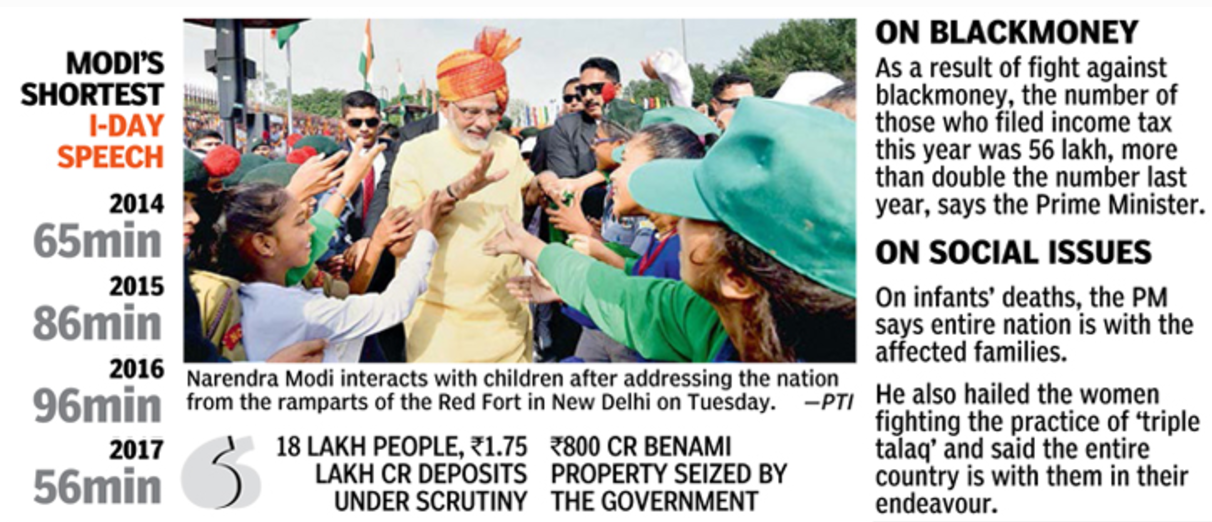
  • Modi's claim of 56 lakh new IT payers is not necessarily the result of demonetization and more over 90% of new IT payers are in the  income range of Rs.2.50-Rs.2.70 lakhs/annum yielding revenue of just over Rs.100 crores. Where as demonetization costed the nation over Rs.150,000 crores, at the least.
  • Modi announced Rs.80,000 crore Kashmir package in Nov 2015 and so far nothing has been spent in Kashmir except on army expenses. The voter response dwindling from 64% in 2014 elections to less than 7% in recent Srinagar bye poll (and 2% in re-poll in some parts) speaks volumes about Modi's failure in Kashmir so far.
  • Modi must realize that Kashmir problem is not just law & order problem which can be solved by army nor an economic package will buy peace there. But the solution lies in removing the alienation of people in Kashmir through political engagement and deliberation.
  • The fact that LS & RS with combined strength of 790 and 14.23% Muslim population their representation should have been 112. The present strength is just 23 (under 3%). 
  • As on date, BJP Muslim MP's in LS are NIL and in RS are just 2.
  • The appearance of schoolgirls on the streets joining the teenage boys throwing stones at the security forces shows that the familial and social norms have broke down.
  • Even after SC ended armed forces immunity under AFSP Act in 2016, to day in Kashmir in every 8th household an able bodied youth is missing (presumed killed by security forces in fake encounters) and in every 5th household a woman is raped by security forces (mostly unreported due to social pressures) and not a single case has been filed against the security personnel and expecting people of Kashmir trust our law enforcers is height of insanity. 
  • Today half of our military totaling 7.50 lakhs is enagaged in Kashmir with a population of under 10 million (96% Muslims) and reported number foreign militants are less than 150.
  • Without initiating establishment of 'rule of law' and engaging people politically how Modi will resolve Kashmir issue and make it a 'paradise once again' is shallow and his speech a blatant lie. 
  • If nothing is done to resolve Kashmir's burning problem except application of brute military might which will not solve the problem and in due course of time we may end up loosing Kashmir forever.

Power is domination, control, and therefore any selective form of truth is a lie.
పామరజనొచితమగు ఫ్రల్లదనములు పలుకుటకు ప్రాఘ్నులంగీకరింపరు.


Modi with his oratory skills, rhetoric, hammering out selective truths and publicizing failures as successes is virtually destroying India economically & politically. First two years he spent time touring the world delivering mesmerizing speeches. In third year he unleashed war on people by quack advised demonetization which hurt the poor most and resulted in destruction of agriculture, construction and informal sector while stated objectives eluded. Then he found GST which would project him as bold financial reformer and rolling it out hurriedly in mangled form without sufficient preparation had impacted small businesses greatly. GST, a novel reform, is expected to impact economy for about two years and there after benefits starts accruing. Both these must have costed nation about Rs.300,000 crores, the exact figures will never be known. All his independence day speech contents are selective truths and blatant lies. Among all politicians, at least Prime Minister should be truthful to nation. All his Red Fort speeches are either selective truths or blatant lies. India belongs to all Indians not just majority Indians.

Friday, 11 August 2017

NPA's: Govt's all talk and no action

  • Infrastructure and capital-intensive industries are imperative for development but too difficult a responsibility for the private sector to shoulder because of long gestation period and low returns.
  • During financial year 2016-17, when demonetization disrupted banking activity, banking sector grew by just 1.7%, which was a 20-year low. 
  • Most of the banks involved in NPA's are public sector entities with the perception that the liabilities of these banks are backed by a sovereign guarantee, that has prevented a run on these banks.
  • The ratio of stressed assets to gross advances in the banking system has crossed the double-digit mark and few borrowers account for a large share of defaults. 
  • As banks are grappling with the defaults, they tried to retrieve themselves from this mess by lending more to potential defaulters or converting part of their debt into equity which did not work. On the other hand, the deficits on the balance sheets of these firms became even larger. When banks decide to make a case for liquidation to recover at least a part of their loans, the net assets were not even a fraction of the value of their exposure, especially since resources have often been diverted out of the firms concerned.
  • Bank NPAs are not a new issue, though the magnitude of the problem was revealed when Raghuram Rajan, the previous RBI Governor, imposed new guidelines on identifying NPAs. 
  • Given poor shape of public sector banks the price at which they could be privatized is likely to be indefensible.
  • The only way out is banks recapitalization by government and writing off NPAs and going forward diligently. Money lost once is generally irretrievable.
  • The new bankruptcy law, forces a settlement must be reached within 180 days. These 12 large defaulters account for around a quarter of NPAs and quick resolution of these NPAs even with a discount, that would reduce government's recapitalization requirements. Little is likely to be recovered from absconding individuals, like Vijay Mallya of Kingfisher Airlines. 
The reform-induced failure of the government to mobilize adequate resources, through taxation or borrowing, to finance capital expenditure is the root cause of the current bank's crisis. Private sector firms borrowed high value banks funds and invested in infrastructure and capital intensive projects with long gestation where the profits have been volatile and difficult to come by, and firms have found themselves unable to service their debts. Today almost all infra and public utility companies are in red. Restructuring of debt etc works rarely and generally postpones collapse of firms and banks. Most important problem is inflation of project costs, corruption and siphoning of funds by promoters. It is well known that promoters take back their investment, albeit illegally, even before project construction takes off.

Wednesday, 2 August 2017

Jobless growth of India's GDP

  • Today, India is facing a peculiar situation of 'jobless growth' and 'growthless jobs' as well, mainly due to defective economic policies and gross fiscal mismanagement.
  • During the past three years, public sector, government’s headcount remained stagnant. State-run banks registered a job growth of just 0.5%. Private corporations have no better figures.
  • Every year, 10-12 million young Indians join the labour force, 5 million people leave agriculture to join the non-agriculture sectors. In contrast job creation is few lakhs only during the past three years which are mostly replacement recruitment.
  • India's GDP growth and new jobs creation in India have not been growing at the same rate. The creation of more and better jobs and livelihoods is imperative for policymakers. Focusing only on GDP growth is a wrong approach.
  • About 550 jobs are disappearing everyday, an alarmist declaration of loss of one million jobs during past five years.
  • The lack of lending by the banks may very well be one contributing factor. 
  • Rise in unemployment is due to agriculture and SMEs, which contributes most employment in India, are the worst affected. The organised sector contributes only 1% of jobs.
  • Big multinationals in India are highly capital-intensive, while the SMEs are four times more labour intensive than the large firms. But they are one of the least productive sectors and their real wages are very low. 
  • India needs to protect sectors like farming, unorganized retail, micro and small enterprises. These sectors need support from the government not regulation. 
  • The agricultural sector in India does absorb more than half the workforce, but a lot of it is disguised unemployment. 
  • The view of Indian villages as the economic backbone of India is flawed and will never lead to the kind of mass employment that is desired in India. At best it minimizes agriculture labour migration to urban areas.
  • Urbanization creates lots of jobs in developing economies.
  • 92% of enterprises that created jobs were from the informal sector, and the biggest stumbling block for these was lack of formal credit. 
  • India needs to free up its labour laws which are archaic, restrictive, and convoluted which incentivizes firms to stay small and remain in the informal sector. Firms, which can achieve economies of scale, are the need of the hour to create jobs for the masses in India.
  • India needs to focus on primary and secondary education and skills development. A skilled worker has a better chance at finding higher paying employment.
  • At present, the business environment is the toughest for small to medium enterprises. Improvement of 'ease of doing business' to firms of all sizes, to be set up and facilitate its smooth running. 
  • Focus on infrastructure and tourism, on sustainable basis, will help creation of jobs at the unorganized level. 

My View:
Modi administration, in the name of reforms is actually destroying 'informal sector' which are mostly operated by less educated people employing semi skilled people. Modi's failed demonetization and hurriedly rolled out mangled GST have destroyed informal sector, agriculture, construction and tiny industries, while achieving nothing. Winning elections is all about hammering of selective narratives rather than sound public policies. Aside improving 'ease of doing business', promoting manufacturing, preserving agriculture at profitable levels, encouraging small businesses & industries, services, infrastructure, tourism are the keys for providing employment to masses. Banks must be financially healthy and support informal sector so that our economy grows and provide employment to our aspiring youth. Trophy projects, white  elephants and icons are not the indicators of development. It is all round life style improvement of poorest people, which is called 'development'.

Friday, 2 June 2017

Telcos in India deep trouble

  • Until a year ago, all Telcos in India were fairly well off making impressive profits with stock prices attracting investors.
  • With Reliance Jio launching its operations, a year ago, with its inaugural FREE offers compelled the existing Telcos to spend massive amounts in advertising and customer retention activities that resulted in erosion of their handsome profits and landing them with huge losses.
  • The data with us suggests that the total EBITDA (earnings before interest, taxes, depreciation and amortization) of the sector on an annualized basis is Rs 65,000 crore, which is clearly unsustainable for debt of more than Rs 4 lakh crore," the SBI chairperson said.
  • Now Indian banking sector already reeling under insurmountable NPAs of over Rs.7 lakh crores stands exposed to another huge risk of over Rs.4 lakh crores.
  • While Mukesh Ambani's borrowings from Banks is over Rs.1,80,000 crores and his investment in Reliance Jio is estimated at Rs.1,50,000 crores against its original estimate of Rs.85,000 crores. His strategy was to destroy competitors and monopolize Telco business with its advanced VOLTE technology is dealing deadly blow to existing Telcos namely Airtel, Vodafone, Idea, Reliance Communications, BSNL etc.
  • The ongoing consolidation in Telco sector in India will result in job losses to the extent of 40,000 this year.
  • Mukesh Ambani used Bank's money to push Banks to the brink of collapse. It is a matter of time Telcos loans of Rs. 4 lakh crores will become NPAs. How Reliance Jio will pay back its Rs.1.5 laks crores is  a million dollar question.
  • The loans to Mukesh Ambani were granted by Banks during Modi's tenure i.e. during past three years as quid pro quo for funding his 2014 election campaign expenditure.
  • Whether Mukesh Ambani will be able to make profits for Reliance Jio amidst chaos in Telco sector and repay banks is another million dollar question. How many more years he will hang on, we will have to wait and see.
  • In all Indian Banks stands exposed to monumental risk of Rs. 5.50 lakh crores in Telco segment, in addition to existing NPAs of over Rs.7 lakh crores.
  • Since three years Banks were unable to invest in infrastructure segment and other high value projects due to paucity of funds. This has resulted in GDP growth looking southward in addition to the deadly blow dealt by mindless demonetization 2016.
  • Meager budget support for inducing additional capital, public sector banks are simply biting time and recent ordinance with code for NPAs recovery being worthless and with discouraging global parameters, Indian economy today is spiraling down at breakneck speed with all economic indices looking southward there is no magic wand to halt this except looking towards sky for 'ache din'. But 'ache din' will come only when decisions are sound and implementation is faultless but not for rhetoric and high decibel shouting.

My View:
A decade ago while launching Reliance Infocom services Mukesh Ambani's statement is paraphrased as "I wouldn't be interested in a bigger piece of smaller pie but would rather aim at smaller piece of larger pie". But today he stands exposed to bulldozing competitors with his money power and establish monopoly in Telco market and eventually loot the consumers. All this facilitated by none other than Modi. While bank NPAs are result of reckless activities by UPA regime, destruction of Telco sector and monopolizing by Reliance Jio and further burdening of Banks and job losses is the creation by Modi himself.


Wednesday, 8 February 2017

Public money for private profits

Banks raise money by soliciting deposits from the general public or using other instruments available to them and use this public money to fund various projects of the corporate or business entities after due diligence. If a borrower fails to repay the money, a bank’s primary concern is to ensure its profitability and safeguard the interests of its depositors. Until 1994, this was the prevailing view of the banks and the Reserve Bank of India (RBI). RBI had by its circular dated April 23, 1994 directed all banks to send a report on their defaulters, which it would share with all banks and financial institutions (FIs), with two objectives:
  1. To alert banks and financial institutions (FIs) and to put them on guard against borrowers who have defaulted in their dues to lending institutions.
  2. To make public the names of the borrowers who have defaulted and against whom recovery suits have been filed by banks/FIs.
With the liberalization and unshackling of India’s economy, a paradigm shift occurred in this shaming-the-defaulter policy. It is well known that there exists a corrupt and powerful nexus of bureaucrats, bankers and politicians which always works in the interest of big corporate borrowers. Gradually but steadily, a case was made out that if large borrowers fail to repay their debt, the lending banks must make a business decision for the revival and sustainability of the business! This flawed idea was propagated as the nation was made to believe that governments or their institutions are not capable of taking such business decisions and it is incumbent upon lending banks to help revive their ailing borrowers, and to enable the lending institutions to take this call, instruments such as CDR and SDR were put in place by the RBI to allow defaulting corporate borrowers to laugh all their way to the bank.

From past experience, every banker worth his salt knows that once a business becomes a non-performing asset (NPA), the chances of recovery are slim. Thus, in order to do proper accounting of bad debts, banks would write off the borrowed money, and interest thereof, in a period of three years. In August 2001, the RBI set up a CDR cell. CDR, Corporate Debt Restructuring, is nothing but reorganization of a company’s outstanding debt. Under this arrangement, a borrower company is allowed more time to repay the debt, and the interest rates are cut to a minimum so as to reduce the burden of debt on the company. It is presumed that this would help a company to increase its ability to meet its obligations and come out of the red. Some part or whole of the debt may be written off by creditors for equity in the company. While CDR proved to be a useful device for the corporate defaulters to bolster their losing businesses with infusion of fresh funds at much cheaper rates without fear of being declared defaulters and recovery suits filed against them, this also allowed banks to show their books healthy as such debts were no longer taken as NPAs but as CDR.

However, the premise that such an instrument would not only help bring ailing corporate houses out of the red but would also lead to recovery of debt has fallen flat on its face. Given the experience so far, the instrument is unlikely to pay off. The RBI, instead of taking tough remedial measures to recover public money, has chosen to bury its face in the sand like an ostrich, as it stopped asking banks to report their NPAs to it in 2014!

In 2015 it was realized that despite CDR, NPAs had ballooned to over Rs. 3.5 lakh crore, RBI devised another strategy to help defaulting corporate borrowers evade punitive action. Now, banks could take recourse to the strategic debt restructuring scheme, wherein a consortium of lenders converts a part of their loan in an ailing company into equity, with the consortium owning at least 51 per cent stake. The SDR scheme provides banks significant relaxation from the RBI rules for 18 months. Loans restructured under the scheme are not treated as non-performing assets and banks have to make low provisions of 5 per cent in most cases. This again enables banks to report lower NPAs and higher profits for 18 months. By making banks majority owners and replacing the existing management, the scheme gives lenders the powers to turnaround the ailing company, make it financially viable and recover their dues by selling the firm to a new promoter. Loan thus restructured can be repaid in 25 years.

Contrary to RBI’s expectations, SDR scheme has met the same fate as CDR. According to unconfirmed sources, the bad debt now locked in the form of SDR stands at more than Rs. 1 lakh crore and most of the losers are again the public sector banks. If we take into account Rs. 3.6 lakh crore of acknowledged NPAs together with Rs. 3.4 lakh crore in CDR and Rs. 1 lakh crore in SDR, the total outstanding bad debt adds up to Rs. 8 lakh crore, and public sector banks account for over 90 per cent. With a cumulative market cap of about Rs. 2.7 lakh crore, the bad debts of all the nationalized banks are over three times their worth.

In a decision dated Dec 16, 2015, the Supreme Court ordered RBI to release information about its activities and the banks it is expected to regulate. Rooting for transparency in its functioning and calling for more stringent measures to punish non-compliance, RBI Governor Raghuram Rajan said in his New Year message to his officers: “It has often been said that India is a weak state. Not only are we accused of not having the administrative capacity of ferreting out wrong doing, we do not punish the wrong-doer – unless he is small and weak. This belief feeds on itself. No one wants to go after the rich and well-connected wrong-doer, which means they get away with even more.”

However, RBI has shown it does not care a fig about those words of transparency and accountability as it is refusing to share information with RTI requesters including in clear violation of the Supreme Court order. It leaves no one in doubt on whose side the officialdom of the central bank stands.

Public money for private profits; 
Risk spread on the nation and profits privatized.

My View:
It is just a matter of common sense never to lend sick unit more money and expect it to turn around and repay the debt and also additional debt. It will never work. How our banks feel that this type of schemes will work is again a matter of simple guess. In public sector banks, executives work to please their political bosses not for banks and its depositors interests. No one is accountable or answerable. All will share the booty of wrong doings. After all the money belongs to depositors and nation and not their own. CDR and SDR schemes are fraudulent schemes designed with the objectives of  'Public money for private profits' and 'Risk spread on the nation and profits privatized'. Ridiculous it may sound but in reality, it will be the duty of poor people to support during bad times and during good times the wealthy & educated will knock off the benefits and demands poor people to wait for benefits to trickle down to them with time. The best example is Kingfisher Airlines which was lent over Rs.8,000 crores without any collateral security by our public sector banks and lost the whole money, while Vijay Mallya escaped. Almost all infra companies are saddled with massive loans from banks and their net worth dwindling and repayments unlikely in near future.

Tuesday, 3 January 2017

NPAs recovery by banks only gets worse in four years


At a time when bad loans are witnessing a surge, the rate of recovery of bad assets by banks has taken a knock. The rate of recovery of NPAs was 10.3% in 2015-16, against 12.4% in 2014-15 and 18.4% in 2013-14.

Demonetisation will put pressure on NPAs especially for SMEs whose turnover has been affected amid fixed interest costs.

The lower performance of banks is more due to the extra provisioning that they have done to clean up their balance sheets. As the economy recovers, the NPA levels will come down. The system has better recognition norms is comforting.

Rating agencies have voiced concern over public sector banks’ capital needs and inadequacy of funding options. They expect asset quality to be under pressure over next year. Despite government’s plans to increase capital infusions into banks, rating agencies cautioned that more injections were required to support banks’ credit needs, while the latter also manages pressures of asset quality, resolution of problem loans and elevated credit costs.

Banks are now pinning their hopes on the Insolvency and Bankruptcy Code, 2016 which can potentially release about Rs 25,000 crore capital currently locked up in NPAs over next 4-5 years. The code is likely to help India’s banking sector catch up with or even exceed the recovery rates of 32% and average time taken of 2.8 years in other emerging markets. Institutionalizing the code will be a long-drawn affair and it may not provide any material capital relief to banks over short term.

My View:
While Banks are saddled with huge cash due to demonetization improving its liquidity, this has left informal economy with deprivation of working capital and impact on this segment will obviously effect formal economy as well. With banks lowering interest rates, people will withdraw money to invest or lend to informal sector which pays much higher interest rates, despite risks. Since informal economy employs unskilled, illiterate, semi skilled, uneducated and less educated who are otherwise unemployable in formal economy, safeguarding informal economy is paramount.