Showing posts with label demonetization. Show all posts

Thursday, 17 January 2019

Inequality

What political parties are fighting about, is how to achieve a more egalitarian society, where everyone has an equal opportunity of reaching the top. There are too many children without equal opportunities for success. World inequality continues to grow. In  the past three decades, 28% of the increase in real incomes in North America and Western Europe was captured by the top 1% of earners. The top 1% of India's population holds nearly three quarters of the nation's wealth.
  • The majority view seems broadly to want to tax earners and owners more heavily; to take away from some so others can have more. It’s easy to convince people that this is the quickest, actually the only way.
  • Inequality is not in itself unfair. We all know that rare skills possessed should be rewarded better. Building assets for poor people is extremely important. 
  • The surest and quickest way to ameliorate inequality and diminish poverty is radical economic transformation at all levels of government, the entire bureaucracy and the state-owned companies, so that it would spend every single available rupee of taxpayer money on development and upliftment; that state organs’ efficiency and productivity are increased radically; and that corruption is eradicated.
  • The middle class wealth reached its peak in the mid-1980s. But it’s been ravaged by stagnant incomes, unstable property & investment markets and growing consumer debt. 
  • Many developing nations have targeted poverty alleviation. While China has achieved poverty alleviation on an historic scale, the obstacles - bureaucratic inefficiency and failed policy implementation remain. India has made progress in alleviating poverty, although it lags significantly behind China. 
  • Inequality hampers growth by leaving human potential unrealised. The middle class provides market for consumer goods and services, which in turn creates jobs. The cycle is interrupted when profits are excessively retained, rather than reinvested into further capacity – such as health and education sectors. 
  • More than 20% of  Indians are poor. India saw the fastest rise in inequality between 1980 and 2016, and 55% of the country’s income share is in the hands of the wealthiest 10%. Across the developing world, blunt policies are not only proving ineffective at reducing poverty, but also widening the wealth gap. 
  • Most national level policies are either ham-fisted or intentionally ineffective. They tinker at the margins with transfer payments and social programmes, while failing to address structural causes such as gaps in educational achievement and public health. 
  • Failure to improve basic services is one of the most glaring gaps in inequality policy. Private sector and philanthropic intervention, while helpful, is no substitute for equal access. India spends only 1% of GDP on health services, compared with the world average of 6%. 
  • The policy ineptitude by the governments in the US and India are in thrall to discredited claims about “trickle-down economics” and have passed sweeping tax reforms that substantially favour corporations. 
The twin reforms of demonetization and a goods and services tax may have also stunted job growth by crippling the construction and informal sectors, that employs most migrant workers. Political will  is inexcusably weak. Both the economics and the ethics of inequality demand transformational thinking. But the voice of the poor continues to be drowned out by a global minority enjoying elite status and by the many who aspire to such status.

Tuesday, 4 September 2018

Modi's adventurism

Adventurism is a pejorative term referring to politics or activism that involves reckless and  irresponsible behavior or conduct pursued only in the interest of excitement. Adventurism is defined as an attitude or way of behaving that involves attempting to gain an advantage by doing things that are regarded as foolish or risky. Adventurism is often used as a criticism against some government's policies. Countries pursuing foreign wars of dubious merit or which have little chance of success have often been accused of adventurism by opponents.
  • By general consensus, the government was widely seen to have faltered on four major counts. It is accused of failing to tackle the over-hang of demonetization, poor implementation of GST, containing prices and inability to create new jobs. Positive endorsements from the IMF, World Bank, investment bankers and a few contrarian economists were contemptuously dismissed.
  • Notwithstanding Rahul Gandhi's assertion that he can fix the problems in six months, macro-economic interventions will take more than a couple of quarters to yield results.
  • It has been argued with some merit that many pain points in demonetisation and GST rollout could have been mitigated if the bureaucracy and tax-administration were better prepared and proactive.
  • Demonetisation is considered to be the biggest villain. There is no denying that demonetisation had worst affected deep rural, where the banking network is least developed. In the cities, small-towns and "urban" areas, the situation largely settled at a new normal in about eight to twelve weeks.
  • There is no disagreement among experts that GST was the mega tax reform that was long overdue. Considering the gargantuan scale of the exercise, it would have been naïve to expect a totally seamless transition. The Opposition had smelt an opportunity for muddying the waters and waylaying the government on GST. They were hoping the turmoil would carry through into the next fiscal year damaging BJP's prospects in 2019.
  • Inflation is the only area where Modi government's performance has been the best. This is also largely due to low oil prices for over three years resulting in narrowing of the twin deficits. No magic wand with Modi, it just happened. Nevertheless, credit goes to Modi & Jaitley.
  • Very high petrol & diesel prices despite lower crude oil prices and thus depriving consumers the benefit of dynamic pricing is a false step that will become a poll plank against Modi. 
  • Without any doubt, job creation remains the most serious of the four weak spots in Modi's portfolio. But there are no quick fixes for it. The Congress and the UPA bought time on it with doles like MNREGA.
  • Long-term job creation will come only through the next wave of reforms - especially on the fronts of labour legislation and land acquisition laws. But the government does not have either the time or political capital left for further economic adventures so late into its term. So, jobs will have to wait till 2019 for a real take-off.
  • What the government cannot afford anymore are governance boo-boos and fiscal adventurism. 

NDA government's policies and actions are nothing but a divisive, destructive and disruptive propaganda. The country is in the grip of communal politics and there is no contradiction between communalism and development. BJP attempts communalism by uniting the largest group and compelling minorities to join the mainstream as politically junior partners but forgets that we are a nation of diverse cultures, sects and religions and can only stay united with a secular thread of humanity and protection of minorities.  BJP failed in fulfilling most promises made in its election manifesto especially remunerative prices for farm produce. People are disillusioned with their false promises as seen by the recent by-election results held in different parts of the country. General elections are just eight months away and BJP is on perfect slippery slope, due to its own arrogant, audacious and ill conceived adventurous actions.

Friday, 29 June 2018

Four years: Modi's missed, wasted & abused opportunities


The 2014 mandate was fueled by hapless frustration with the Congress-led UPA regime and, more pertinently, the Gujarat development model as an alternative. The campaign, the slogans, the rhetoric were populated with words and sentiments that the people of India wanted to hear. The 50-plus page BJP election manifesto was as crisp as a promissory note, listing imperatives and solutions. After four years of Modi's histrionics, with one year to go for 2019 general elections, we Indians are again at cross roads filled with dilemma and uncertainty.
  1. Fighting Corruption ⬆
  2. Checking Price Rise ⬆
  3. Ease of doing business ⬆
  4. The Insolvency and Bankruptcy Code (IBC) for resolving NPA's ⬆
  5. Rural electrification ⬆
  6. Pace of road building ⬆
  7. Jan Dhan Yojana ⬆
  8. Mudra Yojana ⬆ 
  9. Fiscal reforms ⬌
  10. Bullet Trains ⬌
  11. Swachch Bharat ⬌
  12. Railways modernization ⬌
  13. FDI In Multi-brand Retail ⬌
  14. Triple Talaq ⬌
  15. Surgical strikes ⬌
  16. AIMS, IIT and IIM in every state ⬌
  17. International diplomacy & PM's frequent foreign travel ⬌
  18. Medical insurance cover of Rs 5 lakh to 500 million low-income Indians ⬌
  19. Recapitalizing PS Banks ⬌
  20. Defense preparedness ⬇
  21. One crore jobs creation ⬇
  22. Dipped education & healthcare spending ⬇
  23. GDP growth rate ⬇
  24. Demonetisation ⬇
  25. GST ⬇
  26. No Lokpal yet ⬇
  27. Black money from Swiss banks. ⬇
  28. Cashless society ⬇
  29. Make in India ⬇
  30. Skill development program  ⬇
  31. Doubling farmers income ⬇
  32. Empowering Women ⬇
  33. Kashmiri Pandits ⬇
  34. Abrogating Article 370 ⬇
  35. Ram mandir at Ayodhya ⬇
  36. Zero Tolerance on Terrorism ⬇
  37. Persecution of Dalits, Muslims & Christians all over India ⬇
  38. NPA's of PS Banks ⬇
  39. Privatisation of Air India and other PSUs ⬇
  40. Universal medical care ⬇
  41. Administrative and civil service reforms ⬇
  42. Ganga clean up ⬇
  43. Smart cities ⬇
  44. Aadhaar Card ⬇
  45. Implementing uniform civil code ⬇
  46. Corruption in deals like Rafale, Vedanta, Adani etc ⬇
  47. Tax terrorism ⬇
  48. Implementation of AP Reorganization Act 2014 ⬇
  49. Development Packages announced for J&K, Bihar etc ⬇
  50. Desertion of NDA by allies  ⬇
  51. Federal Polity ⬇
  52. Institutional autonomy ⬇
Overall, the Modi government has done seemingly well in patches, due to low oil prices between 2014-2017, but failed in significant areas. Its electoral machinery is formidable. The irony is that Modi instead of imposing himself on the bureaucracy, the bureaucracy has imposed itself on Modi, imprinting its views, values, and methods. It is the taming of Modi by the babus. But after four years, BJP faces anti-incumbency in Hindi heartland states. If opposition parties puts up united face, the Modi government would be voted out in 2019. Combined efforts of Rahul Gandhi, Mamata Banerjee and Sitaram Yechuri only can help the Modi - BJP escape defeat in 2019 General Elections.


By any reckoning, India is worse than it was in 2014 when Modi ascended to power. Modi squandered away the benefit of low oil price regime for 3 years, which was  God's gift to Modi & India to the tune Rs.10,00,000 crores, with his senseless adventures, shortsighted reforms with immature design & implementation. None of the constitutional office bearers today are worthy fellows including Modi himself. Modi doesn't deserve any more chances. Who ever succeeds him will be successful simply because of inheriting worst performance India ever had. Modi will be remembered as one of the worst prime ministers, even below the infamous VP Singh.


Wednesday, 23 May 2018

Modi squander's away low oil price advantage


  • Every $10 price variation in crude oil price, simply means for India as GDP 1% and loss/gain of 1 million jobs lost/added, without doing anything.
  • While UPA II under Manmohan Singh suffered above $100 per barrel oil price, Modi was gifted by God with $50 per barrel oil price regime. The difference simply means 5% GDP growth and 5 million jobs added without doing anything by central government. 
  • Modi retained 85% of lower oil rices to government by increasing excise duty while passing on benefit to consumer - limited to just 15%. This amounts to nearly Rs.7-8  lakh crores additional money with central government and no one knows where it has gone?
  • Modi and FM Jaitley also changed series for GDP growth calculations which has added another 2% totaling to 7% advantage.
  • Average GDP growth rate during the period of UPA Government (2004 to 2014) has been 7.7% despite two global slowdowns in this period.
  • It was 6.9% GDP growth rate, when Modi became PM in 2014. Year-on-year GDP growth was increasing when Manmohan Singh assumed office in 2004, but was falling after Modi took to the helm. Modi inherited a sluggish economy stricken by policy paralysis and corruption. 
  • FM Arun Jaitley, inherited a situation where there was little room left to increase public expenditure. Growth has slowed down but consumption hasn’t gone down, while demand is still there in the market the same was fulfilled by imports.
  • The Demonetisation and the GST rollout have caused major disruption, effecting GDP numbers.

The impact on GDP growth rate with variations in economic activity is never simple. Despite high oil prices, corruption, policy paralysis etc - UPA's economic performance was exuberant where as aided with low oil prices, Modi's reckless fiscal reforms boomeranged and almost destroyed economy. However Modi & Jaitley squandering away the huge savings due to low oil price regime, not solving any of the ailing sectors, their inaction leading to huge pile up of NPAs and banks pushed to brink of collapse etc are unpardonable. Neither Modi nor Jaitley has any depth of knowledge of economics nor have any good people to assist them and most of the time seemed helpless. Definitely we don't need helpless leaders!


Wednesday, 31 January 2018

Helicopter money

The Bank of Japan is getting flak for not announcing it as part of its recent stimulus package. ‘Helicopter Money’ is an idea that is doing brisk rounds in global economic circles.

What is it? 
Helicopter money is an idea mooted by Milton Friedman in his paper ‘The Optimum Quantity of Money’ in 1969 for governments looking to lift their economies out of a slump. “Let us suppose that one day a helicopter flies over this community and drops an additional $1,000 in bills from the sky, which is, of course, hastily collected by members of the community. Let us suppose further that everyone is convinced that this is a unique event which will never be repeated.” Friedman’s theory was that the lucky citizens, thrilled with the windfall, would rush to spend. Higher money supply with no immediate change in output, would lift inflation. And improved consumer confidence would eventually prompt manufacturers to increase output and create more jobs, thus giving the economy a steroid shot to get it going.

Why is it important? 
In a bid to stimulate growth and fight deflation, governments have effected cuts in interest rates, turned to negative rates and unleashed many rounds of the infamous QE or Quantitative Easing. But GDP growth rates, whether in the US or Eurozone and Japan remain stubbornly low. Hence the recourse to more direct methods, like helicopter money.

Putting cash directly into the hands of consumers, it is hoped, will quickly kick-start a virtuous cycle of consumption that can boost up GDP. This is something that indirect QE, which transferred liquidity to banks in order to step up lending, couldn’t achieve. 

Of course, helicopter money, in today’s sophisticated world may not really have Phillip Hammond or Janet Yellen scattering bagfuls of cash from a helicopter. Instead, the British or American governments may decide to give tax refunds or tax credits or even make direct cash transfers to identified citizens. Some devious economists have even suggested pre-loaded smart cards with a certain amount of cash. If citizens don’t spend it within the specified time, the cash will simply disappear!

Why should I care? 
Sounds like a great idea! So when will the Indian government take to helicopter money to boost the economy? Alas, with the RBI watching over inflation and deficits like a hawk, this isn’t likely anytime soon. But we Indians can take comfort from the fact that we thought of helicopter money long before others did. MGNREGA paid cash to rural folk for 100 days of guaranteed work. In cases where that money went into benami accounts, that’s a form of helicopter money. On a more serious note, the excise duty cuts on cars and consumer goods announced in 2008-09 after the global credit crisis were a version of helicopter money too.

What about Pay Commission payouts? Well, strictly speaking, that cannot be termed helicopter money as it is recurring, and paid as reward for work. But these payouts can certainly serve the purpose of helicopter money.

The bottomline 
Helicopter money sounds wonderful, but it works only when people spend the money. Question is - will they hoard it?


While the developed countries have been fixated during the last decade on ways to put more money in people's pockets to stimulate demand, India without any due diligence decided to go the other way, and freeze out a bulk of its citizens' purchasing power by demonetisation. What was supposed to be a surgical strike against tax cheats and counterfeit currency became an attack on the large informal economy that ran on cash and carpet bombed the whole economy. The evil thinking was that about Rs.5,00,000 crores would not get deposited in banks by the people holding unaccounted money and the bonanza would be used recapitalize the banks saddled with NPA's. But in the end, almost all of the cash came back. There was absolutely no need to demonetize the economy in order to recapitalize banks. It's no coincidence that a new GST, implemented was supposed to create a common nationwide market by removing a complex web of local taxation. But when it became operational in July 2017, the single market became a side show, and the tax itself became an enforcement mechanism debacle. Like in the West, where a decade of monetary adventurism has altered people's portfolio choices and made risky assets frothy, India has reached the same end point, by flying the money helicopter in reverse. Unlike quantitative easing, which is a reversible stimulus for the demand side of the economy, India's cash ban and now the GST are seeking to permanently alter the supply side. An ebullient stock market is merely betting this experiment will succeed. But increasing the speed in wrong direction and expecting desired results is insanity.


Tuesday, 30 January 2018

77% of workforce will be In vulnerable employment By 2019

  • In the recent past a report indicates the falling value of wage labour against the accumulation of wealth as dividends and share capital. Another report hints towards the dismal conditions in which Indian workers are forced to work and eke a living.
  • An ILO report estimates that over 77% of the active workforce (not counting the unemployed) will be in vulnerable employment by 2019. ‘Vulnerable employment’ is defined as as self-employed without paid employees and contributing family workers. In India ‘vulnerable employment’ encompasses contractual workers in the organised sector and workers in the unorganised sector. 
  • Grave conditions exist in which the workers, producing high value branded garments, are forced to work in Bangalore. It also reports that women are lured by false promises of wages and held under pressure to work for low wages.
  • A major labour reform is being pushed by the corporate sector to formalise the contract labour system that enables ‘fixed-term employment’ by industries. The new labour rules would allow the companies to shift the risk of the business cycle on the workers. This allows companies with less than 300 workers to close down or retrench workers without prior notice and approval. Presently in most states, the limit is set at below 100 workers.
  • The complex tax regime with multiple exemptions leads to a skewed burden of taxes. It identifies that apart from allowing larger companies to pay a much lower rate of tax than smaller companies, exemptions for accelerated depreciation incentivises capital-intensive production rather than the use of labour. The effective tax rate for companies with turnover less than Rs. 1 crore is above 30% while companies that make over Rs. 500 crores pay less than 26% in taxes.
  • The UK - India Business Council (UKIBC) and the Confederation of British Industry have together written to the Indian government seeking a lowering of corporate taxes and implementing reforms to further dilute labour laws. The lobby groups have argued that such measures would improve the ease of doing business in India and also help increase British investments in India.
  • The workers had been working in abysmal conditions for meagre wages ranging from Rs. 6000/- to Rs. 10000/-. The reasons for accidental deaths go beyond violations of norms but is more systemic. Women suffer disproportionately as they are exposed to informal work. A labour activist points out that labour laws are brazenly violated.
  • Trade unions have staged demonstrations and road rokko in various cities of Tamil Nadu voicing their dissent against the central and state government’s economic policies. The demands included a raise in minimum wage to a living wage, end to contractualisation and ‘anti-labour’ policies, the protests focussed on price rise, hike in transport fares in Tamil Nadu and the dismantling of the Public Distribution System which has been the hallmark of the welfare system in Tamil Nadu.
  • Belying the opinion that India is creating far fewer jobs (or even bleeding jobs), a new report, published by a professor of economics at IIM Bangalore and Chief Economic Advisor of SBI, has concluded that we are headed towards creating 7 million (70 lakh) jobs by the end of the financial year 2017-18. This has led to a furious debate over the issue of job creation in India in the last few years.
  • The biases that could have crept into the data is that the threshold of 20 employees for EPFO registration might lead to a false growth when a company that has 19 workers increases its payroll by 1. While the net increase is just 1, EPFO will record a growth of 20. It also does not delete accounts immediately when jobs are lost. An amnesty scheme announced two years back has brought in many workers into the ambit. This cannot be claimed as new employment. Thus, EPFO is not the best source to estimate net growth in jobs. 
  • It is argued that at a time when the economy has been jolted by shocks such as Demonetisation and GST implementation that have adversely affected the unorganised sector, it cannot be ‘wished away’ by cherry-picking data. 


The attitude of our central & state governments to dole what ever concessions MNCs ask to set up their manufacturing units in the name of generating some jobs and indirect economic benefits is fundamentally defective. These industries apart from tax concessions will have to be given land at throw away prices ruining the poor farmers but also precious resources like water & electricity are to be diverted for their use. The pollution and climatic impact and industrial waste dumped in our land fills is incalculable. The cultural impact is another thing. If these negatives are loaded to the benefits, the net benefit would be negative. Labor reforms exposing workers to be exploited by these industries is nothing but height of insanity. Unlike IT employees these workers whenever they are retrenched getting alternate jobs wouldn't be easy and the agony they and their families undergo in the absence of robust social security is unimaginable. Therefore we should do what ever is good for our society especially poorer classes. No point in solving one problem and creating a much bigger problem.


Wednesday, 27 September 2017

Yashwant Sinha Indicts Arun Jaitley's 'Mess'


  • I shall be failing in my national duty if I did not speak up even now against the mess the finance minister has made of the economy. I am also convinced that what I am going to say reflects the sentiments of a large number of people in the BJP and elsewhere who are not speaking up out of fear.
  • Jaitley was, to begin with, a lucky finance minister, luckier than any in the post-liberalisation era. Depressed global crude oil prices placed at his disposal lakhs of crores of rupees. This unprecedented bonanza was waiting to be used imaginatively. The legacy problems like stalled projects and bank NPAs were no doubt there and should have been managed better like the crude oil bonanza. But the oil bonanza has been wasted and the legacy problems have not only been allowed to persist, they have become worse.
  • So, what is the picture of the Indian economy today? Private investment has shrunk as never before in two decades, industrial production has all but collapsed, agriculture is in distress, construction industry, a big employer of the work force, is in the doldrums, the rest of the service sector is also in the slow lane, exports have dwindled, sector after sector of the economy is in distress, demonetisation has proved to be an unmitigated economic disaster, a badly conceived and poorly implemented GST has played havoc with businesses and sunk many of them and countless millions have lost their jobs with hardly any new opportunities coming the way of the new entrants to the labour market. 
  • For quarter after quarter, the growth rate of the economy has been declining until it reached the low of 5.7% in the first quarter of the current fiscal, the lowest in three years. The deceleration had started much earlier. Demonetisation only added fuel to fire.  According to the old method of calculation, the growth rate of 5.7%  is actually 3.7% or less.
  • SBI chairman stated that the telecom sector is the latest entrant to the long list of stressed sectors.
  • The reasons for this decline have been allowed to accumulate over time to cause the present crisis. It was not difficult to take counter measures to deal with them that called for devoting time to the task, serious application of mind, understanding of the issues and then working out a game plan to tackle them. It was perhaps too much to expect from a person (FM) who was carrying the heavy burden (Defence, Divestment & Corporate Affairs) of so many extra responsibilities. The results are there for all of us to see.
  • The only new thing is the reconstituted Economic Advisory Council of the prime minister. Like the five Pandavas they are expected to win the new Mahabharat war for us.
  • Forty leading companies of the country are already facing bankruptcy proceedings. Many more are likely to follow suit. The SME sector is suffering from an unprecedented existential crisis.
  • The input tax credit demand under the GST is a whopping Rs 65,000 crore against a collection of Rs 95,000 crore. The government has asked the income tax department to chase those who have made large claims. 
  • We protested against raid raj when we were in opposition. Today it has become the order of the day. Post demonetisation, the income tax department has been charged with the responsibility of investigating lakhs of cases involving the fate of millions of people. The ED and the CBI also have their plates full. Instilling fear in the minds of the people is the name of the new game.
  • Economies are destroyed more easily than they are built. It took almost four years of painstaking and hard work in the late nineties and early 2000 to revive a sagging economy we had inherited in 1998. Nobody has a magic wand to revive the economy overnight. Steps taken now will take their own time to produce results. So, a revival by the time of the next Lok Sabha election appears highly unlikely. A hard landing appears inevitable. 
  • Bluff and bluster is fine for the hustings, it evaporates in the face of reality. 
  • The prime minister claims that he has seen poverty from close quarters. His finance minister is working over-time to make sure that all Indians also see it from equally close quarters.
  • P Chidambaram said that Congress is happy that Yashwant Sinha has echoed their criticisms of the government. He also tweeted "Yashwant Sinha speaks Truth to Power. Will Power now admit the Truth that economy is sinking?"

Everyone in the country knows our economy is distressed and in deep trouble due to foolish acts of our PM & FM. Some speaks and many (BJP/Modi bhakts) won't. After inflicting irreparable damages, what is the point in appointing 5 member Prime Minister Economic Advisory Council or working out on a meager Rs.50,000 crores stimulus package or announcing Rs.16,000 crore free electricity for all by end of 2018 benefiting 4 crore poor people. Any change in economic direction will take few to several years and nothing much can be expected before 2019 elections. Destroying the institutions like Planning Commission etc have had its effect for this directionless economy. Unless Modi learns to respect experts and take their advice - discarding the habits of consulting quacks and astrologers, India has no future. Alternately, people of India may find Modi's substitute in 2019 and they will.

Friday, 22 September 2017

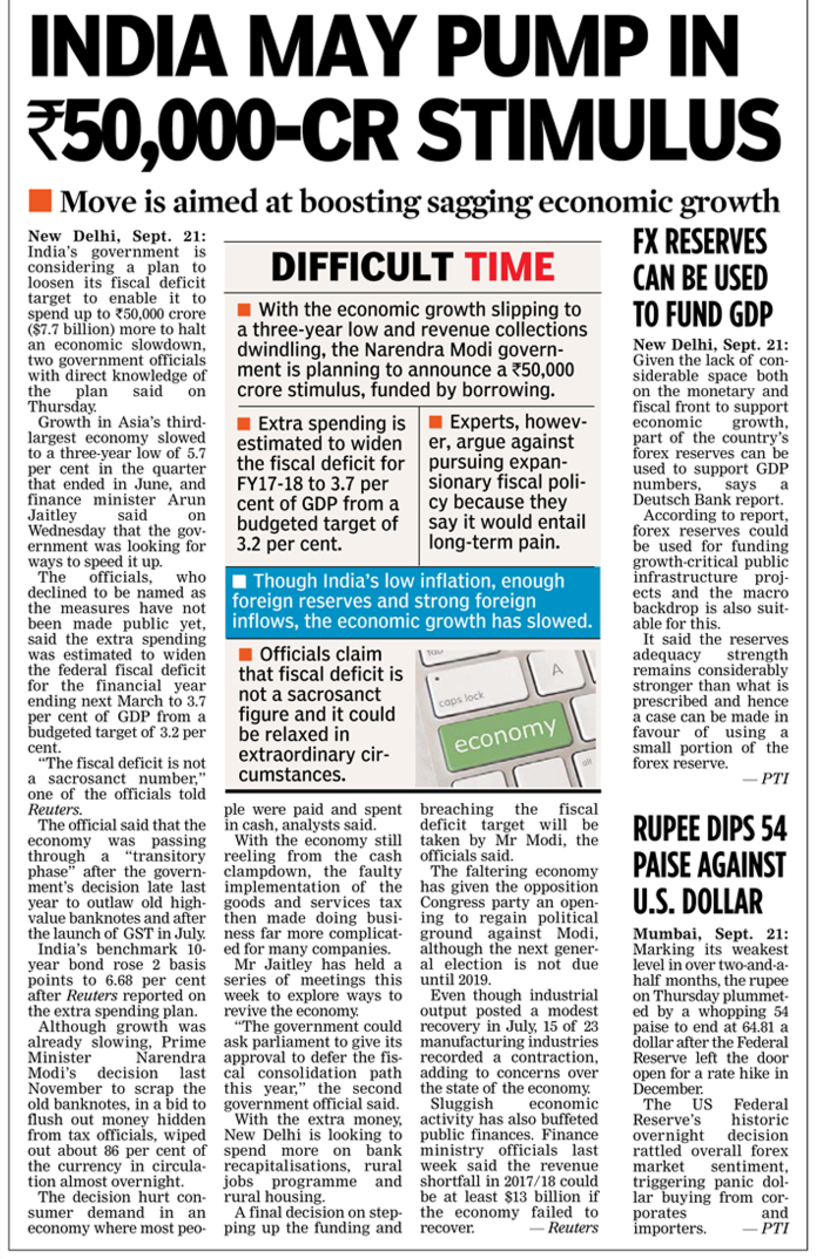
Jaitley's Rs.50K stimulus package. Will it work?


  • Arun Jaitley more or less announced Rs.50,000 economic stimulus package by loosening fiscal deficit from 3.2 to 3.7% to halt economic slow down which slipped from 7.1% to 5.7%. It was actually projected to grow from 7.1% to 8.1% this year but for demonetization, unprepared and hurried roll out of 'mangled' GST etc.
  • History and experience had shown that any where in the world 'stimulus packages' never yielded targeted results except giving some initial confidence boost.
  • Chinese government went on spending trillions of dollars since 2008 to boost its sagging GDP growth rate but ended up in piling up huge national debt and white elephant trophy projects which are even more difficult to maintain & service. GDP remained stagnant below 7%. 
  • This Rs.50,000 comes from printing currency notes which will result in higher 'inflation' which in turn hurts poor & poorest most. It tantamount to taxing the lower classes for the benefit of upper classes who gets the benefits. In other words we are following the economic model aptly described as "Socialize the risks and privatize profits". Ridiculous!
  • The 2009 US $787bn Obama's stimulus package had actully contracted economy by 2.8% and jobs saved were no where nearer to targeted saving of upto 2.3 million. Tax concessions which were expected to increase consumer spending have resulted in individuals saving those tax concessions in view of uncertain future. The Stimulus for small business helped create jobs. The aid helped, but many states were so underwater that their losses outweighed the federal assistance.
  • More than stimulus package which is a 'monetary policy', a 'fiscal policy' would give much better results rather little bit slowly. 

If you haven't done anything for yourselves, your life is not wasted.
In democracy, governments can't be overthrown; they collapse under their own weight.

If stimulus package solves problems, they why limit it to Rs.50,000 crores, make it Rs.5,00,000 crores. The caution indicates their doubts about results. A popular saying says 'if you are not sure of results, then don't do it'. Modi's senseless decisions of demonetization and subsequent unprepared, hurried and mangled GST roll out have hit the economy by several lakhs of crores of rupees etc are such undemocratic decisions that is short off war with common man. Consequences are surfacing incessantly there after. There is no escape from consequences of wrong doings. Stimulus package with a meager amount is another attempt to divert public attention and to claim government is responsive. What is needed is sound thinking, careful planning and meticulous implementation. None of the Modi's team members are good for anything. It doesn't require more than common sense to say that this stimulus package will not succeed and nation will be burdened and people impoverished. At best this will add some more fire to Modi's advertisement and publicity! Within three days of demonetization, it was amply clear that it was heading for colossal failure and arrogant Modi refused to take any corrective steps like restoring status quo ante or allowing old notes also to continue for at least three months. Instead he made impassioned appeal to people to bear the pain for 50 days and thereafter targeted results would be imminent. But what happened is 'all pain and no gain'. Even Supreme Court, the constitution protector, failed in its job by remaining a mute spectator by passing just a remark 'discontinuing of higher denomination notes appears to be carpet bombing and not surgical strike'. Modi is worse than VP Singh of 1990. One more foolish decision by Modi will be enough to see Rahul Gandhi as PM in 2019. 

Tuesday, 19 September 2017

Rahul Gandhi better than Narendra Modi

Rahul Gandhi's speech and Q&A at Berkeley
  • At UC Berkeley, on Sep 11, 2017, Rahul Gandhi critiqued the Government of India without resorting to insult or abuse.
  • Rahul was so disarmingly candid that the BJP government in Lutyens Delhi panicked and held a press conference to hurl personal insults at him. 
  • The final straw was the assassination of activist-rationalist-journalist Gauri Lankesh. It was  a planned murder by a trained shooter. Enough is enough. The gang in power must go.
  • Rahul is better than Modi and for that matter 'anyone is better than Modi'.
  • Rahul will lead the next government, given Modi's self-inflicted fatal injury of demonetisation that has pushed the economy into free fall, and given Modi's broken promises of job creation.
  • Rahul Gandhi is more dignified than the crass and nasty Modi. 
  • It is obvious to increasingly more voters that Modi's taunts and abuses were mistaken in 2014 for toughness and determination.
  • Modi's reliance on clever acronyms makes clear his disdain for wisdom. 
  • Demonetisation was not deliberated or calibrated, but an ill-advised move that Modi blindly jumped into.
  • Former RBI governor Raghuram Rajan felt that demonetisation would hurt the economy in the short-run without long-run benefits and was not offered the usual two-year extension of tenure; Modi prefers his own decisiveness to expert advice.
  • Calling Congress Vice President Rahul Gandhi "pappu" or "shehzada" does not behove someone occupying the Prime Minister's position. It is learnt that Modi has appointed 20 IT professionals to attack Rahul Gandhi in synchronised fashion, which is an act done in frustration.
  • The BJP rumour machine manufactures lies about Rahul (and he mentioned this at Berkeley). They say he is disinterested, he is reluctant, he would rather holiday abroad, that his sister is smarter, etc. The nastiest lies have been disproved in court, but unemployed trolls like Subramanian Swamy nevertheless continually recirculate them. To Rahul's credit, he does not get bogged down countering each and every bit of calumny.
  • BJP leaders had no right to attack the Congress, especially Rahul Gandhi, because the "ancestors of BJP" were working in connivance with the British Whereas Rahul's ancestors were fighting for independence of India and were jailed for prolonged periods.
  • Rahul is basically an introvert. This is a fact of life. Some humans are introverts. Despite being an introvert, he still manages to attempt a shake-up of India's oldest political party or to address massive election rallies.
  • He's not a bully. At Berkeley, he honestly answered questions from the audience. Modi, on the other hand, doesn't even meet the press, disparaging the media with such vehemence that his troll machine takes the cue and substitutes abuse for argument. Heck, Modi doesn't even take questions from his own partymen, as Member of Parliament Nana Patole said a fortnight ago.
  • Rahul will not hesitate to take aboard some strong hands when he forms a government. This is a clear contrast to Modi, an insecure man who can only head a Cabinet of duds. Even fellow traveler Arvind Panagariya had to leave.
A pessimist might say that even if Rahul as PM did absolutely nothing, he would still be better than Modi. The Delhi deputy chief minister who worries there will be no alternative to Modi in 2019 will be proved wrong. It is likely that Rahul's government will never plumb the depths of incompetence we currently see. 

Rahul Gandhi's speech even though well drafted but delivery and subsequent questions & answers were immaculate. He might not be a saint in the past, like any other politician in India, but there were neither untruths nor exacerbation. This reminds me of Rajiv Gandhi's press conference during his first visit to USA after becoming PM in 1980s which catapulted him to an invincible slot then. Kudos to Rahul Gandhi for taking up the onerous task of opposing the invincible Modi for 2019 general elections. While trouncing of UPA in 2014 was a historical necessity, defeat of Modi & BJP and saving India in 2019 is even more important than that.

GDP Growth rate precarious


  • Economic growth is caused by (1) an increase in aggregate demand and (2) an increase in aggregate supply.
  • While the increase in demand is linked to consumption and requires enormous liquidity. Where as supply increase to match increased demand requires investment and easy working capital.
  • With stagnant incomes in all classes resulted in demand decrease.
  • With stagnant private investment and fragile PSU Banks - working capital for industries is limited and supply side is also restricted. This also restricts exports.
  • With no jobs created during past three years economic activity remained stagnant.
  • Jobless growth & consumer spending growth are unsustainable beyond a point.
  • Infrastructure building remained stagnant.
  • Demonetization impacted informal sector sector and agriculture beyond imagination and about 5 million casual jobs evaporated.
  • GST roll out resulted in inventory reduction everywhere. Mangled GST badly implemented resulted in confusion and unscrupulous traders are collected higher GST and paying nothing to Government. At least 30% dealers haven't registered with GST but are actively collecting GST and pocketing the same. Cash transactions and GST evasion is on very large scale.
  • China recorded average GDP growth of 10.5% during 2003-12 but remained stable at 7.4% thereafter. This despite government's investment of trillions of dollars to enhance growth, which is unsustainable.

Modi & Jaitley should understand that country's economics are complex and there is no single pill to boost GDP growth. Having destroyed racing economy with demonetization and further impacting with mangled GST roll out without adequate preparation impacting economy greatly and GDP growth is limping at 5.7% which otherwise would have been close to 10%. Now Modi & Jaitley are facing dilemma with cash starved treasury and banks, boosting GDP growth is no easy task. With prevailing indicators revival is unlikely prior to 2019 elections.

Saturday, 9 September 2017

Chest thumping will come back to haunt us

  • Any monetary economist would say don't do it (demonetisation) until you have all the money printed.
  • If you take poll of monetary economists, they would tell you that on the day you actually do it, you should be prepared to replace as much currency as needed for transactions. Otherwise it will cause a reduction of economic activity.
  • Monetary economists would say, be ready to replace on day one everything that was used for transactions. A significant fraction of that, not all 86%, but enough so that anybody who wanted money will be able to take it out from ATMs.
  • There are channels through which government can by pass RBI legally (like 1978 demonetisation ordinance).
  • Ultimately if Governor disagrees - Dr. YV Reddy had a interesting response to what he would have done! - He said he would have gone to the hospital and then resigned on health grounds. Now some people can't go to the hospital they look the picture of health.
  • All bank accounts could be linked to Aadhaar, keeping in mind the privacy issues. There are privacy issues and there are issues of tax collection. So long as you make sure that every revenue officer cannot start fishing in that database and lot of it is automated and you can only go into it when those suspicious transactions are flagged and ordinary citizen's privacy is protected. That is the way to reduce the flow.
  • We have to recognise that we are dealing with the government employees as they are, not how we wish they would be. The reality is that there is some corruption in the government also. To give license to some areas of government (like tax officers) without checks and balances could enhance corruption.
  • If you look at digitisation, we saw a blip up and then looked down after the stress period was over.
  • India was growing at about 7.5 to 8 per cent at the point of demonetisation. We have come down substantially and some of this has been because of demonetisation. The world economy is going stronger than at this time last year and in that sense we should be going up with the tide and should have moved up with the growth. In fact, it has moved down. There are three factors: one is the stress in the banking system and the bad loan situation, the second is the demonetisation shock and the third is the anticipation of the goods and services tax (GST). At this point, our growth is not anything to write home about. Hopefully, these are temporary factors, but certainly we have to make sure that our business people feel more confident that there are no more surprises.
  • I don’t think the RBI has been undermined, because ultimately this decision belongs to the government. 
  • There has always been a tension between the finance ministry and the RBI. The finance ministry likes to believe that the RBI is one of its organs, and the RBI correctly believes that it is a Central bank and not just another regulator who is at the beck and call of the ministry’s bureaucrats. The tension about this is partly because the position of the RBI governor hasn’t been clearly established within the system. On the one hand, you have chief ministers saying ‘sir’ to you, and on the other, you have secretaries claiming that they have authority over you.
  • Constant bickering is not particularly good. It takes away from you the time you have to devote to more important things.
  • I was trying to say, ‘Let’s not be complacent’. We have problems; our real problems start when we thump ourselves on the chest and say how well we are doing and then don’t pay attention to the fact that there is so much more to be done. These things, like the thumping of the chest, will come back to haunt you. Let others praise you, let others give you kudos. But don’t keep boasting, because the media will take it up for a little while, but investors remember. My point was—here’s some good stuff but we have to be careful that we are not complacent. And it was taken here as me being derisive; that was clearly not the intent. We have to be much less boastful and much more focused on the work that needs to be done.
  • Our future, that this is the India you want to build, not an intolerant India.
  • As a public servant, you also have a public responsibility. 
  • You can’t stay in the job if you have serious differences with the government. 
  • When there is an environment in the public that has not been created by the government—but it emerges—then you have a duty to say that this is not the way we should go as a country.
  • There was a discussion of the Enforcement Directorate looking at over-invoicing, which was rampant. Why didn’t we go after that? That was very easy to catch.
  • There was no obligation on the government’s part to extend my tenure, and similarly, there was no obligation on my part to stay on. The University of Chicago was not the constraint.


Friday, 1 September 2017

Unemployment in India

Unemployment, irregular jobs and low salaries continue to hurt India while it continues to embrace labour reforms. Around 77% families have no regular wage earner and more than 67% have income less than Rs 10,000 a month. Unemployment is higher in urban areas, among women, among educated and in agriculture sector. A society where a large proportion of the labour force is unemployed suffers from poverty and vulnerability. An increase in unemployment reduces aggregate spending power, slows down the economy and it increases the vulnerability of households to deal with economic shocks. Govt's employment through various schemes like MGNREGA, at an expense of about Rs.48,000 crores, failed to remove unemployment problem due to corruption and bureaucratic apathy in implementation. 
  • Unemployment Rate in India averaged 7.32% between 1983 and 2013, with a high of 9.40% in 2009 and low of 4.90% in 2013. Unemployment in India is projected to increase to 17.8 million in 2017.
  • On Nov 22, 2013, as BJP's prime ministerial candidate Narendra Modi at an election rally in Agra had promised creation of 1 crore jobs every year if his party won the election. 
    The BJP manifesto stated that “The country has been dragged through 10 years of jobless growth by the Congress-led UPA government. Under the broader economic revival, BJP will accord high priority to job creation and opportunities for entrepreneurship.”
    After three years of government formation, job creation remains the worst failure of the government as the job creation remained lowest in eight years.
  • In 2015 only 1.35 lakh jobs were added, compared to 9.3 lakh jobs that were added in 2011-12 during UPA regime.
  • About 15 lakh jobs were lost in the first four months of 2017 as the number of employed people came down from 406.5 million to 405 million. Each year 12 million people enter the workforce and 65% of India's population are under the age of 35. 
  • Labour participation rate is a ratio of all adults willing to work, whether employed or unemployed, to the total population. This ratio was 48% in Jan 2016. It fell to below 45% in Nov 2016. Now it reached 43% in July 2017. Most Indians choose not to work. Low labour participation rate hinders economic growth.
  • There were only seven countries in the world that had a labour participation rate of 43% or less. These are Iraq, Puerto Rico, Moldova, Syria, Timor-Leste, Samoa and Jordan. Labour participation rate in China is 71%. The world average is 63%. Other major countries are Indonesia with a labour participation rate of 67%, Pakistan (54%), Nigeria (56%), Bangladesh (62%) and Philippines (65%).
  • In India, the unemployment rate measures the number of people actively looking for a job as a percentage of the labour force. In 2016, the country’s unemployment rate was 7.97%, with rural unemployment at 7.15% and urban unemployment at 9.62%.
  • Shift in the pattern of employment from permanent jobs to casual and contract employment has adversely affected the wages, employment stability and social security of the workers.
  • Why do so many Indians choose not to work? Indians are neither lazy nor rent-seekers by nature. The problem is in the lack of good jobs; in opportunities to work in a place where meritocracy rules and one can work hard with dignity and honesty for growth and prosperity. If such jobs are available in good numbers Indians will definitely choose to work.
  • A jobless growth is neither sustainable nor desirable. It is a dangerous trend that creates social tension and disharmony. It spreads further inequality, which may lead to societal collateral damage.  
  • It is the young who are losing jobs and it is the young again, who have stopped looking for jobs although they are unemployed. Young people are not ready to take jobs which are considered to be socially degrading or lowly. Such youngsters could easily stray into unlawful activities. 
  • Causes of unemployment in India: (1) Growth of population (2)Underdevelopment of the economy (3) Slow growth in the agricultural sector (4) Defective system of education (5) Absence of manpower planning (6) Degeneration of village industries (7) Inappropriate technology (8) Slow growth of industrial sector (9) Immobility of labour and (10) Jobless growth.
  • While unemployment is an important problem India faces, more serious problem is severe underemployment with workforce struck in low-productivity & low-wage jobs. Skilled people gets jobs easily and hence skill development among the youth is imperative.
  • Achieving higher economic growth, in the range of 8% to 10%, is necessary to solve the problem of jobless growth.

Very few governments think about youth unemployment 
when they are drawing up their national plans ... Kofi Annan

Long-term unemployment makes a worker less employable.

Quite often the unemployed youth commit crimes to earn their living. Due to lack of opportunities in India, intelligent youth migrate to foreign countries. Their intellectual abilities are used by foreign countries which causes loss to India. Unemployment impacted organisational practices. It has resulted in unfair and corrupt practices in organisations such as low wages, harassment, fake muster rolls etc. The attitude of some private sectors towards employees is unfair on account of availability of surplus labour. Modi after becoming PM had enjoyed touring the world and delivering charismatic speeches and playing rogue politics in India. Midway the term he unleashed senseless demonetization which didn't achieve any of its intended objectives but left nation and its poor suffer unintended consequences. Thereafter, mangled and hurriedly rolled out GST is impacting economy and GDP growth like never before. Demonetization and GST are responsible for GDP growth slipping from 8.1% to 5.7% instead of growing to over 10%. 1% GDP growth loss roughly means loss of 1 million jobs. While recovery is certain after few years, in the meantime poor, peasants and lower classes are paying bitter price for no fault of theirs and for Modi's wild & blind adventures. 

Wednesday, 23 August 2017

Unintended consequences

The law of unintended consequences, often cited but rarely defined, is that actions of people, and especially of government, always have effects that are unanticipated or unintended. Unintended consequences are outcomes that are not the ones foreseen and intended by a purposeful action. They could be beneficial, drawbacks and perverse results.

The first and most complete analysis of the concept of unintended consequences was done in 1936 by the American sociologist Robert K. Merton. He identified five sources of unanticipated consequences. Ignorance, error, imperious immediacy of interest, basic values requiring prohibit certain actions and self-defeating prediction or the self-fulfilling prophecy.

In medicine, most drugs have unintended consequences, or side effects, associated with their use. However, some are beneficial. For instance, Aspirin, a pain reliever, is also an anticoagulant that can help prevent heart attacks and reduce the severity and damage from thrombotic strokes. Famously, the drug Viagra was developed to lower blood pressure, with its main current use being discovered as a side effect in clinical trials.

The law of unintended consequences is at work always and everywhere. The law of unintended consequences provides the basis for many criticisms of government programs. As the critics see it, unintended consequences can add so much to the costs of some programs that they make the programs unwise even if they achieve their stated goals. A policy that protects one industry from foreign competition makes it harder for another industry to compete with imports.

If cars, trucks and buses start driving themselves, people who earn their living from driving these vehicles will suddenly find themselves out of a job. Loss of driver jobs in USA alone would be 4 million - which is more than jobs lost during 2008 Great Recession. Account for all the supervisory, management and support staff for these driving jobs and that number could double. Many of these workers are classified as low-skilled workers and it will be difficult for such unemployed workers to quickly find new work, and the cost of re-training them could be high. Another interesting consequence is that after a few generations, very few people will even know how to drive a car anymore.

An example of unintended consequence: Social Security has helped alleviate poverty among senior citizens. It has carried a cost that goes beyond the payroll taxes levied on workers and employers. Today’s workers save less for their old age because they know they will receive Social Security checks when they retire. It means that less savings are available, less investment takes place, and the economy and wages grow more slowly than they would without Social Security.

An unintended consequence of China eradicating sparrows costed 20 million lives in late 1950's: During the late 50s and early 60s, communist China's Mao Zedong undertook a benign ecological program to kill sparrows which ate the grain of the peasants. Mao knew nothing about animals. He didn't want to discuss his plan or listen to experts. He just decided that the 'four pests' should be killed. The masses of China were mobilized to eradicate the birds that resulted in the near-extinction of the sparrows in China. By killing sparrows, they eliminated the primary enemy predator of the locust. Without any natural predator the locust thrived. Grain production in most rural areas collapsed and a massive famine began. The resulting massive famine in China killed an estimated 20 million people. 
Politics is tricky; it cuts both ways. Every time you 
make a choice, it has unintended consequences 

Without reflection, we go blindly on our way, creating more 
unintended consequences, and failing to achieve anything useful

The worst unintended consequences are being faced by Indians consequent to senseless demonetization by Modi during Nov 2016. He did it just Mao's way - a quack advised & secretly planned in a most undemocratic and autocratic way surprising the whole world. The consequences are enormous including loss of lives of over 100 people. The brunt was borne by poorest, as usual. Read the opinions. While achieving none of its stated objectives, unintended consequences are growth slowed, informal economy brought to stand still, millions lost livelihoods, agriculture destroyed, banking sector ruined and so on. It was aptly described as most naive, least thought through policy decisions ever and a massive man-made disaster. Steve Forbes described it as "India's government perpetrated an unprecedented act of demonetization, that is not only damaging its economy and threatening destitution to countless millions of its already poor citizens but also breathtaking in its immorality...What India has done is commit a massive theft of people's property without even the pretense of due process, a shocking move for a democratically elected government." A vicious cycle has been set into motion by Modi and unpredictable problems and unintended consequences are bound to surface incessantly. It may take few years to come back to pre-Nov 2016 levels of economy. However Modi preferred keep Indians in denial by not answering Parliament, fudging economy's data, and publicizing its failure as successful and is the beginning of relentless fight against corruption. Ironically, Modi too is corrupt in many different ways, but much less compared to Congress and his Gujarat CM days were knows as Mr. 3%. His stature doesn't august well in the company of Adani's & Ambani's as well.

Friday, 18 August 2017

Modi's New India


Rolling stone gathers no mass

Modi has initiated so many schemes so far in the last three years namely Million jobs every year, Swiss bank black money, Anti corruption, profitable MSP to agriculture, Swachch Bharat, Make in India, Demonetization, GST and so on and few of them costed nation several lakhs of crores of rupees and none of them have achieved any of its intended objectives and nation is saddled with unintended consequences. Now he comes out with another slogan 'New India coming!' and no one knows from where it will come. On other hand Kashmir situation is at its worst, border standoff with China threatening imminent war are serious issues where nothing is being done. He neither owned up responsibility of failures nor regretted causing hardships to poor people of India with his quack advised demonetization and mangled GST implemented in a hurry. India with agriculture supporting 60% population and informal sector that provides 90% of jobs needs to be carefully nurtured, preserved and promoted. Modi in the pretext of bringing them into tax net is virtually destroying agriculture and informal economy causing loss of livelihoods to millions of people. His style and BJP's functioning has solid foundation on corruption next only to Congress and his anti corruption stand cuts no ice. With his rhetoric and mesmerizing speeches how long Modi will continue to cheat people of India is a matter of time which will not go on forever. In any case India will pay the price. 

You can fool some of the people all of the time, and all of the people some of the time, 
but you can not fool all of the people all of the time.


Saturday, 12 August 2017

Demonetization effect: RBI dividend to Govt halved


  • The RBI dividend  paid to the government is the lowest since 2011-12 (Rs 16,010 crore).
  • The RBI did not provide any reason for the decline in dividend. 
  • Economists said this indicated the cost incurred by the central bank in printing new notes as well as in sterilizing liquidity old currency notes that were scrapped returned to the banking system.
  • In the Union Budget for 2017-18, the government had accounted for a dividend of Rs 74,901 crore from the RBI and other nationalized banks. RBI’s share would be Rs 58,000 crore. 
  • RBI Governor Urjit Patel told a parliamentary panel that notes not returned remain the RBI’s liability and cannot be passed on to the government as dividend. 
  • The low actual dividends will exert pressure on the government and its fiscal deficit could increase from 3.2% of the GDP to 3.4% this year. 
  • At its peak, the excess liquidity parked by banks neared Rs 5 lakh crore, on which the central bank had to pay them 6% interest.  The average daily liquidity absorption continued to remain above Rs 2 lakh crore after demonetization was announced.
  • The appreciation of the rupee, 6% since Jan 2017, against the dollar depressed returns, in rupee terms, on the RBI’s foreign holdings.


Modi who highlights and bombards on media even smallest achievements are great, will never talk about such negatives. As Gujarat CM he neither owned up responsibility for massacre of over 2000 Muslims nor regretted it. So far, he has not talked about demonetization failure, its impacts and remedial measures taken for mitigating the problems it created to common people of India, especially in Parliament where he is duty bound to do so.

Growth may not be in 6.75-7.5% range: Economic Survey


  • GDP Growth during 2015-16 was 7.9%. GDP Growth during 2016-17 was 7.1% ... against anticipated 8.5% due to demonetization. 
  • GDP Growth during 2017-18 is projected to be 7.7%, but the Economic Survey has a pessimistic view on growth forecast with downward risk to the earlier estimated growth range of 6.75-7.5% GDP growth for 2017-18. Growth is expected to undershoot the earlier range.
  • CPI inflation to be below 4% by March this fiscal, which only indicates anemic condition of economy.
  • The challenges included are appreciation of the rupee, farm loan waivers, rising stress on balance sheets in power as well as telecom and transition issues arising from implementing the Goods and Services Tax (GST).
  • Fiscal slippages due to series of deflationary impulses that are weighing on an economy yet to gather its full momentum.
  • Farm loan waivers by states would touch Rs. 2.7 lakh crore and could cut economy demand by up to 0.7% of GDP.
  • Fiscal deficit will be 3.2% of GDP in 2017-18 as compared to 3.5% last fiscal.
  • Since February 2017, the rupee has appreciated by about 1.5%.
  • The bank NPA's rose from 9.2% in Sep 2016 to 9.5% in Mar 2017.
  • Reliance Jio’s entry with free voice and data has led to a brutal price war in the telecom industry, hurting revenue and profitability of incumbents amid ballooning debt, increasing the sector’s share of non-performing assets, which is a cause for worry, the Economic Survey said. Ironically, Reliance Jio was funded by same banks to the tune of Rs.1.80 lakh crores which has exposure in telecom sector to the tune of Rs. 5 lakh crores and their diminished EBITDA has lost its ability to service massive debt. 
  • A positive unintended consequence of demonetization is that about 5.4 lakh new tax payers* have joined the tax net post note ban, which probably could have been achieved even without note ban.
    *mostly between Rs.2.50 & Rs.3.00 lakhs taxable income with aggregate tax payment less than Rs.100 crores.


Even as the unintended consequences of  arrogant, audacious & attrocious demonetization of Modi are surfacing at regular intervals and estimated to normalize in about two years time, the hurriedly implemented mangled GST, with in six months of note ban, has created avoidable numerous troubles to trading, manufacturing and informal sectors disturbing supply chain of commodities is unpardonable another adventure by Modi for political and personal glorification gains rather than in public and national interest. Almost all segments of economy are suffering and the most prominent being loss of millions of jobs and distressed agriculture. For increasing speed of travel, if your car driver presses brakes instead of accelerator, again and again, what will you do? Simply change the driver. Right. Driver Modi must be replaced, if our nation needs to progress.

Friday, 11 August 2017

NPA's: Govt's all talk and no action

  • Infrastructure and capital-intensive industries are imperative for development but too difficult a responsibility for the private sector to shoulder because of long gestation period and low returns.
  • During financial year 2016-17, when demonetization disrupted banking activity, banking sector grew by just 1.7%, which was a 20-year low. 
  • Most of the banks involved in NPA's are public sector entities with the perception that the liabilities of these banks are backed by a sovereign guarantee, that has prevented a run on these banks.
  • The ratio of stressed assets to gross advances in the banking system has crossed the double-digit mark and few borrowers account for a large share of defaults. 
  • As banks are grappling with the defaults, they tried to retrieve themselves from this mess by lending more to potential defaulters or converting part of their debt into equity which did not work. On the other hand, the deficits on the balance sheets of these firms became even larger. When banks decide to make a case for liquidation to recover at least a part of their loans, the net assets were not even a fraction of the value of their exposure, especially since resources have often been diverted out of the firms concerned.
  • Bank NPAs are not a new issue, though the magnitude of the problem was revealed when Raghuram Rajan, the previous RBI Governor, imposed new guidelines on identifying NPAs. 
  • Given poor shape of public sector banks the price at which they could be privatized is likely to be indefensible.
  • The only way out is banks recapitalization by government and writing off NPAs and going forward diligently. Money lost once is generally irretrievable.
  • The new bankruptcy law, forces a settlement must be reached within 180 days. These 12 large defaulters account for around a quarter of NPAs and quick resolution of these NPAs even with a discount, that would reduce government's recapitalization requirements. Little is likely to be recovered from absconding individuals, like Vijay Mallya of Kingfisher Airlines. 
The reform-induced failure of the government to mobilize adequate resources, through taxation or borrowing, to finance capital expenditure is the root cause of the current bank's crisis. Private sector firms borrowed high value banks funds and invested in infrastructure and capital intensive projects with long gestation where the profits have been volatile and difficult to come by, and firms have found themselves unable to service their debts. Today almost all infra and public utility companies are in red. Restructuring of debt etc works rarely and generally postpones collapse of firms and banks. Most important problem is inflation of project costs, corruption and siphoning of funds by promoters. It is well known that promoters take back their investment, albeit illegally, even before project construction takes off.

Tuesday, 8 August 2017

GST and KCR's outbursts

  • In November 2016, KCR was the first non-BJP/NDA chief minister to support Modi's demonetization move. Telangana was the first state to pass the GST legislation on Apr 16, 2017. TRS extended unconditional support to BJP's  Ramnath Kovind as NDA's Presidential nominee and Vice President candidate.
  • The dalliance between the ruling TRS and the BJP has practically ended with the completion of elections of the President and the vice-president. While the change in tone of KCR may appear at the outset to fight the GST, the battle between the Modi and TRS governments is about much more than what meets the eye. 
  • GST Council has already lowered GST rates on  public utility and infrastructure projects from 18% to 12% as requested by several states in its first meeting. The Telangana state government has been asking the Centre not to levy 12% GST on the public utility and infrastructure projects. Telangana wants these projects to be taxed at 5%. 
  • Under GST, the tax rate on cement, steel, and concrete — all key ingredients for the projects — has been reduced. This benefit will be pocketed by EPC contractors.
  • Due to GST @12% in place of VAT @5%, Telangana government will have to bear the additional burden of Rs.19,500 on all ongoing public utility and infrastructure projects which are worth Rs.2.30 lakh crores.
  • Telangana CM K Chandrasekhar Rao declared Goods & Services Tax (GST) is a failure in several Nations. He made it clear success of GST in India depends on how well Centre handles the concerns.
  • Now the CM KCR decided to write to Prime Minister Narendra Modi to reduce 12% GST on the ongoing projects. Rao held that since the project estimates have been prepared keeping in view 5%  VAT, it is not possible to change them. He had "threatened" that the state government would engage in a "legal battle" in Supreme Court against the union government over the issue.

KCR walking extra miles to please Modi, devoid of merit and for unknown reasons, in matters of demonetization, GST, President & Vice President elections and expecting all he wants from Modi is not only naive but also stupidity. Modi is only a taker but never a giver. Ask Naveen Patnaik how much he got extra for Odisha from Modi, during past 3 years. Literally zero. The impacts of GST and its rates were well known in advance. Going forward states will become like municipalities of centre with very less freedom to mobilize funds. Centre will become extremely powerful with no direct responsibility of people welfare where as states will become extremely powerless and saddled with total responsibility of people's welfare. This is in contradiction of federal polity of our constitution. Ambedkar's fears of abuse of constitution without amending it are coming true in Modi's India.

Wednesday, 2 August 2017

India losing its way, 70 years after independence

  • In 1960, an American writer predicted that in an unstable India no outsider will be able to say with assurance where political legitimacy resides.
  • Three years earlier, C.Rajagopalachari had predicted that “the centrifugal forces will ultimately prevail”, bringing anarchy or fascism. Older generation people, who had survived partition, mournfully surveyed the country’s future, some even hoping the British would come back.
  • Even in 1969, India relied on wheat given away by America, and a “guest control order” specified that only 50 people could be invited to parties where food was served. To travel abroad, Indians required the approval of the Reserve Bank.
  • India has not reduced poverty levels as dramatically as China. Still 250 million Indians live on less than four dollars a day, but the progress since the British left has been impressive.
  • In 1947 life expectancy was 32 years, now it is 68. The per capita income in India was $439. Now it is US $1861, an all time high and was at record low of US$ 304 in 1960.
  • In 1947 only 1,500 villages – a mere 0.025% – were electrified; now 97% of 6.41 lakh villages have electricity. After two centuries of British rule, literacy in India was only 12% of the population and now 74% are literate.
  • Every change of government since 1947 has been via the ballot box, with the army never involved - something Greece, Spain, Portugal or even France can’t claim..

As its 70th anniversary approaches, India beset with fears? 
  • The way, since Narendra Modi’s astonishing election victory in 2014, the country seems to be turning its back on the tolerant, secular society India’s founding fathers wanted. 
  • Modi has always ridden two chariots: Modi’s real business of making India prosperous; and his Hindu business of appeasing his fanatical Hindu followers.
  • Some people are confident that Modi will change India for the better, and that the Hindu business will amount to nothing.
  • Yet Modi has proved a timid reformer, whose tinkering has included an overnight demonetization that led to such chaos that many people died.
  • His Hindu followers have been given free rein. This has seen a ban on the slaughter of cows, and a growing intolerance of minorities and their lynching.
  • Today in Mumbai, there is now a form of religious apartheid in housing. A Muslim client wanted to buy a flat in a suburb but the broker said “You are a Muslim. This building is not for Muslims. Hindus only.” 
  • In some parts of Mumbai, the most vibrant city, have become so segregated that “owners say this building is for vegetarians only, so no Muslim, Christians, Jews, Parsis or even meat-eating Hindus”. Ironically 31% of Indians are vegetarian and 69% are non-vegetarian.
  • In Mumbai of the 50's and 60's, all faiths lived side by side. 

Narendra Modi: Is he India's saviour, or sectarian with blood on his hands?