Showing posts with label Jobs. Show all posts

Tuesday, 4 September 2018

Modi's adventurism

Adventurism is a pejorative term referring to politics or activism that involves reckless and  irresponsible behavior or conduct pursued only in the interest of excitement. Adventurism is defined as an attitude or way of behaving that involves attempting to gain an advantage by doing things that are regarded as foolish or risky. Adventurism is often used as a criticism against some government's policies. Countries pursuing foreign wars of dubious merit or which have little chance of success have often been accused of adventurism by opponents.
  • By general consensus, the government was widely seen to have faltered on four major counts. It is accused of failing to tackle the over-hang of demonetization, poor implementation of GST, containing prices and inability to create new jobs. Positive endorsements from the IMF, World Bank, investment bankers and a few contrarian economists were contemptuously dismissed.
  • Notwithstanding Rahul Gandhi's assertion that he can fix the problems in six months, macro-economic interventions will take more than a couple of quarters to yield results.
  • It has been argued with some merit that many pain points in demonetisation and GST rollout could have been mitigated if the bureaucracy and tax-administration were better prepared and proactive.
  • Demonetisation is considered to be the biggest villain. There is no denying that demonetisation had worst affected deep rural, where the banking network is least developed. In the cities, small-towns and "urban" areas, the situation largely settled at a new normal in about eight to twelve weeks.
  • There is no disagreement among experts that GST was the mega tax reform that was long overdue. Considering the gargantuan scale of the exercise, it would have been naïve to expect a totally seamless transition. The Opposition had smelt an opportunity for muddying the waters and waylaying the government on GST. They were hoping the turmoil would carry through into the next fiscal year damaging BJP's prospects in 2019.
  • Inflation is the only area where Modi government's performance has been the best. This is also largely due to low oil prices for over three years resulting in narrowing of the twin deficits. No magic wand with Modi, it just happened. Nevertheless, credit goes to Modi & Jaitley.
  • Very high petrol & diesel prices despite lower crude oil prices and thus depriving consumers the benefit of dynamic pricing is a false step that will become a poll plank against Modi. 
  • Without any doubt, job creation remains the most serious of the four weak spots in Modi's portfolio. But there are no quick fixes for it. The Congress and the UPA bought time on it with doles like MNREGA.
  • Long-term job creation will come only through the next wave of reforms - especially on the fronts of labour legislation and land acquisition laws. But the government does not have either the time or political capital left for further economic adventures so late into its term. So, jobs will have to wait till 2019 for a real take-off.
  • What the government cannot afford anymore are governance boo-boos and fiscal adventurism. 

NDA government's policies and actions are nothing but a divisive, destructive and disruptive propaganda. The country is in the grip of communal politics and there is no contradiction between communalism and development. BJP attempts communalism by uniting the largest group and compelling minorities to join the mainstream as politically junior partners but forgets that we are a nation of diverse cultures, sects and religions and can only stay united with a secular thread of humanity and protection of minorities.  BJP failed in fulfilling most promises made in its election manifesto especially remunerative prices for farm produce. People are disillusioned with their false promises as seen by the recent by-election results held in different parts of the country. General elections are just eight months away and BJP is on perfect slippery slope, due to its own arrogant, audacious and ill conceived adventurous actions.

Sunday, 18 February 2018

'Pakorawallah' and Modi's mind game for elections 2019


On Nov 21, 2013 while addressing election rally in Agra, BJP's Prime Ministerial candidate Narendra Modi promised to provide one crore jobs to the youth of the country, if voted to power at the Centre. He became PM in 2014 and at the end of his 4 of 5 year tenure, Modi stares at elusive jobs against the backdrop of debacle of his disruptive reforms like demonetisation, GST etc and growing realization that the government will not be able to create formal jobs for over 6-7 million joining the country’s workforce annually. In 2016-17, actual jobs created were just 4.1 lakh as against the BJP’s electoral promise of creating one crore jobs annually. Unable to destroy non-tax paying informal sector and expanding tax paying formal sector, Modi is now embracing informal sector for his 2019 electoral campaign. 'Pakorawallah' is an indication of his newest mind game.
  • Creating jobs is India’s biggest worry and it will only get worse. 
  • India is expected to have 100 crore people aged between 15 and 64 years of age by 2027, which means the world’s largest and youngest workforce. As the economy progresses, millions of people employed in low productivity farm sector will have to be moved to higher-productivity non-farm jobs. Barring China, this scale of migration has no precedent in history.
  • India’s self-employed is and will remain humungous. Self-employment is common in India. Sometimes, it is out of choice but more often it is out of compulsion. 
  • They represent 47% of India’s 470 million workforce. They include street vendors, rickshaw pullers, carpenters, plumbers, chaiwallahs, grocers, taxi drivers, doctors, accountants, pakorawallahs etc. Most of the self-employed are below the economic radar. 
  • The scope of tax evasion makes informal sector even more attractive. 
  • They are homeless, office-less and unbanked. They are vulnerable and footloose and live on the fringes. They rarely figure in government policies or statistics, or even statements. 
  • Self-employed is not a homogeneous group. Income instability is their biggest problem. One serious illness can set them back by several years.
  • With economic growth regular and casual workers have risen while the number of self-employed has dipped. ILO says 77% of Indian workers will be engaged in vulnerable employment by 2019.
  • Last month, self employed pakoda sellers made headlines when Modi said, “Youth selling pakora outside… and earning Rs.200 a day also means creation of jobs.” 
  • The Economic Survey 2018 defines formal employment as, one, where the employers are providing some kind of social security (like EPF and health or life insurance) to their employees, and, two, where firms are part of the tax net. According to the first definition based on social security, 31% of India’s non-agricultural workforce, 75 million out of an estimated at 240 million, have formal employment. According to the employers-in-the-tax-net second definition, 54% (or 127 million) of the non-agricultural workforce is in the formal sector. What is it Modi is trying to convey by redefining 'employment' with his own way?
  • Mudra loans are disbursed for non-agricultural activities, including dairy, poultry and beekeeping. 90% of the loans to over 10 crore beneficiaries in last three years were under the ‘Shishu’ category averaging Rs 43,000. Labour ministry might be working out a formula under which 40-50% of the 104 million beneficiaries of the Pradhan Mantri Mudra Yojana could be bracketed as employed.
  • If India has to progress, mainstreaming its 470 million self-employed will be an important stepping stone. Modi knows that confronting unemployment head-on rather than sidestepping it may be a smarter strategy.
  • India’s IT industry is in a crisis, with technological changes forcing them to pivot or perish. Almost 65% of its 4 million IT workers are not retrainable and runs the risk of losing jobs.
  • The degree of disruption technology will cause, with the automation wave is certain to cull jobs. 
  • If we want growth with jobs, the push has to be on small industries, and not on the middle or the top. But the biggest beneficiary of initiatives like 'ease of doing business' will be the MSMEs who also bear the biggest brunt of the inefficiencies in the system.
  • India's employment elasticity – number of jobs created per percentage of GDP growth — has been among the lowest. It is now declining – from 0.3% between 1991 to 2007 has halved today. This is mainly because India’s growth, dominated by the services sector and not labour-intensive manufacturing, has a bias for skilled workers. 
  • The majority of India’s workforce is engaged in informal, unorganised, low-income, low-productivity jobs. This is not self-employment. This is self-exploitation. They need to be moved up from 'subsistence-based livelihood' to 'good self-employment'. Policy makers should focus on increasing formal wage employment and good self-employment. 
The Modi government, in its last year, is short on time. And India’s job seekers short on patience. In politics, perception management is as important as the change on the ground. Modi government likely to lean 'more on perception management' with narratives, publicities and media management rather than any change on the ground to face general elections in 2019. 


Political language makes lies sound truthful and murder respectable but Modi must remember that he can't fool all the people all the times despite his oratory skills and media management. Voters have their own way of understanding what is good for them and whom they should vote. Narratives and money power works some times only. Rajasthan bye poll results has already sent spine chilling message to Modi which is reflected by Amit Shah's lackluster postmortem analysis. Surfacing scandals is another cause for worry for Modi. Above all rising graph Rahul Gandhi gives him sleepless nights.


Wednesday, 31 January 2018

Helicopter money

The Bank of Japan is getting flak for not announcing it as part of its recent stimulus package. ‘Helicopter Money’ is an idea that is doing brisk rounds in global economic circles.

What is it? 
Helicopter money is an idea mooted by Milton Friedman in his paper ‘The Optimum Quantity of Money’ in 1969 for governments looking to lift their economies out of a slump. “Let us suppose that one day a helicopter flies over this community and drops an additional $1,000 in bills from the sky, which is, of course, hastily collected by members of the community. Let us suppose further that everyone is convinced that this is a unique event which will never be repeated.” Friedman’s theory was that the lucky citizens, thrilled with the windfall, would rush to spend. Higher money supply with no immediate change in output, would lift inflation. And improved consumer confidence would eventually prompt manufacturers to increase output and create more jobs, thus giving the economy a steroid shot to get it going.

Why is it important? 
In a bid to stimulate growth and fight deflation, governments have effected cuts in interest rates, turned to negative rates and unleashed many rounds of the infamous QE or Quantitative Easing. But GDP growth rates, whether in the US or Eurozone and Japan remain stubbornly low. Hence the recourse to more direct methods, like helicopter money.

Putting cash directly into the hands of consumers, it is hoped, will quickly kick-start a virtuous cycle of consumption that can boost up GDP. This is something that indirect QE, which transferred liquidity to banks in order to step up lending, couldn’t achieve. 

Of course, helicopter money, in today’s sophisticated world may not really have Phillip Hammond or Janet Yellen scattering bagfuls of cash from a helicopter. Instead, the British or American governments may decide to give tax refunds or tax credits or even make direct cash transfers to identified citizens. Some devious economists have even suggested pre-loaded smart cards with a certain amount of cash. If citizens don’t spend it within the specified time, the cash will simply disappear!

Why should I care? 
Sounds like a great idea! So when will the Indian government take to helicopter money to boost the economy? Alas, with the RBI watching over inflation and deficits like a hawk, this isn’t likely anytime soon. But we Indians can take comfort from the fact that we thought of helicopter money long before others did. MGNREGA paid cash to rural folk for 100 days of guaranteed work. In cases where that money went into benami accounts, that’s a form of helicopter money. On a more serious note, the excise duty cuts on cars and consumer goods announced in 2008-09 after the global credit crisis were a version of helicopter money too.

What about Pay Commission payouts? Well, strictly speaking, that cannot be termed helicopter money as it is recurring, and paid as reward for work. But these payouts can certainly serve the purpose of helicopter money.

The bottomline 
Helicopter money sounds wonderful, but it works only when people spend the money. Question is - will they hoard it?


While the developed countries have been fixated during the last decade on ways to put more money in people's pockets to stimulate demand, India without any due diligence decided to go the other way, and freeze out a bulk of its citizens' purchasing power by demonetisation. What was supposed to be a surgical strike against tax cheats and counterfeit currency became an attack on the large informal economy that ran on cash and carpet bombed the whole economy. The evil thinking was that about Rs.5,00,000 crores would not get deposited in banks by the people holding unaccounted money and the bonanza would be used recapitalize the banks saddled with NPA's. But in the end, almost all of the cash came back. There was absolutely no need to demonetize the economy in order to recapitalize banks. It's no coincidence that a new GST, implemented was supposed to create a common nationwide market by removing a complex web of local taxation. But when it became operational in July 2017, the single market became a side show, and the tax itself became an enforcement mechanism debacle. Like in the West, where a decade of monetary adventurism has altered people's portfolio choices and made risky assets frothy, India has reached the same end point, by flying the money helicopter in reverse. Unlike quantitative easing, which is a reversible stimulus for the demand side of the economy, India's cash ban and now the GST are seeking to permanently alter the supply side. An ebullient stock market is merely betting this experiment will succeed. But increasing the speed in wrong direction and expecting desired results is insanity.


Sunday, 28 January 2018

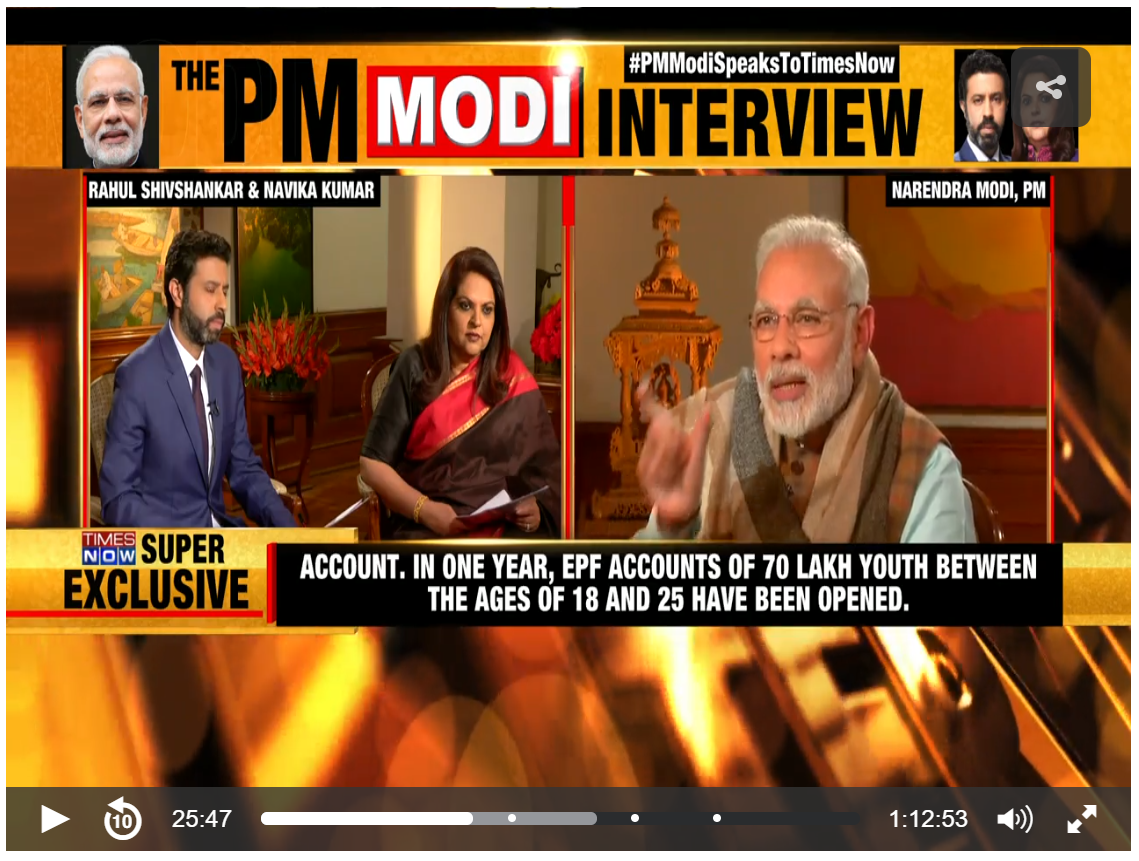
70 lakhs jobs in 2017 - a blatant bluff


Prof Pulak Ghosh and Dr Soumya Kanti Ghosh created a minor storm when they claimed that 70 lakh new ‘payroll’ jobs will be created in India in the organised sector in 2017-18. They reported that the EPFO manages a corpus of over Rs 11 lakh crore for its 550 lakh subscribers. According to the authors, 45.4 lakh new subscribers in the age band 18-25 years had enrolled under the EPFO in 2016-17 and started making their monthly contributions to the Fund. They also found that 36.8 lakh new subscribers in the same age band had enrolled between April and November 2017 and, therefore, they estimated that, for the full year 2017-18, 55.2 lakh new subscribers would be enrolled.
  • Seventy lakh new jobs is a claim that will take one’s breath away. The total ‘payroll’ stock as on March 31, 2017, was 919 lakh. It has taken the country 70 years to create a ‘payroll’ stock of 919 lakh jobs but, miraculously, in just 12 months, the country will generate 70 lakh new ‘payroll’ jobs — that is nearly 7.5 per cent of the current stock!
  • By comparison, China with a GDP five times that of India, adds about 150 lakh jobs a year.
  • If organised sector that employs 20 or more persons can generate 55 lakh new jobs in a year that qualified for enrollment under the EPFO, then we can declare that India has truly and comprehensively slain the demon of unemployment!
  • If we assume that for every ‘payroll’ job counted by the authors there will be another job created in the informal sectors, then the count will rise to 140 lakh in 2017-18. According to the Ghoshs’ report, 150 lakh persons enter the labour force every year of which 66 lakh is skilled manpower. Soon, the problem will not be joblessness but lack of jobseekers!
  • The authors also pointed out that the limited data available in the public domain indicated that the number of contributing members in the EPFO grew by 7% in 2014-15 and 8% in 2015-16 but, according to the Ghoshs’ report, the number jumped by 20% in 2016-17 and by a further 23% up to December 2017.
  • The EPFO data indicates that the number of contributing members decreased from 4.62 crore in July to 4.38 crore in September this year (2017).
  • The PM Modi referred to the MUDRA scheme and said “over 31 million loans have been sanctioned to entrepreneurs. Even if conservatively each enterprise creates one sustainable job, this initiative itself amounts to 31 million new jobs.” Alas!
  • It seems Modi is intentionally confusing by mixing up self employment' as jobs and misleading. While a 'job' is certain, regular and reasonably secure, self employment is not. What we are talking about is jobs in formal sector.
  • If we equate self employed, under employed and casual employed as job holders, then there is neither unemployment nor joblessness.
  • Labour participation rate is a ratio of all adults willing to work, whether employed or unemployed, to the total population. This ratio was 48% in Jan 2016. It fell to below 45% in Nov 2016. Now it reached 43% in July 2017. Most Indians choose not to work. Low labour participation rate hinders economic growth. Labour participation rate in China is 71%. The world average is 63%. Other major countries are Indonesia with a labour participation rate of 67%, Pakistan (54%), Nigeria (56%), Bangladesh (62%) and Philippines (65%).
  • The 70 lakh jobs claim, as claimed by Modi, is not only a misleading boast but also a blatant bluff.

PM Modi’s recent assertion that a person earning Rs 200 a day by selling pakodas is also employed. The fact that the prime minister actually celebrates this kind of ’employment’ as a major success of his Mudra scheme is even more worrisome. It is not a pride that millions are managing to eke out a meagre income. Instead it should be seen as a sign of under-employment.

India is witnessing jobless economic growth during the past three years and the government doesn't know how to create jobs and hence making all false claims and propaganda. Demonetization and GST's faulty roll out have had destroyed informal sector employment. MNREGA was able to provide just 50 days of work against guarantee of 100 days. Mudra loans aimed at promoting  micro enterprises averaging Rs.43,000 is just useless and serves very little purpose. We all know that politicians speak lies, nothing but lies but we do expect Prime Minister to be truthful to the nation.


Thursday, 4 January 2018

Advertising

  • Advertising is a means of communication with the users of a product or service. Advertisements are messages paid for by those who send them and are intended to inform or influence people who receive them to buy their products or services.
  • Advertising is attempting to influence the buying behavior of customers or clients by providing a persuasive selling message about products and/or services.
  • Politics is what happens when two or more human beings interact. Every organisation is political, and everything it does involves politics. Advertising itself is an intensely political activity. 
  • The phrase “The customer is always right” was originally coined by Harry Gordon Selfridge, the founder of Selfridge’s department store in London in 1909, and is typically used by businesses to: (1) Convince customers that they will get good service at this company and (2) Convince employees to give customers good service. More and more businesses are abandoning this maxim because it leads to bad customer service.
  • Advertising encourages more consumers to buy products and services. As the demand for products and services goes up because of advertising, more people are needed to manufacture, supply, ship and test those products and services. Thus, more jobs are created.
  • Advertising positively impacts society because it helps maintain mass communications media, i.e. newspapers, radio, magazines, and television making them much less expensive for the public.
  • Advertising aims to present a product in the best light and the dramatization usually crosses the line into falsely representing a product.
  • Political advertising is vast and multifaceted. Conventional wisdom holds that political advertising in general  and negative advertising in particular  is harmful to democracy.
  • Advertising plays an essential role in the production of consumerist demand by inventing false “needs” and by stimulating the formation of compulsive consumption habits, totally violating the conditions for maintenance of planetary ecological equilibrium.
  • Children do not have the ability to identify advertisements as marketing messages until they are in their teens. This means that marketing messages can be perceived as truths and those messages can stay with them until they become adults.
    In a study, the effects of branding were looked at and 3 to 5 year olds were given two portions of identical foods. One portion was given in McDonald’s wrappers. When asked to point out which foods tasted better, the children said that the ones with the McDonald’s wrappers were better.
  • Advertisement leads to branding and branded products are not only expensive but also taxed more although they seem to be more clean, less adulterated and higher quality.
  • An average child is exposed to over 40,000 commercials through TV every year. Children are spending more time watching TV than they are in school, meaning that they are viewing more advertisements.
  • Consumption of fast foods has increased among children due to the advertisements. The rising popularity of fast foods and snacks has led to an increase of obesity, heart problems, diabetes and other serious health issues among children. Young and healthy-looking models are used, hiding the fact that these foods are some of the unhealthiest in the world.
  • Many advertisements these days use beautiful young women to attract buyers. This will no doubt have a seriously negative effect on how children think. From chocolates to clothing, almost every ad seen is sexual in nature. Children then think that they need to look that way to be accepted.

The customer is always right until she or he chooses not to buy.


In today's intensely competitive world of consumerism most advertisements are eye catching with slogans. In colorful advertisements, untruths are glorified and truths appear in small print. Children should be protected from the ill effects of advertisements. Consumer awareness is important for understanding and evaluating the product will meet their requirements or not. Buy only what you really need. While in doubt, don'y buy - especially if it involves credit card loans or bank personal loans. 


Thursday, 12 October 2017

Joblessness: Modi's Achilles' heel of 2019 elections

  • In 2013 election campaigning, Modi PM candidate of the BJP, at a rally in Agra thundered "If the BJP comes to power, it will provide one crore jobs every year" which is now haunting him.
  • In May 2017, a Labour Bureau quarterly report noted that a mere 230,000 jobs were created in eight key sectors from Apr-Dec 2016, a far cry from Modi's 2013 promise. This, when over a million aspirants enter the Indian job market every month. 
  • The GDP growth slipped to 5.7% in the Apr-Jun quarter, the lowest in three years, with manufacturing growing at a five-year low of 1.2%, from 10.7% a year ago.
  • CMIE estimates that about 1.5 million jobs were lost during January-April 2017, the first quarter after the Nov 2016 demonetisation exercise. Worse, India is set to see a further 30-40% reduction of jobs in manufacturing compared with last year.
  • With a general election in less than two years, the dearth of jobs could prove the Achilles' heel of the Modi government, rein in the high prices of essential goods and rectify anomalies in the GST. 
  • RBI, in its monetary policy statement on Oct 4, reiterated the need for recapitalising banks.
  • Currently 30,000 new youngsters are joining the job market every day, yet the government is creating only 500 jobs a day - Rahul Gandhi said, even as he admitted that the UPA government too faced the same challenge.
  • India could have been sailing smoothly at 10% plus growth, but for the spate of disruptions, including demonetisation, GST, RERA and the new bankruptcy norms. Individually they may carry a broad range of benefits, together they have inflicted collateral damage much more than was anticipated.
  • The real estate sector, which creates 1.5 million jobs, has been the worst hit. Home sales fell 26% in the Delhi-NCR in the first half of 2017 as demand nosedived post-demonetisation. Unsold inventory in the Delhi-NCR stood at 180,000 units and it will take developers four-and-a-half years to sell it.
  • As many as 67 textile units are reported to have shut down across the country, rendering 17,600 people jobless.
  • In Nov 2016 Larsen & Toubro sacked 14,000 employees, 11.2% of its workforce, as business slowed down and digitisation left many employees redundant. IT companies, including Tech Mahindra, Wipro and Cognizant, laid off tens of thousands of staff as global business grew tougher. HDFC Bank laid off 11,000 workers over three quarters citing digitisation. Yes Bank eliminated more than 10% of its workforce citing increased redundancy, poor performance and the impact of digitisation. Hiring intentions in corporates are 20 percentage points lower year-over-year. In the informal sector lakhs of workers go jobless as construction projects dry up given the unprecedented investment slowdown.
  • Manufacturing was stuttering despite the government's high-decibel 'Make in India' campaign. Acquiring land for setting up manufacturing units continued to be tough. Private investment growth has been falling since 2012. The country still ranked a low 130th in the World Bank's ease of doing business rankings.
  • India's job challenge is staggering, to put it mildly. The country needs to create 16 million jobs a year for the next 15 years to take advantage of its demographic dividend.
  • In key areas like textiles, India has ceded its leadership to countries such as Bangladesh and Vietnam.
  • Adding to the manufacturing woes is the implementation of new digital technologies like the internet of things, cloud computing and artificial intelligence in the manufacturing process, making traditional jobs obsolete. These technologies with a squeeze in services, are affecting IT jobs too.
  • Sectors like construction, real estate, power, energy, infrastructure are destroying jobs. There has been a 30% decline in job creation since 2007-08 in these sectors.
  • Short-term job creation looks near-impossible since we have been focusing on the wrong kind of manufacturing for 60 years, and are now paying the price.
  • Bank credit has fallen by 50 per cent. New projects are not coming up as private investment is drying up. Focus on construction will also boost the steel and cement industry. Construction and infrastructure can boost economic activity and jobs substantially, but they have been marred by time and cost overruns. As critical as supporting giant projects is extending help to small entrepreneurs. 
  • Recapitalisation of banks can also help them lend to businesses, given that bad loans to the extent of Rs 7.7 lakh crore have weakened their capacity to lend.
  • IT is losing its sheen as a significant job provider, with markets such as the US becoming more protectionist. Technological advances are also rendering the work force obsolete at a faster clip. 
  • This could be the right time to boost consumption through lowering interest rates or giving government subsidies to certain businesses.
  • Reviving the informal sector remains the biggest challenge. It's impossible to gauge the extent of joblessness given paucity of data. There is simmering discontent waiting to explode that we must prevent. We must act now.
  • The government has also increased budgetary allocations for anti-poverty programmes and rural employment generation schemes. The highest ever allocation under the MGNREGA was made during 2017-18. About 51.2 million households were provided employment during 2016-17.
  • The larger debate continues to be over what India should focus on: manufacturing or services. Growth in the recent period has been driven by services, which in itself was owing to substantial inflows of foreign finance. India needs rapid manufacturing growth fueled by both export growth and expansion of the domestic market. 
  • Today's joblessness is similar to that of late 1960's which prompted PM Indira Gandhi to amend Apprenticeship Act in 1973 to include training of graduate and diploma engineers as "Graduate" & "Technician" Apprentices and to mitigate their problem.
  • Jobs will remain a thorn in this government's side which appears unsolvable and will have telling effect in 2019 elections. 

Good or bad aside, during UPA regime GDP growth benefited all, despite corruption and scams except 2008 global recession and 2013 economic dip. Modi riding the wave of anti incumbency and joblessness became PM in 2014 and instantly forgot his promises and commitments. He focused on foreign jaunts and blaming predecessor and did nothing for next two years. The advantage of low oil prices since 2013 was squandered away. Without even discussing with economic experts, he ventured on quack advised demonetisation and mangled GST roll out without adequate preparation and keeping away keys sectors out of GST and economy plunged into distress and millions jobs lost. Banks recapitalisation was given a miss and today banks do just retail banking only. In 2017 almost all economic parameters are worse than in 2013 and nothing much is likely to happen in next two years prior to 2019 elections. Modi & BJP are certain to pay price for their arrogance and incompetency. 

Sunday, 4 June 2017

Anti Slaughter Rules

  • The Government of India's innocuous sounding amendment, ‘Restrictions on sale of cattle’ promises to be the final death knell of cattle and buffaloes in India, and along with them, the destruction of what little remains of a dignified life and livelihood for farmers.
  • The rules defines ‘cattle’ to mean “cow, calf, bull, bullock, buffalo, heifer, steer and camel”.
  • The notification is another instance of the ‘mischievous and deceptive’ law-making practice involving camouflaging a controversial provision with seemingly progressive and innocuous provisions in order to deceive and mislead the general public.
  • The notifications breaks the steady supply of cattle to slaughter houses and operations and beef exporters.
  • The rules will hurt mostly Muslim traders who face mounting violence by increasingly assertive cow vigilante groups. Farmers will also be hit because they will be deprived of a traditional source of income from selling non-milch and old cattle. Farmers who can't take care of their cattle will have to pay for their upkeep in shelters.
  • The move introduces lots of paperwork for cow traders who are mostly poor and illiterate. Before the trade, both seller and buyer will have to produce identity and farmland ownership documents. After buying a cow, a trader must make five copies of proof of sale and submit them at the local revenue office, the local veterinary doctor in the district of the purchaser, animal market committee, apart from one each for seller and buyer. An insanity at its best!
  • Slaughtering means 'the act of killing or butchering of livestock for market';
    Cruelty means 'disposed to inflict pain or suffering'.
  • By equating ‘slaughter’ with 'cruelty' and criminalizing the trading of animals for slaughter at animal markets as an act of cruelty, the central government has enforced a country-wide ban on the slaughter of buffaloes and cattle, leather industry and the consumption of beef.
  • These new rules choke the free movement of animals via the markets undermining the freedom and rights of farmers, traders and all others whose livelihoods are linked to this production cycle that sustains cattle and buffaloes of this country.
  • It is pertinent to note that the Act does not prevent slaughtering of animals. The Act permits destruction or killing of animals for the purposes of food on the condition that such destruction was not accompanied by unnecessary pain and suffering. Slaughter houses which slaughters 90% of cattle, sources cattle from middlemen & animal markets which will now become defunct with this ban order.
  • The dairy farmer's life and livelihood are at stake because 40% of a dairy farm’s income is derived from the sale of unproductive cows & buffaloes.
  • The assumptions that (i) there is always a farmer ready to purchase another’s cow or bullock and (ii) a farmer will be willing to retain or buy an unproductive cow, buffalo or bullock are totally false. 
  • During drought times, everyone looks to sell their cows and bullocks for want of water and fodder and the farmers gets a reasonable price in the market because of traders involved in the trade of animals for slaughter.
  • Indian beef is in great demand in the world market because it is cheaper and India is the largest beef exporter.
    - Meat exports are over 1.3 million tonnes per annum of which 95% is beef..
    - Meat exports industry is Rs.27,000 crores pa.
    - Leather market is estimated at Rs.40,000 crores pa.
    - Dairying is Rs.80,000 crores pa.
    - Cattle trading is the livelihood of about 15 million Muslims.
    - About 35 million people depend on slaughtering, beef & leather industry.
    - In all, 50 million people are dependent on cattle related businesses.
    - Majority of rural population supplement their meager incomes with dairying.
    - Most workers in leather industry are Dalits.
    - Only 10% of buffaloes heads for slaughter houses.
  • The number of animals in milk - cows & buffaloes are about 100 million. Out of which approximately 10% i.e. 10 million unproductive cows & buffaloes are slaughtered every year. With this ban, who will provide grass & feed to this 10 million unproductive cows & buffaloes? There is no mention  about this in Modi's ban order.
  • Slaughtering and the markets for beef and leather, complements dairying. Farmers rear cattle for dairy or as work animals, and when they become non-productive, the have value for its beef and skin used for leather. Beef is a by-product of dairying and draught, is another aspect of livestock economy.
  • If today the slaughter of cattle and buffaloes is considered an act of cruelty, then it will be only a matter of time before the sale for slaughter of sheep, goats and poultry will also be forbidden. With the food preferences of the majority of citizens who eat meat and a massive number of livelihoods at stake, this highly contentious interpretation of cruelty needs to be interrogated and challenged.
  • While Europe, Australia, New Zealand and the US are waiting to dump large volumes of subsidized milk powder into India, and Indian dairy cooperatives fighting hard to stop this, it is extremely foolish of the government to literally kill dairying in the name of animal welfare.
  • Instead of creating 20 million jobs per annum, Modi is destroying informal sector which provides mass employment with his mindless and sadistic decisions.
  • This Modi's senseless order is not sustainable and will be revoked. The earlier is better to contain damages. Already Madras High Court has issued 'Stay Order' few days ago. 
  • This is another classic example of 'quack' advised policy decisions by Modi. No expert in the field of Animal Husbandry, Dairying or official in Ministry for Rural Development etc will recommend this type of insane decisions.
My View:
While ban on cow slaughter is understandable for Hindu religious sentiment reasons, altogether banning cattle slaughtering is utterly unwarranted. While cruelty is inhuman, slaughtering of cattle is not. Unproductive cattle, if not slaughtered and unfed will die in due course suffering hunger and pain. When the Act expressly permits slaughter of animals for food, rules imposing a ban on sale of cattle for slaughter is untenable. The Rules harm many by infringing their rights and benefit none, except certain animals, upon whom no explicit fundamental rights are conferred by the Constitution. Modi with his another quack advised cattle ban order has unleashed death warrant on Farmers and Muslims and is attempting forcing the nation to become vegetarian directly interfering with personal food choices of people and destroying millions of jobs. While the Centre is empowered to frame rules, implementation of the regulation of livestock falls under the State government’s ambit and rules can't violate the Act.

Thursday, 8 December 2016

Modi's failures

Modi ascended to power in 2014 riding on the tsunami of anti-incumbency of scam ridden Congress led UPA. While Modi is still drawing huge crowds abroad with his charisma and is darling of upper middle classes which are in complete disconnect with lower classes, peasants & rural population is a colossal failure in India during the past two and half years, despite favorable crude oil prices at less than one third of its peak prices. Their argument that "those who governed us for 60 years should not ask for an appraisal in merely 24 months" is untenable.


Here is the list of failures:
  1. Industry stagnating and exports are falling consistently.
  2. Inflation especially food inflation is rising.
  3. Job creation dismal. Textiles, leather, metals, automobiles, gems and jewellery, transport, information technology and the handloom sectors together created just 135,000 jobs during 2015, 67 per cent lower than 421,000 jobs that were added in 2014, the last year of the Manmohan Singh government.
  4. Make in India remains a slogan only.
  5. Bringing back black money in Swiss banks etc in 100 days remains a shallow promise.
  6. PSU Bank's NPA doubled from Rs.2.86 to Rs.5.71 lakh crores in the past one year, due to default by corporate's close to ruling BJP. Improving liquidity or recapitalization needed urgently for banks remain operational.
  7. Despite crude oil prices falling by 70% from its peak prices, consumer sale prices were reduced by just 15%. GOI retained 85% advantage to itself by increasing excise duty etc.
  8. Riding on the wave of low oil prices, Modi government hasn't made any meaningful impact on Indian economy so far.
  9. The BJP had promised to increase the Minimum Support Price (MSP) at the rate of cost of production along with 50 per cent profit. Agricultural sector is in distress with  no hike in Minimum Support Price (MSP) for farmers.
  10. The biggest failure, however, is the mishandling of the agriculture and drought situation across the country and the continuing neglect of agriculture. While Modi promises to double agricultural incomes, it is yet to be seen how he will achieve that target. Agricultural growth rate has fallen from about an average of 3.7 per cent per year under UPA to just about one per cent in Modi's tenure.
  11. The drought situation was totally neglected. The drought manuals and rules by the government itself said that water trains and tankers are to be pressed into service as last resort and number of steps ought to have been taken before reaching that step which the government at the centre and state missed. Lack of seriousness by the government of India in assessing and mitigating the drought situation and crisis worsened afflicting nearly 33 crore Indians across several states. Drought is, perhaps, the only natural calamity one can plan against in advance, unlike floods and earthquakes. National Disaster Management Authority manual on management of drought speaks of "drought mitigation" as part of public policy and not just drought relief but this was clearly lost on the Modi government.
  12. All schemes are being renamed and repacked with reduced central contributions passing on the burden on states. They are unable to conceive any new sensible scheme so far on their own.
  13. Cross border firings and ceasefire violations in Jammu & Kashmir are at a high.
  14. Modi's Pakistan policy and his foreign policy is defective. It has been driven by style over substance, adventurism over analysis; by self projection, vanity and petty domestic political calculations over larger interests. The ministry of external affairs has been more like a tour operator or logistics handler, and not a source of policy and executive inputs. Modi's relentless foreign travel remained pleasure trips burdening exchequer.
  15. Income Declaration Scheme (IDS) remained a big failure, despite tough talk.
  16. Demonetization of big notes of Nov 8, 2016, except for its secrecy in unveiling failed to achieve any of its stated objectives viz. black money, fake money, terrorist financing & corruption except causing disruption to civic life in all segments especially informal economy, agriculture and rural economy apart from causing innumerable difficulties for common man for exchanging old notes or withdrawing their own cash from banks. About 70 people died standing in bank/ATM queues and 15 bank employees died due stress and long work hours continuously. Manmohan Singh had rightly remarked that "I do not disagree with the objectives but the process of demonetization is monumental mismanagement and is a case of organised loot and legalized plunder of the common people".
  17. Failed to recover Rs.8,000 crores lent to King Fischer Vijay Mallya who has absconded and banks have just written off as bad loans.
  18. GST bill still incomplete.
  19. Swachh Bharat, Yoga, LPG subsidy give up & Cashless transaction campaigns, even though good, doesn't deserve that much high decibel campaigns.
  20. Smart Cities & Digital India projects are yet to take off from the ground despite announcements a year ago.
  21. Has not fulfilled many of the AP Reorganization Act 2014 commitments or BJP promises of 2014 election campaigns to Andhra Pradesh. Whatever little has been done was with delay of two years reducing its impact and results.
  22. Diverting lot of money for his pet project Ahmedabad - Mumbai bullet train which serves only rich & upper middle classes with ticket price of Rs.3,000.
  23. Many agreements and concessions for enriching richer people but nothing for poor or rural population.
  24. Modi and his Cabinet colleagues foreign trips cost the exchequer Rs.567 crore during 2015-16, an increase of more than 80% from the previous year Rs 269 crore. This is besides the over Rs.500 crore spent by his bureaucrats on their foreign travel.
  25. Reliance has resorted to stealing gas from ONGC gas fields during 2009-11 to the tune of Rs.12,000 crores. Against the consultant recommended claim of ONGC for Rs.30,000 crores Modi passed orders on Reliance to pay up Rs.10,000 crores recently. This was contested in courts by Reliance.
  26. Recollect BJP's political failed adventures in Uttarakhand and Arunchal Pradesh to usurp power leading to a suicide by an innocent Ex-CM in Arunachal Pradesh. It was rumored that BJP spent Rs.15 crore per MLA crossing in intense horse-trading.
  27. NDA and all state governments are spending lots of money on advertisement campaigns while doing very little on the ground.
  28. While Assam's BJP win can't be termed as endorsement of Modi's government, Delhi & Bihar's defeat is a clear rejection for Modi. In all the five states that went to the polls recently, BJP dropped its vote share since 2014, and minus Assam. Even the Congress party scored nearly twice as many Assembly segments compared to the BJP. The Modi tsunami is now withdrawing back to the sea and those who revelled when it hit the coast are now in a real danger of being drowned by it.
  29. Artificial JNU controversy on nationalism is another black spot on Modi.
  30. Modi government seemed more keen on confrontation than conciliation in order to get tricky legislation's passed. Consequently, very little has actually got done on the development and economic front.
The reason for the victory of Narendra Modi was the tremendous support he got from first-time young voters and floating voters who saw him as the best alternative then may very well change their opinion come 2019 and that is the nature of a fence sitter who isn't ideologically wedded to what the BJP represents.

Patriotism is the last refuge of the scoundrel but in the case of Modi's government, pseudo-patriotism is the last resort of the incompetent.

My View:
The last two years, if seen in totality, offer very little for the Modi government to gloat about. Modi government harping on the past that Congress hasn't done anything is futile. While Congress was certainly bad, they never meddled with the lives & livelihood of poor & peasants. In the absence of strengthening Lok Pal & RTI bringing Politicians, Bureaucrats, Judiciary & Businessmen under its purview, granting autonomy and teeth to CBI, CVC  & ACB etc and no steps to enforce transparency & accountability, Modi's talk about elimination of corruption & black money etc is shallow and is a mere lip service. Modi should do something for the nation with sincerity of purpose evident rather than blaming Congress for all the ills of nation even after two and half years of ascending to power. It sounds nice only during first quarter and second quarter but sounds awkward in the 10th quarter. Above all, Modi government in collision course with Supreme Court regarding judges appointment matters for prolonged periods of over an year doesn't august well irrespective of merits.

Wednesday, 9 November 2016

Donald Trump wins 45th Presidential Election 2016 - What it means for India?

Donald Trump wins 45th Presidential Election in USA
  • Trump’s immigration policies, especially as he has spoken of putting up border walls, stopping immigrants from entering the country and ending the use of the H-1B. 
  • It is likely that the future policies will start looking inward and slow down international education exchanges and student mobility.
  • There may not be any need to worry as higher education in USA is a trillion dollar business for the American economy and India is the second highest in terms of sending students there. “They need us more than we need them.” 
  • Interestingly Telugu students in US universities numbering around 30,000 adds to US economy about one billion dollars, every year. All Indian students about 150,000 spends $5 billion in US universities.
  • Career advancement is one of the prime motivations for Indian students to study in the US. Trump’s anti-immigrant stance may create stricter visa and immigration policies that may make it even more difficult for students to come to the US and find internship and job opportunities.
  • After Brexit, US elections have shown that nationalist viewpoints are gaining momentum. This will prompt visa and immigration policies to limit transition from education to employment opportunities. 
  • Trump may remove restrictions on drug imports. This will benefit Indian generic drug companies. India contributes to nearly a third of all drugs sold in the US and this is unlikely to change, given the thrust on affordable health care.
My View:
Although Trump made controversial and inconsistent statements about India and China in regard to students, jobs, H1B etc. with his 'nationalist' and 'anti globalisation' pronouncements, he may not act in haste because what ever he does it not only hurts India but also hurts US equally. Getting approvals from Congress and Senate is not an easy task for him. But many of his followers with 'Jobs for Americans' agenda are emboldened with his pronouncements and sooner or later these might take shape and are detrimental to Indians. See the confidence of Chinese who states that 'let him hurt China at America's expense' and their market indices are stable today while world indices witnessed volatility.