Showing posts with label Sardar Patel. Show all posts

Friday, 2 November 2018

Why Modi built Sardar Patel statue?


The Statue of Unity, depicting Sardar Vallabhbhai Patel, is being championed by Prime Minister Narendra Modi, but there is far more to the story of this expensive project. It was Dy PM Sardar Patel  who banned RSS in the aftermath of Gandhi's assasination said "the RSS was not involved... his assassination was welcomed by those of the RSS ...". Golwalkar repeatedly pleaded with Patel, but Patel remained firm. He lifted the ban only after the RSS pledged to stay away from politics, not be secretive and abjure violence and professed "loyalty to the Constitution of India and the National Flag". After removal of ban, RSS hoisted the flag at their headquarters on 26th January 1950. 
  • The hope is that this monument to Patel will attract lakhs of tourists, but there is far more going on with this strange and expensive statue.
  • The statue was a bold assertion of Gujarati nationalism as it was to give Narendra Modi a political lineage to distinguish him from the parent RSS, which sat out the freedom movement. 
  • Why he didn’t build a statue of Guru Golwalkar or Deen Dayal Upadhyaya or V.D. Savarkar. Or even Subhash Chandra Bose, speaks volumes about his designs to snatch Patel's legacy from Congress.
  • Patel is a historic Indian figure - crucial to the Indian independence movement and political organisation of postcolonial India. This on its own, though, does not exactly warrant building the ‘world’s tallest statue’ in his honor. Rather, it is the contemporary politics of Modi’s nationalist project and its model of development that explains Patel’s extraordinary memorialization. 
  • During his term as Jawaharlal Nehru’s Deputy Prime Minister, Patel negotiated - through diplomatic tact underpinned by the threat of force - the incorporation of the 562 princely states of colonial India into the Union of India. This earned him a reputation as the “Iron man of India” and as the unifier of India.
  • Today, the assertion of Indian unity has political meaning beyond the incorporation of the princely states into modern India. Within the Hindutva view of India, unity must be centred around Hinduism and India as a distinctly Hindu civilization.
  • Modi’s statue project seeks to emphasise moving away from secular leaders like Jawaharlal Nehru. Patel’s reputation as an ‘Iron man’ and his willingness to use force to unify India is a counter to Nehru’s nonviolent foreign policy.
  • The statue is connected to Modi and the BJP’s promise for development and investment. In Modi’s time Gujarat was known for authoritarian leadership, communal tensions, and largely jobless, GDP growth.
  • Many believe that BJP has become aware of lack of faces among in the ranks in the list of freedom fighters and that the statue might be a gimmick ahead of elections.
There were so many iconic personalities of independence struggle but the reason why Modi selected Patel for 'Statue' is due to his Hindutva inclinations despite banning and RSS and professing secularism is due to his hatred towards Nehru and Congress and that Gujarati Patel would have become first PM in the absence of Nehru. What he ignores is Patel and Nehru - admiration they had for each other. Patel, in his reply to Nehru on August 3, 1947, wrote "Many thanks for your letter on the first instance. Our attachment and affection for each other and our comradeship for an unbroken period of nearly 30 years admit of no formalities. My services will be at your disposal. I hope for the rest of my life, you will have unquestioned loyalty and devotion from me in the cause for which no man in India has sacrificed as much as you have. Our combination is unbreakable and therein lies our strength. I thank you for the sentiments expressed in your letter." No matter what ever Modi does, Patel remains Congressman and his legacy belongs to Congress. Never to RSS who were hand in hand with British during pre-independence days.


Tuesday, 30 October 2018

Sardar Patel statue - farmer's fume


The world's tallest statue, the Statue of Unity dedicated to the iron man of India Sardar Vallabhbhai Patel is all set to be unveiled by PM Narendra Modi on October 31, 2018, the birth anniversary of Sardar Patel. The work of 182-meter tall statue has been completed after round the clock work by 3,400 labourers and 250 engineers at Sadhu Bet island on Narmada River in Gujarat costs Rs.3,000 crores.
  • The 182-metre (597 ft) statue is the tallest in the world and is twice the size that of Statue of Liberty in New York City, which stands at 93-metres and four times the size of Christ the Redeemer in Rio de Janeiro. It is built from 90,000 tonnes of cement and 25,000 tonnes of iron.
  • Larsen & Toubro won the contract in October 2014 for its lowest bid of Rs 2,989 crore (US$420 million) for the design, construction and maintenance. Gujarat government is reported to have paid more than half of that amount. The remainder came from the central government or public donations.
  • Work on the statue started in December 2013 and was to be completed in 42 months. This was extended by another four months because the critical design phase took longer than expected.
  • "Instead of spending money on a giant statue, the government should have used it for farmers in the district," Mr Vijendra Tadvi, a 39 year old farmer, said, adding that farmers in the area still lack basic irrigation facilities. The statue is complete and Mr Tadvi has found more work as a driver on construction sites. But he is still unimpressed by the government's largesse. All of this is about 10 kms from Mr Tadvi's village, Nana Pipaliya, in the largely poor, rural and tribal Narmada district. Many of its households continue to live in hunger, primary school enrolment has been falling and malnourishment persists, according to a report published in 2016 by the state government.
  • But the government believes the memorial will boost the district's economy, as they expect about 2.5 million annual visitors. 
  • According to the 2011 census, some 85% of the district's working population is engaged in agriculture, a sector which is dominated by small farmers who own two to four acres of land.
  • In the shadow of Patel's statue, farmers have resorted to stealing water. They say they can see the water passing by their farms through a canal that transports it from the dam, but it's illegal to divert the water so they are forced to steal it. One of the farmers said he had laid a pipe underground from the canal to his farm, adding that nearly all farmers in the area did this to survive. "We don't have any option but to take the water illegally as there are no sources of water left for us."


Modi’s penchant for talking big and doing nothing has a chilling similarity with Mussolini’s Fascist Italy is that in the Mussolini regime, politics starts to be less concerned with the act of governing people in an efficient way, for instance, in solving their economic problems. Instead, it is focused more on the spectacle of power, on the visual and impressive display of symbols, myths and rituals and impressive speeches. In terms of everyday life this takes the shape of a domination of form of visual appearance, effects over the content. It also means that politics ceases to be measured by political criteria. Politics itself assumes the form of an artistic act. Ever since Modi became CM of Gujarat in 2001 and then PM in 2014, he has done nothing for the farmers of India in general and farmers of Gujarat in particular, except doling out empty speeches. Needless to say this Rs.3,000 if spent for the benefit of farmers would have changed the course of farmer's lives in about 4 districts forever. Alas good things are rarely done.


Saturday, 5 May 2018

Modi's lies - what it means to India?


US President Donald Trump had spoken 2,140 lies, or uttered several such inaccuracies in his public life since becoming a Republican contender for the White House. Trump is not a stand-up comic artist jocularly falsifying facts to arouse amusement, or a founder of a fake news website running a political agenda. He is not just only the commander-in-chief of the world’s largest military power, but also has the largest nuclear button in the world at dangerously close proximity.
  • If the most powerful leader of the free world cannot be trusted on account of his mental equanimity or is of questionable credibility, we clearly have a lot to worry about. By an uncanny coincidence, the world’s largest democracy, India, has a similar predicament; fake news, post-truth and alternative facts dominate mainstream media.
  • Politicians regularly indulge in making outrageous statements and get away with it. Since their brazen lies go unchallenged and social media amplifies that mendacity, they inflict incalculable damage to society due to proliferation of misinformation, calumny and distorted history. 
  • We as a nation are far too lazy to contradict the negative torrent of fake news with ulterior motives or delusional in the  false notion that automatically people will segregate the wheat from the chaff in the long-term. Or we under the current dispensation are just too scared? Several have surrendered the fight as they believe it is a Sisyphean exercise. Either way, the consequences can be serious. We are in a quicksand, and sinking.
  • From the moment, Modi became the PM in 2014, India’s first prime minister Pandit Jawaharlal Nehru became the target of an orchestrated BJP campaign of calumny and character assassination. A malevolent media campaign was unleashed to malign Nehru, by insinuating that there was an attempt to cover-up the untimely death of the valiant freedom-fighter and former Congress president Netaji Subhas Chandra Bose in an unfortunate air crash. The BJP, using right-wing stooges with literary pretensions, dubious historians, indulgent media editors delighted to be co-conspirators and disgruntled family members of Netaji launched a vicious assault on Nehru’s character. India’s finest statesman was being stigmatised by snake oil salesmen.
  • The BJP was clearly relishing the malicious and disingenuous deluge as Modi gave a generous reception to the noble cause of knowing the ultimate truth on Netaji’s death. A member of the Bose family joined the saffron brigade, contested the elections, and lost. The Sangh Parivar went to the extent of creating a fabricated letter wherein Nehru called Bose a "war criminal". It was utter balderdash, but who cared? The fact is we should.
  • Modi’s speech in Parliament on February 7, 2018,  he hemorrhaged truth by saying that had Sardar Patel been the first PM, Kashmir would have been totally ours. Sure, if my aunt wore a pyjama she would be my uncle. It was a convenient political twist with no historical foundations, but Modi continues to violate the basic precept of political morality by populating ludicrous charges on all and sundry, especially targeting the Nehru-Gandhi family. We are scraping the bottom of the barrel in our daily discourse.
  • Politics was always about perceptions, but in the world of Facebook feeds, YouTube videos, Twitter trolls and WhatsApp forwards, truth itself is subjected to Amazonian proportions of vulnerability. No one is safe. No one has a constant bulletproof against sustained malignant accusations. There are no vanguards.
  • It is a disconcerting reality that the process of transparent news dissemination has become carnivalesque and that Netaji indeed died in the plane crash at Taipei on August 18, 1945, was acknowledged by Modi sarkar in an obscure part of a daily newspaper.
  • The vituperative anti-Nehru strategy was quickly consigned to the backwaters. Several susceptible minds subjected to the carcinogenic tirade against Nehru, would still be wondering  what is the real truth? That residual doubt that lingers long is exactly what fake news really wishes to accomplish. 
  • Remember that the human mind can be extremely fragile to sustained bulldozing. Recollect the Holocaust? That Netaji named one of his infantry brigades in the Indian National Army after Nehru, or that the Nehru wore his barrister robes for the first time to defend the INA army soldiers charged with treason by the British are nonchalantly overlooked.
  • Fake news, consciously elliptical, still triumphs. It is like heads I win, tails you lose.
  • Another masterly deception is a work-in-progress and it even boasts of a grand edifice, the Statue of Unity, allegedly the tallest such in the world. Modi’s ideological mentors and political strategists is the RSS, without whose support he would not have even become the chief minister of Gujarat. It would seem like political incongruity that Modi is lionising Sardar Patel, the same man who banned the RSS for creating a poisonous environment that led to the assassination of Mahatma Gandhi. 
  • Nehru and Patel were brothers-in-arms, each other’s conscience keepers, but Modi and the BJP are burning the midnight oil to tell the country otherwise. It is a cunning project to deceive India. Political hypocrisy has reached epic proportions.
  • Vinayak Damodar Savarkar’s Hindu Mahasabha assassinated Mahatma Gandhi, the father of the nation. Savarkar himself miraculously escaped conviction by the skin of his teeth. Modi has publicly called Savarkar a patriot. The rest is left for public wisdom.


Monday, 12 February 2018

RSS, Tricolor flag & Patriotism

  • One fact is certain: the organization (RSS), which runs the party (BJP) that runs the regime (Modi led NDA) cannot just appropriate the 'Indian national movement' as its own.
  • RSS had refused to participate in the freedom struggle. It has, therefore, no right to claim its glory even though the Congress cannot also monopolize on any 'sole heir status' for various reasons.
  • K.B. Hedgewar, who founded the RSS in 1925, did have some initial loose association with the freedom struggle. But from the 1930s, he ensured that his boys in khaki shorts stayed away from this historic movement. He said "Patriotism is not only going to prison. It is not correct to be carried away by such superficial patriotism." 
  • The Hindu Mahasabha's V.D. Savarkar, who is another cherished role model of the current dispensation, had been active long before Hedgewar but he was rather mercurial. He did lead strident anti-British agitations and was jailed, but he also signed multiple clemency petitions to the colonial government, promising total cooperation if he was released. The Congress retaliated in 1934 and banned its members from joining communal organizations like the Hindu Mahasabha, the RSS and the Muslim League. 
  • In any case, during the critical phase of the Quit India movement and other agitations, not only was the RSS missing but we also have British reports of the 'good conduct' and the law-abiding nature of its members, while thousands of women, children and men all over India braved the onslaught of imperial repression.
  • Nana Deshmukh in his book, RSS: Victim of Slander (1979): "One might well ask: why did the RSS not take part in the liberation struggle as an organisation? The question arose for the first time when Gandhiji launched his movement in 1929-30. It was decided that the members of the RSS were free to take part in their individual capacity". Fine. But it may be instructive to know which particular RSS member actually took part and what suffering he went through for it. 
  • It is only logical that the RSS and its dedicated cadre that run the government should come clear on this phase of history before attempting to snatch credit in this new version of ultra-nationalism.
  • On the eve of Independence, when much of the nation was preparing to celebrate freedom, the RSS's mouthpiece, Organiser, declared that the Indian tricolour will "never be respected and owned by the Hindus. The word three is in itself an evil, and a flag having three colours will certainly produce a very bad psychological effect and is injurious to a country." 
  • Second head of the RSS, M.S. Golwalkar lamented that "our leaders have set up a new flag for the country. Why did they do so? It is just a case of drifting and imitating... Ours is an ancient and great nation with a glorious past. Then, had we no flag of our own? Had we no national emblem at all these thousands of years? Undoubtedly we had. Then why this utter void, this utter vacuum in our minds?" 

Gandhi's assassination on January 30, 1948, however, changed the political chessboard of India decisively. The government banned the RSS and the then deputy prime minister, Patel, declared quite unequivocally that though "the RSS was not involved... his assassination was welcomed by those of the RSS and the [Hindu] Mahasabha who were strongly opposed to his way of thinking and to his policy." Golwalkar repeatedly pleaded with Patel, but the leader, whom the current regime seeks to appropriate, remained firm. He lifted the ban on July 11, 1949, only after the RSS pledged to stay away from politics, not be secretive and abjure violence. More important, it had to profess "loyalty to the Constitution of India and the National Flag". After removal of ban, RSS hoisted the flag at their headquarters on 26th January 1950. Sardar Patel died on 15th December that year, and RSS never hoisted the flag in their headquarters after that until 2002.


Friday, 9 February 2018

Modi, the worst PM


Deccan chronicle | Feb 9, 2018 | Page 10
  • Modi forgot that he was in Parliament where he was duty bound to answer the questions / concerns raised by members unambiguously. 
  • On an election rally, the diatribe against Congress would have sounded fit but in Parliament, Modi’s outbursts sounded awkward and outlandish. The intensity of the denunciation hinted at feeling threatened. This speech coming in the aftermath of BJP's Rajasthan bypolls humiliating defeats in the hands of Congress and such a litany of charges had the air of a litany of woes.
  • Suddenly blaming Congress for partition of India sounded desperately anachronistic. Highlighting imaginations again and again leads him to nowhere and reflects only loss of sanity of mind.
  • Dissing the Congress was country’s favourite spectator sport in 2014 but such a litany now, when the country is not impervious to the slings and arrows is vulgar.
  • He forgot that, in 2014 elections BJP's vote share was just 31.00% against Congress party's 19.31% even though seats won was 282 & 44 respectively.
  • He lacked sense to treat opposition leaders with respect and his pretenses that he is the only patriot and all others as traitors holds no water and is unacceptable nonsense.
  • Talking bad about Gandhi, Nehru, Indira Gandhi etc and praising Sardar Patel, Ambedker  ... who are all dead long ago and most respected leaders in the world speaks very poorly about his education and character.
  • Distorting history for political mileage is another worst aspect.
  • He forgot that whole nation is watching live on TV and his histrionics are at their worst and BJP is bound to lose may votes in the forthcoming 2019 general elections. Elections can't be won projecting others in bad light, all the times.
  • Above all, he has not answered any of the concerns expressed in parliament in gross violation of principles of democracy and constitution.
  • With all round worst performance, there is no way he can win 2019 elections only on oratory skills and campaigning lies, abuses and arousing Hindutva passions. 
  • Recent Gujarat assembly elections, Rajasthan & West Bengal bye poll results clearly indicates that people of India can't be fooled all the times.
  • In no uncertain terms Modi as PM betrayed people of India by abdicating his duties, not being truthful, transparent and accountable apart from squandering away public funds on reckless adventures. 
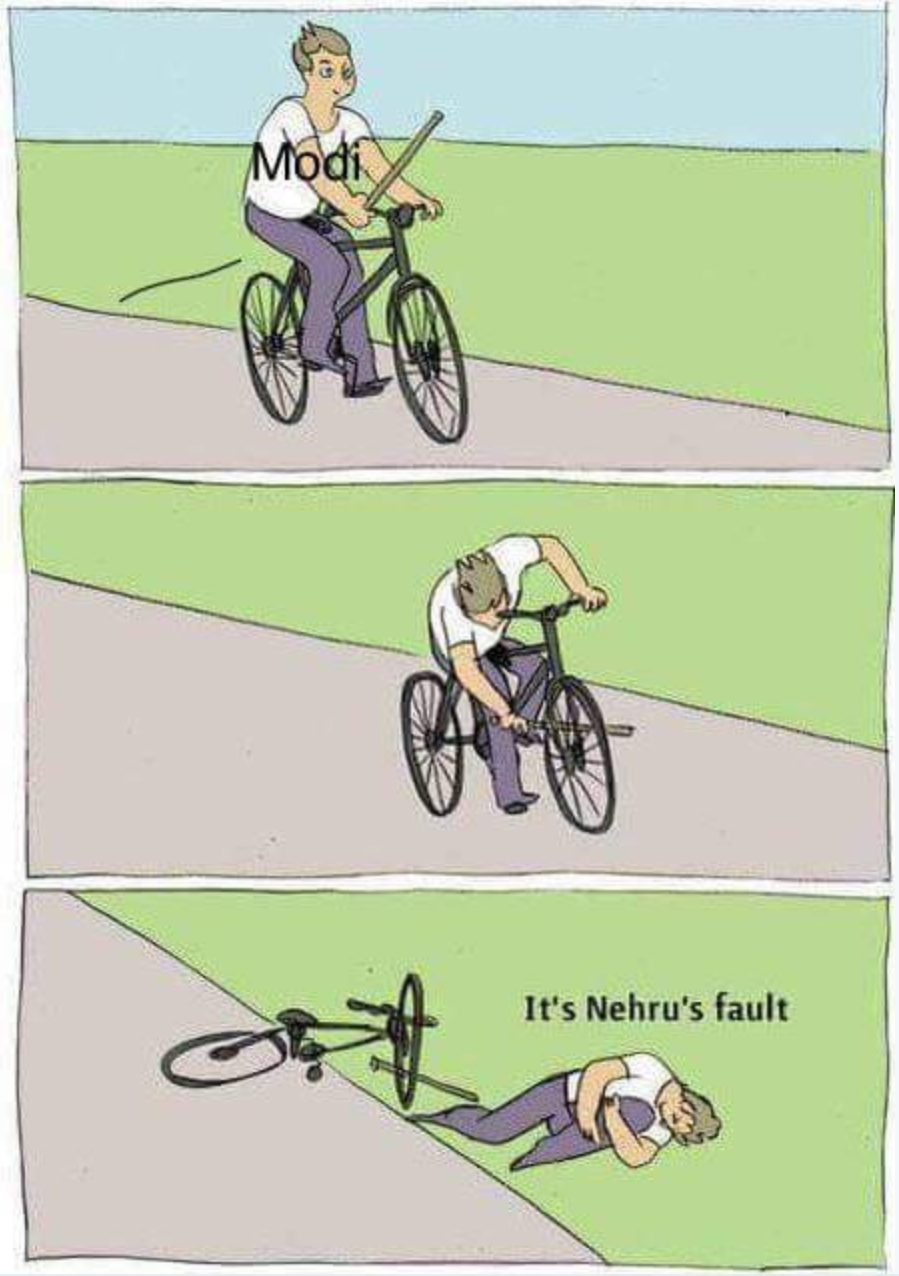
A company's CEO while handing over gave charge to his successor gave two sealed envelopes to be opened only when facing crisis. After first crisis the CEO opened first envelope which read 'blame the predecessor' and that worked. After second crisis he opened second envelope which read 'prepare two envelopes'.
Modi doesn't know that Gandhi, Nehru & Patel were well in harmony. Gandhi chose Nehru as PM because he was young and popular with people of India where as Patel was old and having significant following in Congress. In addition Nehru had excellent relationship with Britain and many other countries and was truly secular where as Patel lagged these traits and has pro Hindutva inclinations and 19% of population of India are non-Hindus and their rights can't be undermined. And there is no reason to believe that Patel is taller than Nehru in any sense. Without doubt Nehru stands tallest among all the Congress leaders after Gandhi. Referring to past and belittling Nehru and his family at the fall of hat to gain political mileage and to cover his own failures works only one time but not after 4 years. Modi with worst performance as PM, not only made him self a laughing stock but effectively paved way for Rahul Gandhi to become PM in 2019, in just 4 years, which Sonia Gandhi couldn't achieve in 20 years.


Saturday, 13 January 2018

SC Judges revolt raises more questions

Deccan Chronicle | Jan 13, 2018


Curiously, the letter written by the four judges was undated and unsigned

The unprecedented mutiny of four senior Supreme Court judges namely Justice Chelameshwar,  Justice Ranjan Gogoi, Justice Madan Lokur and Justice Kurien Joseph accusing CJI Justice Dipak Misra of  bias in SC Administration etc in press conference on Jan 12, 2018, raises more questions than it reveals. While the contentions of these four revolting judges seems to be rationale, their method of dealing i.e. washing the dirty linen in public is unacceptable. The best they could have done is submit their resignations like 1973 resignations by Justice J. M. Shelat, Justice K. S. Hegde and Justice A. N. Grover when they were superseded. The matter of 'saving democracy' should have been best left to politicians and elected representatives. These four judges forgot the maxim 'nemo judex in causa sua', which means that no man can be a Judge in his own cause.
  • The CJI is called upon to show wise leadership of the institution over which he presides has to retain its vitality and robustness. Sardar Patel told HJ Kania three days before he became the first CJI that there is very little place for petty-mindedness in how a CJI deals with his brother judges. Justice Dipak Misra proved himself a miserable failure as CJI. 
  • CJI Deepak Misra in his capacity as 'Master of Roster' has allocated the case of death of special CBI judge B H Loya to a bench of junior judges and that was the flash point of simmering discontent.
  • CJI is 'Master of Roster' and certainly not 'Clerk of Roster' and can use his discretionary powers as he deems fit and is answerable to none. MoP is only a document for guiding the CJI staff while preparing draft roster and not binding on CJI.
  • In any case, no judge can assign a case to himself.
  • On one hand they argue 'Chief Justice is first among equals, nothing more, nothing less' and on other hand they were upset that senior judges were not allocated important cases. There is no such thing called 'senior judge' or 'junior judge'. All judges are equal. 
  • SC Judges might not be subordinates and accountable to CJI, but CJI certainly holds higher position with higher pay, functions, powers and responsibilities. CJI represents entire SC.
  • Their contention as saviors of democracy is untenable. Our democracy is constantly in trouble and never before in the past such revolt has happened. What is visible is ego clash, conflict of personal interests etc.
  • How can CJI allocate important cases to these four judges who doesn't look eye to eye with him? It is humanly impossible. Whatever these four judges stated about the maladies of SC today, they were there since long and every CJI followed these with varying degrees. 
  • Traditions, conventions, customs, practices etc are not binding. They only bind you to the past. Only rules are binding. Subverting the rules to one's own thinking is what is ruling now a days everywhere. These days what matters is competence, tact and trust. 
  • Not withstanding the told reasons, real reasons for this mutiny could be different. In any case judicial tradeunionism is unacceptable nonsense.
  • Modi's government subverted all the institutions in India. Supreme Court is no exception. Which CJI would like to fight with powerful Modi & BJP and lose his of sleep and future benefits?
  • Having raised the banner of revolt, now the onus is on these four revolting judges to bring down curtain amicably as soon as possible. They can not expect any help from any quarter in resolving the SC's internal issue and any delay will give scope for media with all kinds of stories and rumors which will only hurt the integrity of SC and its judges.
  • "Judges should not have gone public" was the unanimous opinion of Bar Council of India. Similar opinions were expressed by Attorney General KK Venu Gopal and eminent jurists FS Nariamn, Soli Sorabjee and many others.
  • In a press release issued on June 24, 2018, the Bar Council of India condemned the former Supreme Court judge Jasti Chelameswar for his comments to several media organisations after his official retirement two days earlier. The release states, “The amount of damage which has been to the institution since last January, would take a long time to be repaired and rectified.” 

Expecting CJI Deepak Misra coming to the terms of revolting four judges and falling at their feet is height of insanity. While CJI can't do anything to these four judges, he might just ignore this incident and next working day will be like any other routine day and business in SC will be as usual. But these four judges having raised unthinkable banner of revolt lost their moral right to sit on the bench and conduct court proceedings and deliver verdicts. Irrespective of causes and outcomes of this dirty event, SC's image stands disfigured and diminished forever.


In framing a government which is to be administered by men over men, the great 
difficulty lies in this: you must first enable the government to control the governed; 
and in the next place, oblige it to control itself ... Alexander Hamilton


Even though everybody says in public they have immense faith in judiciary and respect it, in private no one has. They were only scared of contempt proceedings and punishment. It is well known that judicial system serves rich & powerful only and ordinary citizen can never aspire to approach any court for grievance redress. Like other segments of society and governance, judicial system is also infected with all the ills like politics, corruption, nepotism, incompetence and so on. Leveraging press & media for furthering one's own cause is politics. Judiciary prohibits press conferences by judges under all circumstances. Notwithstanding whether CJI Dipak Mishra committed any mistakes or mischief, these four rebel judges, in a fit of anger, walking out of SC premises dumping scheduled activity to winds have done the unthinkable thing and committed the gravest offence on the Supreme Court itself by calling the press conference and leveling charges against CJI and may face conspiracy charges of destruction of institution of SC. Their incredulity of views is reflected in releasing an undated and unsigned letter addressed to CJI. Their offence is far more serious than Justice Karnan's for which he was jailed for six months by SC, ignoring constitutional immunity & protection.