Showing posts with label global warming. Show all posts

Thursday, 28 November 2019

India’s ominous future: too little water, or far too much

The monsoon is central to Indian life and lore. It shapes the fortunes of millions of farmers who rely on the rains to nourish their fields. It governs what you eat. 
  • Climate change is now messing with the monsoon, making seasonal rains more intense and less predictable. Decades of short-sighted government policies are leaving millions of Indians defenseless in the age of climate disruptions, especially the poor.
  • The lakes that once held the rains in the bursting city of Bangalore are clogged with plastic and sewage. 
  • The rains are more erratic today. Extreme rainfall is more common and more extreme. The number of days with very heavy rains has increased, with longer dry spells in between. Less common are the sure and steady rains that can reliably penetrate the soil. This is ruinous for a country that gets the vast share of its water from the clouds.
  • Global warming has destroyed the concept of the monsoon. 
  • India’s insurance policy against droughts, the Himalayas, is at risk, too. The majestic mountains are projected to lose a third of their ice by the end of the century if greenhouse gas emissions continue to rise at their current pace.
  • Climate change isn’t the only culprit to blame for India’s water woes. Decades of greed and mismanagement are far more culpable. The lush forests that help to hold the rains continue to be cleared. Developers are given the green light to pave over creeks and lakes. Government subsidies encourage the over-extraction of groundwater. Groundwater is drawn faster than nature can replenish it.
  • By 2050, the World Bank estimates, erratic rainfall, combined with rising temperatures, stand to “depress the living standards of nearly half the country’s population.”
  • Since 1950, annual rainfall has declined by 15% in Marathwada. In that same period, cloudbursts have shot up threefold. But during that same period, Marathwada, along with the rest of India, has seen a boom in the production of one of thirstiest crops on earth: sugar cane.
  • In India, one of the most water-stressed countries in the world, the government subsidizes electricity, encouraging farmers to pump groundwater for their fields, as well as fertilizers, which are used in vast quantities. State-owned banks offer cheap loans, which are sometimes written off.


Sunday, 23 June 2019

Climate changes: Our house is on fire - Greta Thunberg

Greta Thunberg, 16, Swedish girl

 Greta Thunberg (left) takes part in a ‘school strike for climate’
at the World Economic Forum in Davos, Switzerland. 

Swedish school strike activist Ms. Greta Thunberg, 16, demands economists tackle runaway global warming. Her Davos speech here:

Our house is on fire. I am here to say, our house is on fire.

According to the IPCC (Intergovernmental Panel on Climate Change), we are less than 12 years away from not being able to undo our mistakes. In that time, unprecedented changes in all aspects of society need to have taken place, including a reduction of our CO2 emissions by at least 50%.

And please note that those numbers do not include the aspect of equity, which is absolutely necessary to make the Paris agreement work on a global scale. Nor does it include tipping points or feedback loops like the extremely powerful methane gas released from the thawing Arctic permafrost.

At places like Davos, people like to tell success stories. But their financial success has come with an unthinkable price tag. And on climate change, we have to acknowledge we have failed. All political movements in their present form have done so, and the media has failed to create broad public awareness.

But Homo sapiens have not yet failed. 

Yes, we are failing, but there is still time to turn everything around. We can still fix this. We still have everything in our own hands. But unless we recognise the overall failures of our current systems, we most probably don’t stand a chance.

We are facing a disaster of unspoken sufferings for enormous amounts of people. And now is not the time for speaking politely or focusing on what we can or cannot say. Now is the time to speak clearly.

Solving the climate crisis is the greatest and most complex challenge that Homo sapiens have ever faced. The main solution, however, is so simple that even a small child can understand it. We have to stop our emissions of greenhouse gases.


Either we do that or we don’t.

You say nothing in life is black or white. But that is a lie. A very dangerous lie. Either we prevent 1.5C of warming or we don’t. Either we avoid setting off that irreversible chain reaction beyond human control or we don’t.

Either we choose to go on as a civilisation or we don’t. That is as black or white as it gets. There are no grey areas when it comes to survival.

We all have a choice. We can create transformational action that will safeguard the living conditions for future generations. Or we can continue with our business as usual and fail.

That is up to you and me.

Some say we should not engage in activism. Instead we should leave everything to our politicians and just vote for a change instead. But what do we do when there is no political will? What do we do when the politics needed are nowhere in sight?

Here in Davos – just like everywhere else – everyone is talking about money. It seems money and growth are our only main concerns.

And since the climate crisis has never once been treated as a crisis, people are simply not aware of the full consequences on our everyday life. People are not aware that there is such a thing as a carbon budget, and just how incredibly small that remaining carbon budget is. That needs to change today.


No other current challenge can match the importance of establishing a wide, public awareness and understanding of our rapidly disappearing carbon budget, that should and must become our new global currency and the very heart of our future and present economics.

We are at a time in history where everyone with any insight of the climate crisis that threatens our civilisation – and the entire biosphere – must speak out in clear language, no matter how uncomfortable and unprofitable that may be.

We must change almost everything in our current societies. The bigger your carbon footprint, the bigger your moral duty. The bigger your platform, the bigger your responsibility.

Adults keep saying: “We owe it to the young people to give them hope.” But I don’t want your hope. I don’t want you to be hopeful. I want you to panic. I want you to feel the fear I feel every day. And then I want you to act.


I want you to act as you would in a crisis. I want you to act as if our house is on fire. Because it is.


Greta Thunberg, a Swedish climate activist told world leaders: 
'I don't want you to be hopeful, I want you to panic.
I want you to feel the fear I feel every day and then I want you to act.'
In an impassioned warning to act now on climate change,
Thunberg told her audience at Davos:
'Either we choose to go on as a civilisation or we don’t'


Monday, 10 June 2019

Uneconomic growth

Growth is uneconomic when it increases environmental and social costs by more than it increases production benefits. The cost associated with economic growth arises as a result of  the social and environmental sacrifices made necessary by that growing encroachment on the eco-system. David Suzuki argued that ecologies can sustain 1.5-3% of economic growth per year and any higher growth will necessarily cannibalize the natural capital of soil or forest. But when growth becomes uneconomic we must find new answers to these problems. 
  • Historically economic growth was the answer given to the major problems raised by Malthus (overpopulation), Marx (unjust distribution), and Keynes (unemployment).
  • Globalization is the current ideological commitment to global economic integration via free trade and free capital mobility. Consequently many tractable national problems like overpopulation, unjust distribution, and unemployment, are converted into one intractable global problem, in the name of “free trade,” and in the interests of transnational capital.
  • Growth in GNP is so favored by economists that they call it economic growth. GNP is supposed to grow forever. There are costs incurred by GNP growth. These costs are depletion, pollution, ecological disruption, sacrifice of leisure time, disutility of some kinds of labor, destruction of community in the interests of capital mobility, takeover of habitat of other species, and running down a critical part of the inheritance of future generations.
  • The law of diminishing marginal utility of income tells us that we satisfy our most pressing wants first, and that each additional unit of income is dedicated to the satisfaction of a less pressing want. So the marginal benefit of growth declines. 
  • The law of increasing marginal costs tells us that we first make use of the most productive and accessible factors of production and only use the less productive factors as growth makes it necessary. Consequently, marginal costs increase with growth. 
  • When rising marginal costs equal falling marginal benefits then we are at the optimal level of GNP, and further growth would be uneconomic.
  • The only limit to economic growth is technology, and there is no limit to technology, ergo no limit to economic growth. Therefore the very notion of “uneconomic growth” makes no sense. Growth does not increase the scarcity of anything, rather it diminishes the scarcity of everything! How can one possibly oppose growth? 
  • Growth that relies entirely on exploiting increased knowledge rather than exploiting increased resource consumption may not qualify as uneconomic growth.
  • Economists agree that GNP was not designed to be a measure of welfare; it measures only activity. Nevertheless they assume that welfare is positively correlated with activity, so that increasing GNP will increase welfare. This is equivalent to believing that the marginal benefit of GNP growth is greater than the marginal cost. The empirical test results turn out not to support the belief.
  • Measures of welfare are difficult and subject to many arbitrary judgments. The empirical evidence that GNP growth has increased welfare is weak. Impact on welfare via policies that increase GNP growth are weak and nonexistent. 
  • Economists habitually argue that we need not worry about global warming because the only climate-sensitive sector of the economy is agriculture, and agriculture accounts for only 3% of GNP. These economists evidently don’t need to eat! 
  • Overpopulation would be cured by the demographic transition. When GNP per capita reaches a certain level children become too expensive in terms of other goods forgone and the birth rate automatically falls. Is it necessary for Indian per capita consumption to rise to the Swedish level for Indian fertility to fall to the Swedish level, and if so what happens to the Indian ecosystem as a result of that level of total consumption?
  • Unjust distribution of wealth between classes would be rendered tolerable by growth, the rising tide that lifts all boats, to recall another slogan. Yet growth has in fact increased inequality both within and among nations. To make matters worse, even the metaphor is wrong, since a rising tide in one part of the world implies an ebbing tide somewhere else.
  • The assumption that growth is economic, that it is making us richer rather than poorer. But now growth is becoming uneconomic. Uneconomic growth will not sustain the demographic transition and cure overpopulation. Neither will it help redress unjust distribution, nor cure unemployment. Nor will it provide extra wealth to be devoted to environmental repair and clean-up. Indirect growth based solutions to the big problems no longer work.
  • We now need more direct and radical solutions to the problems of Malthus, Marx, and Keynes: population control to deal with overpopulation; redistribution to deal with excessive inequality; and measures such as a public employer of last resort, and ecological tax reform to raise resource prices relative to labor. These must be national policies. Many nations have made progress in controlling their population growth, in limiting domestic income inequality, and in reducing unemployment. 
  • Global economic integration by free trade and free capital mobility effectively erases the policy significance of national boundaries. Nations can no longer internalize environmental and social costs in the interests of resource efficiency and social justice, because capital is free to produce elsewhere and still sell its product in the market whose social controls it just escaped. Capital escapes higher wages and taxes of any kind, in particular taxes aimed at re-distributive policies that redress excessive inequality and poverty.
  • Globalization refers to global economic integration of many formerly national economies into one global economy, mainly by free trade and free capital mobility, but also by easy or uncontrolled migration.
  • Whether capital moves to overpopulated low-wage countries, or poor workers move to the high-wage country, the result is the same -- a competitive bidding down of wages to the detriment of countries that have followed a high-wage policy by limiting their numbers and by more equally distributing their wealth.
  • The laboring class in the low-wage country gains in terms of number employed, though not usually in terms of increased wages because of the virtually unlimited supply of cheap labor resulting from past and present demographic growth. The capitalist class in the high-wage country gains from lower wage costs at home as well as abroad. 
  • The big losers are workers in the high-wage countries. With low wages now a competitive advantage in attracting capital, we might expect policies aimed at increasing the supply of labor in previously high-wage countries.
  • Globalization operates by standards-lowering competition to bid down wages, to externalize environmental costs, and reduce social overhead charges for welfare, education, and other public goods. It is far worse than an unrealistic global dream -- it actively undercuts the ability of nations to continue to deal with their own problems of overpopulation, unjust distribution, unemployment, and external costs. It converts many relatively tractable national problems into a single intractable global problem.
Globalization via export-led growth is the new philosopher’s stone of the IMF-IBRD-WTO alchemists. Nations can all turn their lead into gold by free trade. With the revival of alchemy comes a return to the logic of Mercantilism: wealth is gold, and the way for countries without mines to get gold is to export more goods than they import, and receive payment for the difference in gold -- the alchemy of trade. The way to export more than you import is to reduce wages, and to externalize social and environmental costs, because that keeps prices of your exports competitive. Low wages also prevent your laboring class majority from buying imported goods and thereby dissipating the trade surplus. The way to keep wages low is to have an oversupply of labor. An oversupply of labor can be attained by easy immigration and high birth rates among the working class. Globalization requires, therefore, that for a nation to be rich, the working-class majority of its citizens must be poor, increase in number, and live in a deteriorating environment! Behind these absurdities is the further contradiction that under globalization it no longer makes sense to speak of  “nations” (only corporations); nor of “citizens” (only employees).

Globalization is accelerating the shift to an era of uneconomic growth, a time when, as John Ruskin foresaw, “That which seems to be wealth may in verity be only the gilded index of far-reaching ruin.”


Monday, 3 September 2018

Disaster and human history

Case Studies in Nature, Society and Catastrophe
By Benjamin Reilly
  • The present rate of technological advance is unprecedented in human history.
  • Modern college students believe that the study of our historical past has little meaning to their present lives.
  • World population has doubled between 1960's and early years of 21st century. Population density have also reached unseen levels. 
  • The percentage of world's surface covered by urban areas jumped from 0.1% to 1.0% between 1900 and 1990 and if the trend continues more people will be living in urban than rural areas.
  • Human beings are increasingly concentrated in "megacities", sprawling urban areas with millions of residents. The trend has slowed down in developed world but continues unchecked in the developing world. 
  • The parallel explosion of technological and demographic growth in the modern age is not accidental but are intimately linked. These two are complimentary processes and unfortunately linked to unprecedented natural resource depletion. The planet is now losing 120,000 sq.km. of forest every year to logging, herding and agriculture. As a result of human intrusion into forest ecosystems, deadly epidemics may just be a taste of things to come.
  • Deforestation is linked to soil erosion. Soil is created very slowly by nature but can quickly be destroyed by human agriculturists employing unsustainable farming practices.
  • Modern farmers are "skinning our planet" reducing earth's soil deposits by 4 tons per head due to increasing exploitation of hillsides and prairies by land hungry farmers in developing nations. 
  • Mechanized farming renders soil susceptible to erosion. Although soil erosion is not a new problem in human history, the present rate of global soil loss is unprecedented. Mankind is currently stripping soil at 20 times the natural erosion rate, a process that is likely to have catastrophic impact in future.
  • The current rate of technological and demographic advance has also endangered world supply of water, which is the most vita natural resource. Human population pressure - large parts of the world are now in real danger of exceeding available water sources not only in low rainfall years but also during normal years. 
  • As of 2008, 35% of the world's renewable freshwater is already diverted from ecosystem for human use, mostly in agriculture which requires enormous water inputs. In arid countries like Egypt & Israel this statistic is 100% further undermining stability of already volatile region. 
  • Qatar is "mining" their water sources, withdrawing more water from the ecosystem than is replaced by natural sources, 6 times as much as is replenished by natural processes. In UAE it is 17 times annual replenishment.
  • So far, human being had some successes in staving off looming water crisis, through technology, tapping underground aquifers, piped transportation of river water etc. Water poor countries have sustained by importing "virtual water" in the form of food. [Production of one kg rice requires as much as 2,000 liters of irrigation water.] World's largest exporter of "virtual water" is USA which ships out billions of liters in the form of grain allowing importing nations to support higher populations than they could with limited domestic water supplies. None of these techniques will cope with increasing global population in long run.  Desalinization is expensive, rivers have limited capacity, and aquifers that are drained faster will disappear. Already some of the world's great rivers some times run dry before reaching the sea due to escalating demands on their water.
  • Virtual water in inextricably tied to the prices of petroleum, another finite source. The price of virtual water is tied to transportation fuel costs. Food and fuel are increasingly becoming interchangeable commodities, and nations depending on "virtual water" for their water needs, therefore are courting disaster.
  • Deforestation and road building has reduced the soils ability to absorb rainfall, lowering replenishment rate of aquifers. Industrial pollutants have made some of the fresh water sources unusable by humans. 
  • Global warming due to anthropogenic greenhouse gas emissions will likely wreck havoc with the world's water supply. When the already retreading glaciers vanish, many rivers will flow more intermittently. 
  • Global warming will likely result less "average" rainfall and more extreme weather conditions, such as downpours leading to floods & soil erosion, dry spells and drought. Higher temperatures will increase evaporation rates, reduce agriculture production even if local rainfall is technically higher. Scientific understanding of global warming remains incomplete. 
  • The fossil fuels consumed between 1751-1998 were equivalent to the amount of sunlight that the world's plants captured in preceding 13,300 years. This energy fueled mankind's advancement from agriculture to industrial and then to technological age. but released thousands of years buried carbon dioxide into atmosphere.
  • The result is the certainty of environmental change in next few hundred years. But human species is not well suited to rapid environmental fluctuations.
  • It remains to be seen if the rapid medical advances the humans achieved in the 20th century will be able to keep up with new epidemic diseases that arise during 21st century.
  • The disasters of the future might look different from the disasters of the past.
  • Earthquakes and volcanoes will occur like in the past but human population growth in general and megacities in particular will magnify their effects. Other disasters will change more dramatically in future.
  • Population pressure, changing climate will produce unprecedented levels of deforestation, desertification, soil erosion and consequent famine. In the age of soaring food prices, declining water availability famine may become endemic in some parts of the world,  no longer checked by cheap transportation of large food supplies that curbed famines in the late 20th century.
  • Tropical cyclones may become more violent in future, though science is uncertain. 
  • Finally, unprecedented population density, near instantaneous modern transportation and rapidly changing environment will create host of new opportunities for infectious diseases.
  • Advances in technology might ameliorate these supercharged modern disasters. But will certainly create new disasters in future.
  • As mankind's need for more energy continues to increase, fossil fuel reserves continue to dwindle and CO2 continues to accumulate in the atmosphere pressure will build on humanity to exploit nuclear power for its energy needs. Nuclear power has worst reputation as a safe, clean energy source.
  • It is somewhat disquieting to note that a seemingly technological advance could have led to an environmental nightmare.
  • It is clear that different types of natural disasters are intimately linked and are created or badly exacerbated by human agency. In particular, global warming may play the role as "master disaster" of the post 20th century influencing almost every other type of natural disaster.
  • Rising global temperatures may lead to tropical cyclone activity and more frequent El Nino events and spread of tropical diseases. Rising sea levels will swallow coastal agricultural land and concentrate more people in squalid megacities heightening vulnerability to diseases.
  • Poverty bred by global warming worsen even terrestrial disasters since poverty plays a crucial role in determining the vulnerability of human beings to natural disasters. Global warming may precipitate worst famine as rising human population run headlong into declining agricultural activity. The result may be a new Malthusian crisis on a regional or even a global scale.
  • Human beings, especially those living in capitalist economies tend to make choices favoring short term gains and comforts rather than long term sustainability and stability thus making disastrous choices. We continue to build suburbs on fault lines, construct vacation homes on storm swept coastlines or volcano slopes, inundate poorly drained fields with river water leading to soil salinization. 
  • In an age, where population control provides surest means of mitigating future disasters, the worlds wealthiest refuses to fund programs that offer birth control for fear of offending certain social groups. Most damaging of all, human beings are still slow to make sacrifices in short term that might mitigate the environmental damage of global warming in the long run.
  • As a society, we have faith that the technologies of tomorrow will diffuse future disasters that we are creating by our actions today.

Development could be defined as the essence of general transformation and 
destruction of the natural environment and of social relations in order to 
increase the production of commodities (goods and services) geared, 
by means of market exchange, to effective demand. 


The technological progress has been bringing us with environmental issues and problems of pollution and global warming along with advancements that made our lives easier, more efficient and our bodies healthier. There is no alternative to reduce population, preserve ecological assets, minimize emissions & pollutants,  reduce water wastage and start living closer to nature. Plastics and fossil fuel usage must be brought down 10% every year. Nothing should be allowed at the expense of environment. The so-called sustainable practices etc only postpones doomsday.


Wednesday, 7 February 2018

We must quit coal


We have far more oil, coal and gas than we can safely burn. Fuel is enormously useful, massively valuable and hugely important geopolitically, but tackling global warming means leaving most of it in the ground – by choice. Coal is the dirtiest of fossil fuels. It produces per kilogram the least amount of energy and the greatest amount of pollution. Coal supplies a third of all energy used worldwide and makes up 40% of electricity generation, as well as playing a crucial role in industries such as iron and steel. The coal industry stands in the way of a safe and healthy future for us all. From destructive mines to polluting stacks and toxic ash dumps, coal lays waste to our environment. Coal threatens our most basic needs: clean water to drink, clean air to breathe, and a safe climate. 
  • Fossil fuels are a finite resource and each year they get more expensive relative to renewables and nuclear.
  • India is the world’s second-largest coal consumer last year.
  • Despite legitimate concerns, coal use will continue to be significant in the future. Therefore greater efforts are needed to embrace less polluting and more efficient technologies to ensure that coal becomes a much cleaner source of energy.
  • The burning of coal for heat and energy is responsible for 46% of carbon dioxide emissions worldwide and accounts for 72% of total  greenhouse gas (GHG) emissions from the electricity sector. They also  fuel global warming, making coal the single greatest threat to our climate. Coal mining is also a source of methane, a very potent global warming gas.
  • The coal industry uses fresh water enough to meet the basic needs of 100 crore people. We are already at risk of a global water supply crisis. Adding further strain on our water supplies, pollution from coal mines and coal plants contaminates groundwater and waterways.
  • Between 2001 and 2010, world consumption of coal increased by 45%. During the same time period, total anthropogenic GHG emissions were the highest in human history. 
  • Mining and burning coal release harmful pollutants into the air. These include mercury, fine pollution particles, and chemicals that form smog — all damaging to our health. Pollution from burning coal also leads to acid rain, which kills fish and plants and damages soils.
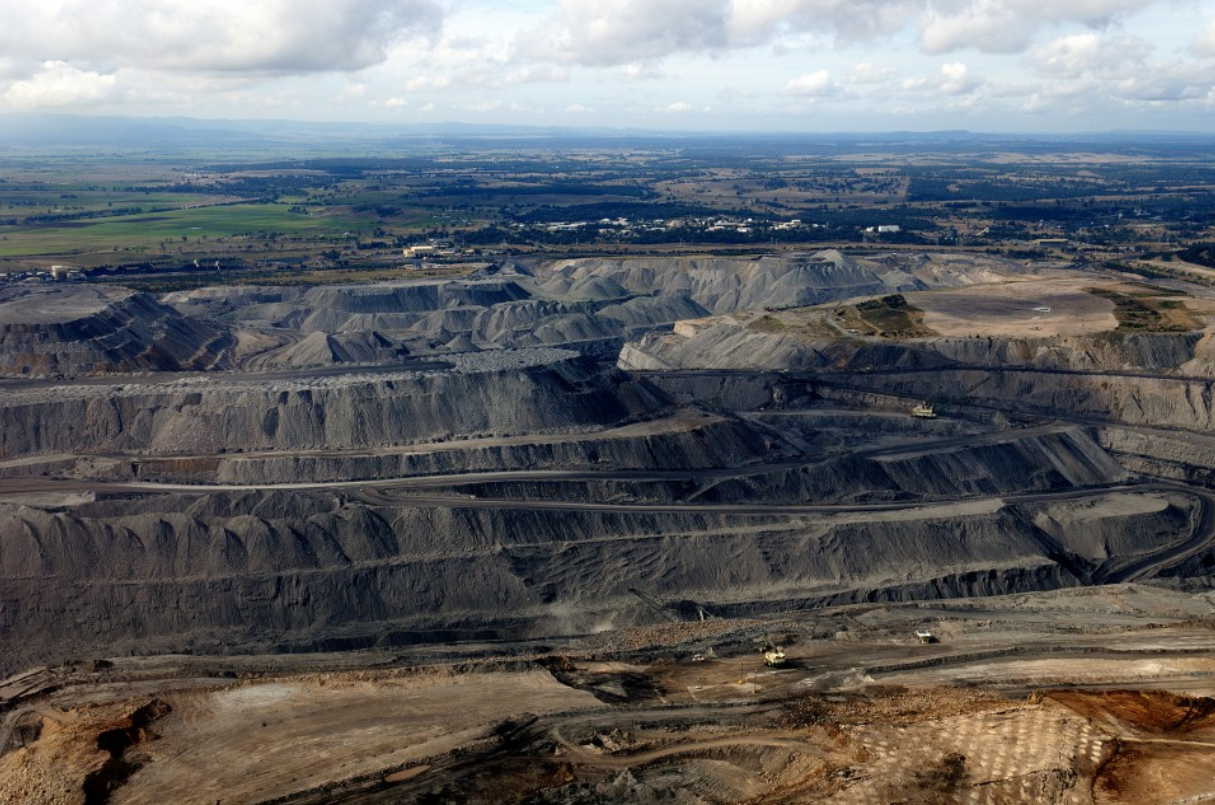
  • Open-pit, open-cast or open cut mining disturbs landscapes on a vast scale, destroying forests and scraping away soils. So severe is the damage, in most cases it cannot be repaired. When mines unearth and disturb rock and earth, toxic chemicals within can mix with water. This leads to acid main drainage, harmful to streams, soils, and plants, animals and people.
  • People living near the destruction are 50% more likely to die of cancer and 42% more likely to be born with birth defects compared with other people.
  • Shifting to clean, safe solutions including renewable energy; close down coal power plants and prevent new ones being built.
  • Coal industry's true costs including the harm it does to our air, water, lands and health are enormous.
  • 23 countries, states and cities will have either phased out coal-fired power plants or set a timeline to do so by 2030.
  • To avoid catastrophic climate change, it is clear that we must end our dependence on coal and invest in affordable and sustainable renewable energy. We need make the shift to 100% renewable energy as soon as possible.
  • The renewable "fuels" used — sun, wind, water, and heat from the earth — are unlimited and free for the taking. It's an obvious advantage over volatile costs of fuels needed to power coal, oil, gas and nuclear plants.
  • Greater energy efficiency is key to a clean, safe and secure energy future for all. We must make better use of energy from the sun, wind, water and earth. Efficiency is all about smart use of energy, not doing without. It saves us money, helps the environment, and improves our health and comfort. It is to get things done using less energy.
  • It’s time we end the age of fossil fuels and help workers and communities transition over to renewables.


With less than 1C of temperature increase so far, we are already seeing some profound changes, including a collapse in Arctic sea ice coverage. It is impossible to say what changes another three or four degrees would bring, but the impacts could very plausibly include a collapse in global food production, catastrophic droughts and floods, heatwaves and the beginning of ice-sheet melt that could eventually raise the sea level enough to wipe out many of the world's great cities. But can we bring ourselves to prioritise a safe planet over cheap fuels, flights, power and goods? Can humanity muster the restraint and cooperation needed to leave assets worth trillions in the ground?