Showing posts with label unemployment. Show all posts

Wednesday, 23 October 2019

Indian economic recession

In the budget, the FM Nirmala Sitharaman claimed that India’s economy would hit $5 trillion by 2025. In the weeks that followed, GDP growth rater fell to a six-year low of 5%; the RBI made a surplus transfer of Rs 1.76 lakh crore to the union government; and the government announced the merger of ten public-sector banks into four combinations. These announcements came against the backdrop of the precarious state of the Indian economy. The country is witnessing an economic slowdown that has spread from the auto sector to all other segments, the unemployment rate is at a 45-year high and the tax collections from the previous fiscal year presented an estimated shortfall of Rs 1.67 lakh crore from the revenue expected by the BJP government. The going seems difficult for both Sitharaman and the Indian economy.
  • The RBI has lowered India's growth forecast for FY20 to 6.1% from 6.9% it projected earlier. The World Bank has cut India's GDP growth forecast from 7.5% to 6% this year.
  • India is a consumption-driven economy. When consumers buy goods and services, the wheels of the economy turn. That has not been happening for several quarters and for various reasons.
  • Fewer jobs (at 6.1% in 2017-18, unemployment was the highest in 45 years), a freeze in salary hikes and bonuses, layoffs and uncertainty in businesses are making people cut down on spending.
  • Incomes and wages in rural India, where 67% of India's population lives, have been hit because of low food prices. Agriculture GDP grew just 2% in the first quarter of the current fiscal, compared to 5.1% in the same quarter of the previous fiscal.
  • Consequently growth in private consumption expenditure is down to an 18-quarter low of 3.1% in June 2019. Savings declined to an all-time low because of static or falling incomes.
  • Construction, which is a big employment generator, is decelerating because of the slump in real estate. Exports fell 6.57% in Sept 2019 compared to a year ago. Discoms are groaning under a combined debt of over Rs 2.4 lakh crore. Corporate sector revenue growth fell to an 11-quarter low and investments plunged to a 15-year low.
  • The banking and financial services sector is in a mess. There is liquidity, but no loans are being given. Banks are tottering under a mountain of NPA's of close to 10% of their total assets. They are fearful of giving fresh loans in case they add to their woes. Non-banking financial companies, which are a major source of consumer loans, are in a mess of their own and unable to extend credit. And the string of collapsing financial institutions has further sapped consumer confidence in the system.
  • The government's rescue acts like slashing corporate tax rates and unprecedented interest rate cuts by the RBI seem to be yielding no results in the short term.
  • These are exceptional times and they call for exceptional measures. Indian government could take cue from the US Federal Reserve spent nearly 800 billion dollars to pre-empt an imminent economic meltdown in 2008.
The Indian economy is in a vicious downward spiral and the Modi government needs to stop worrying about the fiscal deficit & inflation etc and start pouring money into the economy to stimulate growth. They need to put money in people's pockets in every way they can. This appears to be the only way to get the jammed wheels of the economy moving again.


Monday, 10 June 2019

Uneconomic growth

Growth is uneconomic when it increases environmental and social costs by more than it increases production benefits. The cost associated with economic growth arises as a result of  the social and environmental sacrifices made necessary by that growing encroachment on the eco-system. David Suzuki argued that ecologies can sustain 1.5-3% of economic growth per year and any higher growth will necessarily cannibalize the natural capital of soil or forest. But when growth becomes uneconomic we must find new answers to these problems. 
  • Historically economic growth was the answer given to the major problems raised by Malthus (overpopulation), Marx (unjust distribution), and Keynes (unemployment).
  • Globalization is the current ideological commitment to global economic integration via free trade and free capital mobility. Consequently many tractable national problems like overpopulation, unjust distribution, and unemployment, are converted into one intractable global problem, in the name of “free trade,” and in the interests of transnational capital.
  • Growth in GNP is so favored by economists that they call it economic growth. GNP is supposed to grow forever. There are costs incurred by GNP growth. These costs are depletion, pollution, ecological disruption, sacrifice of leisure time, disutility of some kinds of labor, destruction of community in the interests of capital mobility, takeover of habitat of other species, and running down a critical part of the inheritance of future generations.
  • The law of diminishing marginal utility of income tells us that we satisfy our most pressing wants first, and that each additional unit of income is dedicated to the satisfaction of a less pressing want. So the marginal benefit of growth declines. 
  • The law of increasing marginal costs tells us that we first make use of the most productive and accessible factors of production and only use the less productive factors as growth makes it necessary. Consequently, marginal costs increase with growth. 
  • When rising marginal costs equal falling marginal benefits then we are at the optimal level of GNP, and further growth would be uneconomic.
  • The only limit to economic growth is technology, and there is no limit to technology, ergo no limit to economic growth. Therefore the very notion of “uneconomic growth” makes no sense. Growth does not increase the scarcity of anything, rather it diminishes the scarcity of everything! How can one possibly oppose growth? 
  • Growth that relies entirely on exploiting increased knowledge rather than exploiting increased resource consumption may not qualify as uneconomic growth.
  • Economists agree that GNP was not designed to be a measure of welfare; it measures only activity. Nevertheless they assume that welfare is positively correlated with activity, so that increasing GNP will increase welfare. This is equivalent to believing that the marginal benefit of GNP growth is greater than the marginal cost. The empirical test results turn out not to support the belief.
  • Measures of welfare are difficult and subject to many arbitrary judgments. The empirical evidence that GNP growth has increased welfare is weak. Impact on welfare via policies that increase GNP growth are weak and nonexistent. 
  • Economists habitually argue that we need not worry about global warming because the only climate-sensitive sector of the economy is agriculture, and agriculture accounts for only 3% of GNP. These economists evidently don’t need to eat! 
  • Overpopulation would be cured by the demographic transition. When GNP per capita reaches a certain level children become too expensive in terms of other goods forgone and the birth rate automatically falls. Is it necessary for Indian per capita consumption to rise to the Swedish level for Indian fertility to fall to the Swedish level, and if so what happens to the Indian ecosystem as a result of that level of total consumption?
  • Unjust distribution of wealth between classes would be rendered tolerable by growth, the rising tide that lifts all boats, to recall another slogan. Yet growth has in fact increased inequality both within and among nations. To make matters worse, even the metaphor is wrong, since a rising tide in one part of the world implies an ebbing tide somewhere else.
  • The assumption that growth is economic, that it is making us richer rather than poorer. But now growth is becoming uneconomic. Uneconomic growth will not sustain the demographic transition and cure overpopulation. Neither will it help redress unjust distribution, nor cure unemployment. Nor will it provide extra wealth to be devoted to environmental repair and clean-up. Indirect growth based solutions to the big problems no longer work.
  • We now need more direct and radical solutions to the problems of Malthus, Marx, and Keynes: population control to deal with overpopulation; redistribution to deal with excessive inequality; and measures such as a public employer of last resort, and ecological tax reform to raise resource prices relative to labor. These must be national policies. Many nations have made progress in controlling their population growth, in limiting domestic income inequality, and in reducing unemployment. 
  • Global economic integration by free trade and free capital mobility effectively erases the policy significance of national boundaries. Nations can no longer internalize environmental and social costs in the interests of resource efficiency and social justice, because capital is free to produce elsewhere and still sell its product in the market whose social controls it just escaped. Capital escapes higher wages and taxes of any kind, in particular taxes aimed at re-distributive policies that redress excessive inequality and poverty.
  • Globalization refers to global economic integration of many formerly national economies into one global economy, mainly by free trade and free capital mobility, but also by easy or uncontrolled migration.
  • Whether capital moves to overpopulated low-wage countries, or poor workers move to the high-wage country, the result is the same -- a competitive bidding down of wages to the detriment of countries that have followed a high-wage policy by limiting their numbers and by more equally distributing their wealth.
  • The laboring class in the low-wage country gains in terms of number employed, though not usually in terms of increased wages because of the virtually unlimited supply of cheap labor resulting from past and present demographic growth. The capitalist class in the high-wage country gains from lower wage costs at home as well as abroad. 
  • The big losers are workers in the high-wage countries. With low wages now a competitive advantage in attracting capital, we might expect policies aimed at increasing the supply of labor in previously high-wage countries.
  • Globalization operates by standards-lowering competition to bid down wages, to externalize environmental costs, and reduce social overhead charges for welfare, education, and other public goods. It is far worse than an unrealistic global dream -- it actively undercuts the ability of nations to continue to deal with their own problems of overpopulation, unjust distribution, unemployment, and external costs. It converts many relatively tractable national problems into a single intractable global problem.
Globalization via export-led growth is the new philosopher’s stone of the IMF-IBRD-WTO alchemists. Nations can all turn their lead into gold by free trade. With the revival of alchemy comes a return to the logic of Mercantilism: wealth is gold, and the way for countries without mines to get gold is to export more goods than they import, and receive payment for the difference in gold -- the alchemy of trade. The way to export more than you import is to reduce wages, and to externalize social and environmental costs, because that keeps prices of your exports competitive. Low wages also prevent your laboring class majority from buying imported goods and thereby dissipating the trade surplus. The way to keep wages low is to have an oversupply of labor. An oversupply of labor can be attained by easy immigration and high birth rates among the working class. Globalization requires, therefore, that for a nation to be rich, the working-class majority of its citizens must be poor, increase in number, and live in a deteriorating environment! Behind these absurdities is the further contradiction that under globalization it no longer makes sense to speak of  “nations” (only corporations); nor of “citizens” (only employees).

Globalization is accelerating the shift to an era of uneconomic growth, a time when, as John Ruskin foresaw, “That which seems to be wealth may in verity be only the gilded index of far-reaching ruin.”


Saturday, 27 April 2019

General election 2019 blues

This is a waveless election (2019) wherein the preference or dismissal of a leader and issues seem to be pre-determined by the social background (caste and community) of voters. 
  • The BJP  won 31% of the vote with 282 seats nationally in 2014. This is the highest vote to seat conversion indicating heaviest fragmentation of the anti-BJP votes. Plain arithmetic suggests that if all major non-BJP forces come together, the Modi machine will halt.
  • Today BJP today rules 17 of 29 states (a year ago 21/29 states), either directly or with its allies. Despite BJP's countrywide presence, it is also true that the opposition has been winning most of the Lok Sabha by-elections which is a sign of defeat for the Modi-Shah combine in these elections.
  • Anti Modi factors are: Demonetisation, GST, cow vigilante  lynchings, agrarian crisis, unemployment, inflation, cattle trade ban, etc.
  • Pro Modi factors: Good governance, divided opposition, Balakot airstrike, surgical strikes, absence of major scams, etc. Factors such as welfare schemes like the PM Awas Yojana, Ujjwala Yojana (free LPG cylinder connection to BPL families), Rs 2,000 to the farmers, are secondary reasons for BJP.
  • BJP which won in UP (71/80 seats), Rajasthan (25/25), Gujarat (26/26), Bihar (31/40), MP (27/29), Chattisgarh (10/11), Maharashtra (22/48) and Karnataka (17/28), in 2014, may lose most of these seats in 2019. 
  • There is no perceptible Modi “wave” this time and the muscular nationalism plank that the BJP banks on fails to evoke the required response in the face of widespread agrarian crisis.
  • The public resentment against the BJP governments is glaringly evident even though some believe that Modi has no alternative. It is also clear the BJP is not adding any new constituency of voters. The trends point to a clear reduction of the BJP’s tally from its commanding position of 2014. 
  • Stung by the failure of the campaign based on muscular nationalism in the early phases of voting, the BJP desperately looks for new strategies and altered roadmaps, with emphasis on Hindutva. The candidature of the Malegaon blast accused, Sadhvi Pragya Singh Thakur, in Bhopal against Digvijaya singh is a major step towards Hindutva consolidation.
  • Modi's election campaign is increasingly looking like his style of governance over the last five years, particularly the manner in which demonetization and GST were pursued. A new narrative every day, with new reasoning and strategies along with altered road maps to attain a proclaimed objective. This could also lead to results as chaotic as demonetization and GST produced.
  • Congress party has scored some vital points in terms of ideation of new policy initiatives and programmes, but has failed to follow this up with solid organisational initiatives and electoral strategies.
  • In Uttar Pradesh, multiple narratives are impacting the election in different ways. BJP's candidate's weaker profile as compared to BSP-SP-RLD alliance is widely acknowledged.
  • People are not interested in communal issues but have economic concerns. The BJP had impar­ted a larger-than-life cult image to Modi. Even now they are projecting him as a lone lion in the jungle versus the rest. This is not going to work now.
  • Had even a single person been killed in Pakistan by our our strikes, would they have returned Wing Commander Abhinandan in one single piece within days? Is Imran Khan not answerable to the people of Pakistan? So how did Amit Shah claim we killed 250 Pakistanis!” -- Raj Thackeray 
  • EVM's are neither easy to tamper with and at the same time not tamper proof. Its non-transparent mechanism gives scope for losing candidate to think that EVM has been tampered with. Unless public confidence is earned, EVM will remain a contentious issue. EC telling that EVMs are perfect without explaining how they are perfect is nonsense.
  • This election is not about who wins but to ensure that the BJP loses so that the nation survives. “We will take on each other later.”  -- Raj Thackeray 
  • Mukesh Ambani had recently extended his support to Congress candidate Milind Deora in South Mumbai constituency. Raj Thackeray called this shift in Ambani’s loyalty from BJP to Congress is a big message to the country. Ambani is Uddhav Thackeray’s close friend but decided to side with a Congress candidate is a clear indication that Modi is heading towards defeat.
As things stand today, a weak opposition is Modi’s biggest strength and he is likely to benefit from the TINA (there is no alternative) factor the most, with other positives contributing towards making him virtually unassailable. Reactions from the echelons of the Sangh Parivar after the first two rounds of polling point towards a sense of unease. Many leaders admit that there is a possibility that the BJP would only win half the seats it had in 2014. 

Jammu and Kashmir Governor Satya Pal Malik’s act of dissolving the Assembly when three non-BJP political parties in the State were on the verge of forming a coalition government is of a piece with the systematic undermining of democratic polity. Modi unleashing CBI, ED, Income Tax etc on all anti-BJP parties terrorizing opposing candidates and immobilizing their associates is gross misuse of institutions which are supposed work autonomously. In order to safeguard democracy it is important that Modi & BJP must be defeated in this 2019 elections and be watchful that future governments don't follow the same path. 


Tuesday, 30 January 2018

Economic survey 2018

  • GDP is likely to touch 6.75% by the close of this FY. Far behind 8% of 2015-16. Remember GDP growth has nothing to do with well being of common man.
  • Tax base goes up but tax collections are lower.
  • Three year low oil price bonanza is over. The benefit was squandered away foolishly by Modi & Jaitley. Any further increase of oil price will not only slow does GDP growth but impacts inflation.
  • A $20 per barrel increase in oil prices will result in GDP growth slowdown by 1%, and a rise in inflation of 1%.
  • If high international oil prices persist or elevated stock prices correct sharply, provoking a ‘sudden stall’ in capital flows is likely.
  • In the medium term, the three areas that would require a policy focus including employment, education, and agriculture.
  • Further economic reforms like completing banks recapitalization, completing privatization of Air India.
  • The Sensex has risen 46%, during past 2 years, while economic growth and corporate profits have decelerated. This trend has largely been driven by expectations of a revival in growth and a sudden change in the savings pattern of households after demonetisation. A sharp correction cannot be ruled out in case future growth of the economy and corporate earnings do not remain in line with current expectations and stock markets could trigger "stall" in capital flows and force hikes in interest rates.
  • Due to climate change, annual agricultural incomes could reduce by 15-18% in irrigated areas and 20-25% in unirrigated areas. Higher investment needs to be made towards expanding irrigation with the implementation of efficient drip and sprinkler technologies. A plan to provide direct income support to farmers can be put in motion to replace inefficient agricultural subsidies. 
  • Although India's unemployment rate is around 3.5%, the unemployment rate in the 15-24 age group stands at 10.5%, as per ILO estimates. India has an abysmally low capacity to provide jobs to first-time workers. The only solution for India is to strengthen its manufacturing sector. 
  • Providing incentives to labour-intensive export sectors  will not only provide jobs but also implies higher current account surplus for the economy which can provide a cushion against swings in the global oil prices. Therefore, it would go a long way in reducing India's historical macro-economic vulnerability. 
  • Congress leader  Randeep Surjewala said that it has turned out to be much ado without direction, cohesion and vision. Modinomics had decoupled India's robust economy by myopic vision and the double whammy of demonetisation and ill-conceived GST. With one year to go for next general elections, Prime Minister Modi has plunged India's Economy towards despondency, dejection and dire straits.
  • Senior Congress leader P.Chidambaram said though the survey says growth rate for 2017-18 will be 6.75%, implying a second half growth rate of 7.5%, it offers little evidence in support of this claim. Causing 'agrarian distress' is the designed objective of the Modi government as the agriculture-GDP growth under the Modi government has plunged to just 1.9%, half of what was achieved in the first four years of the UPA. It is obvious that the government hopes that the private sector will come to the rescue of the economy. There is not much gas left in the government.
  • In a jibe at the government, Mr Rahul Gandhi tweeted, "The Economic Survey 2018 says, 'Acche Din' are here, except for these minor hiccups: Industrial Growth is (down). Agricultural Growth is (down). GDP Growth is (down) and Job Growth is (down). Don't worry Be Happy!" He also tagged a video of the song "Don't worry be happy" with the tweet.
Modi is in a fiscal bind. Revenue collection remains under pressure following the chaotic roll-out of a GST, and with an eye on next year's election, his spending priorities may turn to the distressed rural sector, putting pressure on the budget deficit. Even though government committed 3.2% budget deficit for this year analysts expect this at 3.5% this year and and 3.2% next year.

Economic upturn is defined as higher GDP growth over three consecutive quarters. Not every uptick which Modi's team bombard incessantly in media and social media. All these economic data doesn't mean anything really. Go to a village and talk to them or meet some frustrated unemployed youngsters in every street corner in the evenings and you will realize state of economy. Nearly 10% of voters for 2019 elections are first time voters in age band of 18-25 educated and/or skilled joined workforce but unemployed who have no knowledge of history or politics or bothered about GDP growth or corruption. Most of them are engaged in subsistence activities and are thoroughly frustrated. They would teach lesson to Modi and BJP in 2019 general elections.

The man who could not do any thing with Rs.4-5 lakh crores of oil bonanza money in 3 years except resorting to wild gambling what can he do now with no money, non performing economy and almost all sectors in distress. Corruption is not the only high priority item in our country. The priority items are healthcare, education, unemployment, agrarian distress, and many more after which corruption control and bullet train comes. Unfortunately for our flamboyant PM style, spectacle and display alone matters and nothing else. Modi has made a hash of anything and everything. The worst PM ever in history of India. The only way to show performance is to create wrong data and that is what exactly he and his gang are doing.


Sunday, 28 January 2018

Indians are worse off under Modi


Prime Minister Modi should spend less time abroad telling foreigners how well India is doing and more time at home asking people how they feel about his administration.

  • Only 3% of Indians consider themselves thriving in 2017 compared to 14% in 2014.
  • India’s largely rural population initially led the decline in life evaluations, with thriving dropping from 14% to 7% between 2014 and 2015, and edging even lower to 4% and 3% in the years after that.
  • Declines among urban Indians have been much more gradual, although they are down in the past year, dropping from 11% to 4%.
  • Modi’s policies have yet to touch the masses. Living wage for family in India remains almost flat in the Rs.17,300-17,400 per month range over his tenure. 
  • Wages paid to low-skilled labor decreased to Rs.10,300 per month in 2017 from Rs.13,300 per month in 2014.
  • There is the persistence of corruption, the rise of nonperforming loans in state-owned banks, high taxation, poor public health, and chronic income inequality — something that Modi inherited from previous administrations. All these explains the misalignment between the high hopes of the Indian people for their economy and what they are personally experiencing.
  • The people had high expectations, and those expectations have not been satisfied. GDP growth is still above 5%, but it has slowed down sharply from past rates of 8 and 9%.
  • The above 5% GDP growth is not creating jobs. There’s this phenomenon of ‘jobless growth.’ India is demographically quite a young nation. And the young people are entering the labor force at too fast a rate compared to job creation. These young people are getting frustrated.

When people see their lives headed in the wrong direction, they want change. That should be of great concern to Modi.


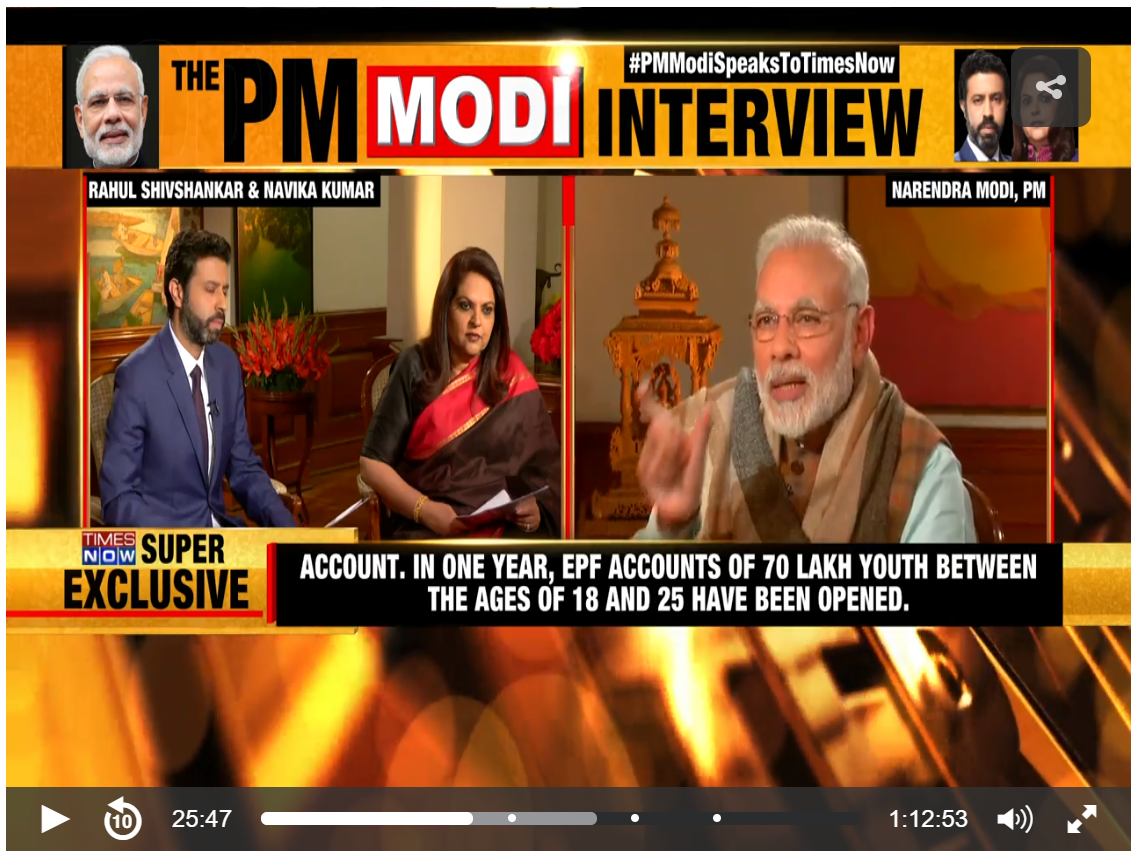
70 lakhs jobs in 2017 - a blatant bluff


Prof Pulak Ghosh and Dr Soumya Kanti Ghosh created a minor storm when they claimed that 70 lakh new ‘payroll’ jobs will be created in India in the organised sector in 2017-18. They reported that the EPFO manages a corpus of over Rs 11 lakh crore for its 550 lakh subscribers. According to the authors, 45.4 lakh new subscribers in the age band 18-25 years had enrolled under the EPFO in 2016-17 and started making their monthly contributions to the Fund. They also found that 36.8 lakh new subscribers in the same age band had enrolled between April and November 2017 and, therefore, they estimated that, for the full year 2017-18, 55.2 lakh new subscribers would be enrolled.
  • Seventy lakh new jobs is a claim that will take one’s breath away. The total ‘payroll’ stock as on March 31, 2017, was 919 lakh. It has taken the country 70 years to create a ‘payroll’ stock of 919 lakh jobs but, miraculously, in just 12 months, the country will generate 70 lakh new ‘payroll’ jobs — that is nearly 7.5 per cent of the current stock!
  • By comparison, China with a GDP five times that of India, adds about 150 lakh jobs a year.
  • If organised sector that employs 20 or more persons can generate 55 lakh new jobs in a year that qualified for enrollment under the EPFO, then we can declare that India has truly and comprehensively slain the demon of unemployment!
  • If we assume that for every ‘payroll’ job counted by the authors there will be another job created in the informal sectors, then the count will rise to 140 lakh in 2017-18. According to the Ghoshs’ report, 150 lakh persons enter the labour force every year of which 66 lakh is skilled manpower. Soon, the problem will not be joblessness but lack of jobseekers!
  • The authors also pointed out that the limited data available in the public domain indicated that the number of contributing members in the EPFO grew by 7% in 2014-15 and 8% in 2015-16 but, according to the Ghoshs’ report, the number jumped by 20% in 2016-17 and by a further 23% up to December 2017.
  • The EPFO data indicates that the number of contributing members decreased from 4.62 crore in July to 4.38 crore in September this year (2017).
  • The PM Modi referred to the MUDRA scheme and said “over 31 million loans have been sanctioned to entrepreneurs. Even if conservatively each enterprise creates one sustainable job, this initiative itself amounts to 31 million new jobs.” Alas!
  • It seems Modi is intentionally confusing by mixing up self employment' as jobs and misleading. While a 'job' is certain, regular and reasonably secure, self employment is not. What we are talking about is jobs in formal sector.
  • If we equate self employed, under employed and casual employed as job holders, then there is neither unemployment nor joblessness.
  • Labour participation rate is a ratio of all adults willing to work, whether employed or unemployed, to the total population. This ratio was 48% in Jan 2016. It fell to below 45% in Nov 2016. Now it reached 43% in July 2017. Most Indians choose not to work. Low labour participation rate hinders economic growth. Labour participation rate in China is 71%. The world average is 63%. Other major countries are Indonesia with a labour participation rate of 67%, Pakistan (54%), Nigeria (56%), Bangladesh (62%) and Philippines (65%).
  • The 70 lakh jobs claim, as claimed by Modi, is not only a misleading boast but also a blatant bluff.

PM Modi’s recent assertion that a person earning Rs 200 a day by selling pakodas is also employed. The fact that the prime minister actually celebrates this kind of ’employment’ as a major success of his Mudra scheme is even more worrisome. It is not a pride that millions are managing to eke out a meagre income. Instead it should be seen as a sign of under-employment.

India is witnessing jobless economic growth during the past three years and the government doesn't know how to create jobs and hence making all false claims and propaganda. Demonetization and GST's faulty roll out have had destroyed informal sector employment. MNREGA was able to provide just 50 days of work against guarantee of 100 days. Mudra loans aimed at promoting  micro enterprises averaging Rs.43,000 is just useless and serves very little purpose. We all know that politicians speak lies, nothing but lies but we do expect Prime Minister to be truthful to the nation.


Tuesday, 16 January 2018

Rahul Gandhi proves his mettle


Today, after winning successive elections since 2014 except Bihar, Delhi and Punjab [BJP & allies rule expanded to 19 of 29 states; Congress rule restricted to just 5 states] the invincible Prime Minister Modi is scared of only one man by the name Rahul Gandhi, whom he & his trolls once described as 'pappu' and a 'reluctant politician'. During the past six months Rahul Gandhi smashed all these and gave a spirited and stunning fight in Gujarat election making Modi and his BJP machine sweat like never before. Here are some points proving his mettle:
  1. Rahul Gandhi said on demonetisation "Initially the government spoke about black-money, then moved to counterfeit currency and then again to a cashless society campaign. The prime minister took this so-called bold decision single-handedly. The bold decision can also be a foolish decision. And this has devastated the country. More than 100 people have died. Farmers, fishermen, daily wage earners have been hit hard." He also said "Dr Jaitley, the economy is in the ICU because of notes ban and GST. Aap kehtey hai aap kissi sey kum nahi/ magar aapki dava mein dum nahi."
  2. Rahul Gandhi said on GST roll out "A reform that holds great potential is being rushed through in a half-baked way with a self-promotional spectacle. GST is being executed by an incompetent and insensitive government without planning, foresight and institutional readiness. India deserves a GST roll out that does not put crores of its ordinary citizens, small businesses & traders through tremendous pain & anxiety. Their GST is 'Gabbar Singh Tax'. Small shopkeepers are finished. Lakhs of youths have been unemployed. But they are still not ready to listen. Congress GST is 'Genuine Simple Tax'. Modiji’s GST is 'Gabbar Singh Tax'." 
  3. Rahul Gandhi hammers on 'unemployment' issue repeatedly. On his superb trip to USA he said, "I think the central reason why Mr. Modi arose is the question of jobs in India. There’s a large part of our populations that simply do not have jobs and cannot see a future. But, certainly our prime minister is not doing enough in creating jobs. 30,000 new youngsters are joining the job market every single day and yet the government is only creating 500 jobs a day. My main issue with Mr Modiji is that he diverts that issue and points the finger somewhere else instead of listening." Though the ruling government floated a plethora of schemes like ‘Make in India’, ‘Startup India’ and ‘Digital India’, all of these initiatives proved to be duds.
  4. Speaking on women rights back in 2014 Rahul Gandhi  said, "We talk a lot about becoming a superpower in the world but till the women of our country do not feel comfortable and secured, our country cannot become a superpower. And to tell you the truth, we don’t want such a superpower status, where women are not empowered. One thing I have learnt is if you empower women, they can do anything. One important battle we have to win is the women’s reservation Bill in Parliament. We’re not going to let go of it." The BJP had promised during their pre-election rallies that the women’s reservation bill would be passed as soon as they got into power. Despite three and a half years of Modi rule, the bill has not come up in the Lok Sabha so far.
  5. Rahul Gandhi while speaking on intolerance had previously said, "Truth and Power are not the same thing. Truth is what stands up to power. Today, there is no doubt that the emperor is completely naked but there is no one with any courage to point it out. When the British came to India, people handed over freedom to them. It was never taken away from us. This could very well happen now. Both the RSS and Mr Modi want to create a country where people live in utmost fear surrendering their voice so that they can rule unhindered. Mr Modi, after locking his cabinet colleagues in a room announced demonetization which wiped off lakhs of jobs. Many media houses have been depicting this as a work of genius even while admitting in private that it was an act of insanity. Most of them have lost their voice." At his recently concluded USA trip, he again said, "What happened to the tolerance that prevailed in India? What happened to the harmony? For thousands of years, India has had a reputation of peace and harmony. This is being challenged. Our most powerful asset is that 1.3 billion people lived happily, non-violently, peacefully. This is something that as Congress people, every single one of us has to defend."
  6. On agrarian crisis Rahul Gandhi said in a rally in Maharashtra, "Everyone knows that a farmer needs the support of the nation and the State Government. If you ask any farmer, how much money comes from their farm, then every farmer will tell you – if the MSP is not increased, if there are no rains and no compensation or bonus is given, then they won’t be able to work, and this is the truth behind today’s India."  Criticising the ruling NDA Government, Rahul said in Gujarat "the suit boot government doesn’t do anything for the farmers." Speaking earlier this year to the bereft farmers from Tamil Nadu, he said,” The farmers have been sitting here for so long. But neither the government nor the Prime Minister is listening to them. The people and farmers of Tamil Nadu deserve to be heard by the Prime Minister who is disrespecting them by not initiating any dialogue. Over the last three years, debt worth Rs 1.4 lakh crore held by 50 industrialists have been written off. Why the same is not being done in case of the farmers? Why are their debts not being waived? It is the Prime Minister’s responsibility to do so.” 
  7. Rahul Gandhi has made the 'failed development model of BJP' as the body and soul of his Gujarat campaign. Modi had come to power based on the stellar work he had apparently done in Gujarat which he promised would be juxtaposed to other states as well. But Rahul Gandhi ripped that narrative to pieces saying, "Gujarat model of development can be called toffee model or ‘gubbara’ (balloon) model, which is nothing but loot of public money to benefit big people like Tata and Adani. Modi had given away 45,000 acres belonging to poor farmers and the size of Bihar’s Purnea district to a single person (Adani) at a rate of rupees one per sq metre which is equivalent to the price of a toffee. He gave away the entire stretch of land at a paltry sum of Rs.300 crores. Modi had also provided Rs.10,000 crore loan to Tata Motors for its Nano car project at 0.1% interest, while the common man get loan from banks at 12% interest. For every Nano car, the Gujarat government is providing Rs.40,000 assistance. The total budget of the Gujarat government on education, health and other welfare is less than Rs.10,000 crore." Speaking later he added, "Vikas has gone crazy? India’s economy has been destroyed. But everyone is quiet because they are afraid to speak against Narendra Modiji. These are not my words. Senior BJP leader Yashwant Sinha has written this in a newspaper article today. Poverty reduction in Gujarat was highlighted as a huge success but reports have since shown that it has been slower than most of the other states. There has been undoubted progress in electrification and infrastructure development but that has mostly played in the hands of the corporate sector with little to no improvement for the masses! If Gujarat model was dissected, an entire thesis could well be written on it with both pros and cons. We would just stop short of calling it a bigger success than it was.
  8. We worked for 10 years to bring peace in Kashmir. Speaking in USA on the violence in the valley, Rahul Gandhi said, "PDP was instrumental in bringing youngsters in politics, but the day Modi made alliance with PDP, he destroyed them (PDP). He (Modi) massively opened up space for the terrorists in Kashmir, and you saw the increase in violence.Violence against anybody is wrong. Hatred, anger and violence can destroy us, the politics of polarisation is dangerous. These incidents are making millions feel that they have no future in their country. I lost my father, my grandmother to violence, if I don’t understand violence then who will?"


Tuesday, 19 December 2017

BJP wins Gujarat & HP without shine & bragging rights


  • BJP winning (1) Gujarat six times in a row and (2) winning Himachal Pradesh, ousting Congress, with a 2/3 majority is by no means a small achievement for Modi but what is lacking is its shine and bragging rights.
  • With 49.1% of the vote, the BJP lost 10 percentage points from its 2014 Lok Sabha tally.
  • NOTA grabbed over 5.5 lakh votes, or just under 2% of the votes polled.
  • Gujarat voters have handed the BJP its sixth straight victory, but tempered the win by reducing its majority to 99 – its lowest tally since 1995.
  • The ruling BJP won 36 of the total 40 seats spread in six major cities and that saved the day for the BJP in the tight contest between PM Modi and Congress president Rahul Gandhi.
  • CM Vijay Rupani and DyCM Nitin Patel won their seats while five serving Ministers and Assembly Speaker Ramanlal Vora were defeated.
  • The PM Modi’s 20-minute speech reflected his worries and the party’s vulnerabilities despite the victories.
  • Though BJP has won despite the anti-incumbency factor, the State polls turned into a photo finish unlike the landslide and much below the BJP’s target of winning 150 seats. Saurashtra, the BJP’s stronghold since 1995, dealt the party a big blow, as the Congress won 30 out of 54 seats in the region.
  • In Saurashtra's 11 districts, the BJP got nearly wiped out in 5 districts.
  • Most of Modi's speeches at rallies focussed on divisive themes. Mandir-Masjid, Mughals, Pakistan, Ahmed Patel, Salman Nizami, etc., he practised classic dog-whistle politics that might have stoked passions among some sections of the electorate.
  • Whatever the BJP leaders may say, the victory by an extremely slim majority and well short of its aim of 150+ seats is a setback.
  • With the kind of spirited fight provided by Congress, BJP's proclaimed goal of a “Congress-mukth Bharat” suffers severe set back.
  • In Himachal Pradesh, despite the big win, the BJP faced the ignominy of seeing its chief ministerial candidate, Prem Kumar Dhumal, lose to his Congress rival.
  • BJP may be tempted to believe that neither demonetisation nor the flawed roll-out of the GST regime has dented its support among traders and the middle class. But the heart-stopper in Gujarat has given enough reason for it to rethink, do a reality check and reconnect with the remoter parts of India.

Notwithstanding the fact that BJP won Gujarat elections 99/80 defeating Congress, the truth is that Modi has addressed 34 rallies & 97 road shows campaigned like a CM not as a PM, never mentioning any of his development schemes but relied entirely on divisive & religious polarisation, Pakistan, Mughals, Muslims, Mandir-Masjid, abusing Congress leaders and arousing passions etc. Modi did everything like a street politician to win elections forgetting that he is holding office of PM and is oath bound to uphold its dignity and sweated like never before. On other hand Rahul Gandhi, in the company of 3 young turks, was at ease engaging people questioning ruling party of its failures, visiting temples, raising concerns of agrarian distress, unemployment, failed demonetisation and GST etc. While Modi was assisted by his entire central cabinet & several other BJP leaders from other states Rahul Gandhi was virtually alone. Modi put Gujarat above nation by postponing parliament's winter session and condensing its duration so that he could campaign more in Gujarat. Modi subverted EC by influencing it in delaying announcing poll schedule to enable his announcing sops to Gujarat. The kind of money spent for BJP's campaigning and liquor flowing in this dry state has dented his claim as crusader against corruption and black money. Modi's spectacular show in riding the sea plane (specially flown from Karachi for this show) a day before campaign ended is in violation of his own security protocol. Modi’s penchant for style and no substance has a chilling similarity with Mussolini’s Fascist Italy with less concerns for efficient governing of people in solving their economic problems but focused more on the spectacle of power, on the visual and impressive display of symbols, myths and rituals. With BJP winning 99/80 against Congress Modi diminished himself while Rahul Gandhi stood taller posing as a challenger for 2019 general election while his dream of  “Congress-mukth Bharat” stands buried. Like any other programmable computers, tampering EVMs is neither easy nor very difficult and its alleged tampering by BJP will never be known. The talk of the town is that many Modi's cabinet colleagues silently wished defeat of BJP in Gujarat so that he starts learning to walk on the ground. In order to preserve our democracy it is necessary to have a narrow & rigid election campaigning code and also prohibit constitutional office bearers taking up any assignment for a period of two years after retirement.


Sunday, 17 December 2017

Unorganised sector has large hidden potential for job creation

  • Unorganised sector's large hidden potential for job creation is the best hope for India.
  • Every politician and economist talks about 'development' and 'job creation' all the times but nothing much has happened during past 5 years.
  • Unemployment rate is stable mainly due to falling labour participation rates among children and women. Also because of hidden unemployment due to unemployed getting engaged as casual workers or absorption in family enterprises and underemployment of many workers.
  • Despite youth bulge in population there is no youth bulge in workforce and hence there is no demographic dividend.
  • We have large number of poorly educated workers.
  • Employment conditions will improve with an increase in the share of organised sector.
  • Earnings per worker improved by 2.3% in organised sector and 4.2% in unorganised sector between 1999-2000 and 2011-12 but gender equality in the work declined.
  • Recent trends show unemployment increase from 3.8% (2011-12) to 5% (2015-16) due 5 million 'employment loss'.

How large is the job gap? How soon can India reach a point where there is no hidden unemployment and all who want work can find it at a fair wage and decent work conditions?

  • Current surplus labour at 117 million (52 million who can be withdrawn without loss of production, anther 52 million who are not at present in labour force but are able and willing to work and 13 million who are reported unemployed)
  • Annual additions would be about 6-8 million.  
  • Can we absorb about 16 million a year in decent work and reach full employment by 2030?
  • China's model of export driven job creation looks less attractive due to global slow down, growing protectionism and growth of robotics and automation.
  • Growth in manufacturing with matching skill development, infrastructure construction, urban development, housing, information technology, investment in energy will produce many jobs but far less than availability.
  • The organised sector can't deliver jobs on the scale required. Job creation requires skill development for productivity enhancement.
  • Powerful trade unions are able to take care of very limited proportion of workers.
  • Labour reforms are required to ensure fair wages, competition and decent work conditions.
  • Wages of production workers declined from 15.4% of GVA (2000-01) to 8.5% (2011-12) in unorganised sector.
  • Vast majority of workers in unorganised sector lack security and suffer wage differentiation by caste, community, gender, geography for identical tasks.
  • Some reforms for protection and wage determination of workers in unorganised sector are necessary. Labour policy must address inequity and exploitation issues. 
  • For India to meet its job creation obligations, unorganised sector, with growth, reform and modernisation, is big hope with tremendous hidden potential. 


Unorganised sector, as its name suggests, doesn't follow many rules & processes and are outside income tax department lens. But its ability to provide vast number jobs fuels economic growth and contributes a lot in the form of indirect taxes. The recent demonetisation & GST proclaims formalisation of informal sector but in reality it has destroyed unorganised sector and that is evident from loss of 5 million livelihoods and GDP growth drooping from 9.1% to 5.7% and government(s) going penniless. But as they grow over time they themselves will migrate into formal sector with increased revenues, profits and benefits of formal sector. It makes sense for government(s) to allow this sector to function without fear or reverence, who will eventually become good tax payers too.

Agriculture sector with land reforms, land aggregation & cooperative farming, farm mechanisation, efficient & assured irrigation, rain water harvesting & ground water table increasing, remunerative pricing, crop insurance, efficient markets, quality inputs, warehousing & cold storages, food processing units etc will enhance rural development and reduce rural urban migration etc.

Friday, 8 December 2017

Development and poverty

POVERTY
  • Poverty is present everywhere. Manifestation of poverty is a challenge.
  • Poverty and development are two sides to a coin. Where there is poverty, there may not be development.
  • Poverty is not only a lack of money to take care of basic necessity of life it creates a picture of aimlessness, uncertainty and hopelessness in the mind of the poor. 
  • An unhealthy or poor population produces less and may be forced into practices damaging the environment. It is the poor people who suffer most acutely from lack of development. 
  • The poor are anxious about the future in regard to the national political life, degradation of the environment, the high rise of inequality among people coupled with mass unemployment.
  • The high level of selfishness in the society with people looking only to their needs and fearful of others. Corruption is endemic. Crime rate is high and the future of generation yet unborn is clouded with uncertainty.

DEVELOPMENT
  • Development is often socio-economic, political, science and technology biased. 
  • The concept of development is a complex one. Its difficulty is not only in terms of definition or description but also in terms of measurement. 
  • Lack of infrastructure, deep seated corruption, various forms of conflict, bad governance and poor healthcare facilities cannot promote a healthy population committed to work for progress and development.
  • GDP as the measurement does not say anything about the distribution of total income of its country. It does not capture the totality of the development situation of the country.
  • The people are both the means and the end of economic development.
  • Human beings are at the center of concerns for sustainable development. 
  • They are entitled to a healthy and productive life in harmony with nature.
  • Development cannot be merely economic development or GDP as important as that may be. 
  • Development must include the conditions of reality that allow people to take their destiny into their own hands, individually and collectively involving economic, social, political, psychological, environmental, cultural, religious and international dimensions. 
  • Development is the ability and capability of the people to procure sufficient natural resources to meet the basic needs of all in a self-reliant manner.
  • The situation of the bottom forty percent of society is often bypassed by development and government.
  • Human welfare is the ultimate end of development not economic indices.
  • The welfare of the human person in its totality is the good health of a person and his skills cultivated through educational programmes as his endeavours add to the wealth of his nation.
  • Development strategy should be people centred and community participation must be evident. Any project that people/community cannot identify with will collapse. 

SUSTAINABLE DEVELOPMENT
  • World Commission on the Environment and Development (WCED) defines sustainable development as ‘development that meets the needs of the present without compromising the ability of future generations to meet their own needs.’
  • WCED posits that the present generation has been reckless and wasteful both in its exploitation and use of natural resources by pursuing a series of socio-economic and industrial policies which endangers global environmental security. It condemned the inequalities with and among nations and called for a restructuring of contemporary economic relations to guarantee an equitable distribution of national and international wealth.
  • The International Economic System (IES) is primarily profit orientated. Consequently, everything could be sacrificed on the altar of profit to the detriment of development of peoples and individuals, the often stated corporative responsibility of multinationals.
  • Can accountability and transparency be found in their political intercourse?
  • Poor countries are without development and citizens may not be able to compete with others because of lack of necessary capital, the technical-know-how and expertise. Symbiotically, without development poverty may not be eradicated. The solution to the dilemmatic situation is to confront the reality of poverty and challenges of development simultaneously, nationally and internationally.

There is no humiliation more abusive than hunger ... Pranab Mukherjee


Any kind of development that don't benefit bottom 40% of people, environmentally sustainable and generate mass employment is not a development at all. The trickle down theory, the standing rationale for our economic reforms, doesn't not address the aspirations of the poor people and eliminate poverty is unacceptable nonsense. Health, drinking water, sanitation, education, skill development and empowerment with adequate capital are essential for poverty eradication and meaningful development of poor people especially in rural India. Govt spending meager 2.27% on healthcare and 3.70% on education in the current budget against a minimum of 5-6% indicates empathy deficit towards the poor people of India. Even these meager allocations are towards high end spending rather than improving PHCs and schools. Hyped disruptive economic reforms Demonetisation & GST continuum have impacted poor most with loss of livelihoods and incomes and driven towards desperation and our rulers thought fit to turn a Nelson's eye.

Friday, 1 September 2017

Unemployment in India

Unemployment, irregular jobs and low salaries continue to hurt India while it continues to embrace labour reforms. Around 77% families have no regular wage earner and more than 67% have income less than Rs 10,000 a month. Unemployment is higher in urban areas, among women, among educated and in agriculture sector. A society where a large proportion of the labour force is unemployed suffers from poverty and vulnerability. An increase in unemployment reduces aggregate spending power, slows down the economy and it increases the vulnerability of households to deal with economic shocks. Govt's employment through various schemes like MGNREGA, at an expense of about Rs.48,000 crores, failed to remove unemployment problem due to corruption and bureaucratic apathy in implementation. 
  • Unemployment Rate in India averaged 7.32% between 1983 and 2013, with a high of 9.40% in 2009 and low of 4.90% in 2013. Unemployment in India is projected to increase to 17.8 million in 2017.
  • On Nov 22, 2013, as BJP's prime ministerial candidate Narendra Modi at an election rally in Agra had promised creation of 1 crore jobs every year if his party won the election. 
    The BJP manifesto stated that “The country has been dragged through 10 years of jobless growth by the Congress-led UPA government. Under the broader economic revival, BJP will accord high priority to job creation and opportunities for entrepreneurship.”
    After three years of government formation, job creation remains the worst failure of the government as the job creation remained lowest in eight years.
  • In 2015 only 1.35 lakh jobs were added, compared to 9.3 lakh jobs that were added in 2011-12 during UPA regime.
  • About 15 lakh jobs were lost in the first four months of 2017 as the number of employed people came down from 406.5 million to 405 million. Each year 12 million people enter the workforce and 65% of India's population are under the age of 35. 
  • Labour participation rate is a ratio of all adults willing to work, whether employed or unemployed, to the total population. This ratio was 48% in Jan 2016. It fell to below 45% in Nov 2016. Now it reached 43% in July 2017. Most Indians choose not to work. Low labour participation rate hinders economic growth.
  • There were only seven countries in the world that had a labour participation rate of 43% or less. These are Iraq, Puerto Rico, Moldova, Syria, Timor-Leste, Samoa and Jordan. Labour participation rate in China is 71%. The world average is 63%. Other major countries are Indonesia with a labour participation rate of 67%, Pakistan (54%), Nigeria (56%), Bangladesh (62%) and Philippines (65%).
  • In India, the unemployment rate measures the number of people actively looking for a job as a percentage of the labour force. In 2016, the country’s unemployment rate was 7.97%, with rural unemployment at 7.15% and urban unemployment at 9.62%.
  • Shift in the pattern of employment from permanent jobs to casual and contract employment has adversely affected the wages, employment stability and social security of the workers.
  • Why do so many Indians choose not to work? Indians are neither lazy nor rent-seekers by nature. The problem is in the lack of good jobs; in opportunities to work in a place where meritocracy rules and one can work hard with dignity and honesty for growth and prosperity. If such jobs are available in good numbers Indians will definitely choose to work.
  • A jobless growth is neither sustainable nor desirable. It is a dangerous trend that creates social tension and disharmony. It spreads further inequality, which may lead to societal collateral damage.  
  • It is the young who are losing jobs and it is the young again, who have stopped looking for jobs although they are unemployed. Young people are not ready to take jobs which are considered to be socially degrading or lowly. Such youngsters could easily stray into unlawful activities. 
  • Causes of unemployment in India: (1) Growth of population (2)Underdevelopment of the economy (3) Slow growth in the agricultural sector (4) Defective system of education (5) Absence of manpower planning (6) Degeneration of village industries (7) Inappropriate technology (8) Slow growth of industrial sector (9) Immobility of labour and (10) Jobless growth.
  • While unemployment is an important problem India faces, more serious problem is severe underemployment with workforce struck in low-productivity & low-wage jobs. Skilled people gets jobs easily and hence skill development among the youth is imperative.
  • Achieving higher economic growth, in the range of 8% to 10%, is necessary to solve the problem of jobless growth.

Very few governments think about youth unemployment 
when they are drawing up their national plans ... Kofi Annan

Long-term unemployment makes a worker less employable.

Quite often the unemployed youth commit crimes to earn their living. Due to lack of opportunities in India, intelligent youth migrate to foreign countries. Their intellectual abilities are used by foreign countries which causes loss to India. Unemployment impacted organisational practices. It has resulted in unfair and corrupt practices in organisations such as low wages, harassment, fake muster rolls etc. The attitude of some private sectors towards employees is unfair on account of availability of surplus labour. Modi after becoming PM had enjoyed touring the world and delivering charismatic speeches and playing rogue politics in India. Midway the term he unleashed senseless demonetization which didn't achieve any of its intended objectives but left nation and its poor suffer unintended consequences. Thereafter, mangled and hurriedly rolled out GST is impacting economy and GDP growth like never before. Demonetization and GST are responsible for GDP growth slipping from 8.1% to 5.7% instead of growing to over 10%. 1% GDP growth loss roughly means loss of 1 million jobs. While recovery is certain after few years, in the meantime poor, peasants and lower classes are paying bitter price for no fault of theirs and for Modi's wild & blind adventures.