Showing posts with label MNREGA. Show all posts

Tuesday, 4 September 2018

Modi's adventurism

Adventurism is a pejorative term referring to politics or activism that involves reckless and  irresponsible behavior or conduct pursued only in the interest of excitement. Adventurism is defined as an attitude or way of behaving that involves attempting to gain an advantage by doing things that are regarded as foolish or risky. Adventurism is often used as a criticism against some government's policies. Countries pursuing foreign wars of dubious merit or which have little chance of success have often been accused of adventurism by opponents.
  • By general consensus, the government was widely seen to have faltered on four major counts. It is accused of failing to tackle the over-hang of demonetization, poor implementation of GST, containing prices and inability to create new jobs. Positive endorsements from the IMF, World Bank, investment bankers and a few contrarian economists were contemptuously dismissed.
  • Notwithstanding Rahul Gandhi's assertion that he can fix the problems in six months, macro-economic interventions will take more than a couple of quarters to yield results.
  • It has been argued with some merit that many pain points in demonetisation and GST rollout could have been mitigated if the bureaucracy and tax-administration were better prepared and proactive.
  • Demonetisation is considered to be the biggest villain. There is no denying that demonetisation had worst affected deep rural, where the banking network is least developed. In the cities, small-towns and "urban" areas, the situation largely settled at a new normal in about eight to twelve weeks.
  • There is no disagreement among experts that GST was the mega tax reform that was long overdue. Considering the gargantuan scale of the exercise, it would have been naïve to expect a totally seamless transition. The Opposition had smelt an opportunity for muddying the waters and waylaying the government on GST. They were hoping the turmoil would carry through into the next fiscal year damaging BJP's prospects in 2019.
  • Inflation is the only area where Modi government's performance has been the best. This is also largely due to low oil prices for over three years resulting in narrowing of the twin deficits. No magic wand with Modi, it just happened. Nevertheless, credit goes to Modi & Jaitley.
  • Very high petrol & diesel prices despite lower crude oil prices and thus depriving consumers the benefit of dynamic pricing is a false step that will become a poll plank against Modi. 
  • Without any doubt, job creation remains the most serious of the four weak spots in Modi's portfolio. But there are no quick fixes for it. The Congress and the UPA bought time on it with doles like MNREGA.
  • Long-term job creation will come only through the next wave of reforms - especially on the fronts of labour legislation and land acquisition laws. But the government does not have either the time or political capital left for further economic adventures so late into its term. So, jobs will have to wait till 2019 for a real take-off.
  • What the government cannot afford anymore are governance boo-boos and fiscal adventurism. 

NDA government's policies and actions are nothing but a divisive, destructive and disruptive propaganda. The country is in the grip of communal politics and there is no contradiction between communalism and development. BJP attempts communalism by uniting the largest group and compelling minorities to join the mainstream as politically junior partners but forgets that we are a nation of diverse cultures, sects and religions and can only stay united with a secular thread of humanity and protection of minorities.  BJP failed in fulfilling most promises made in its election manifesto especially remunerative prices for farm produce. People are disillusioned with their false promises as seen by the recent by-election results held in different parts of the country. General elections are just eight months away and BJP is on perfect slippery slope, due to its own arrogant, audacious and ill conceived adventurous actions.

Sunday, 28 January 2018

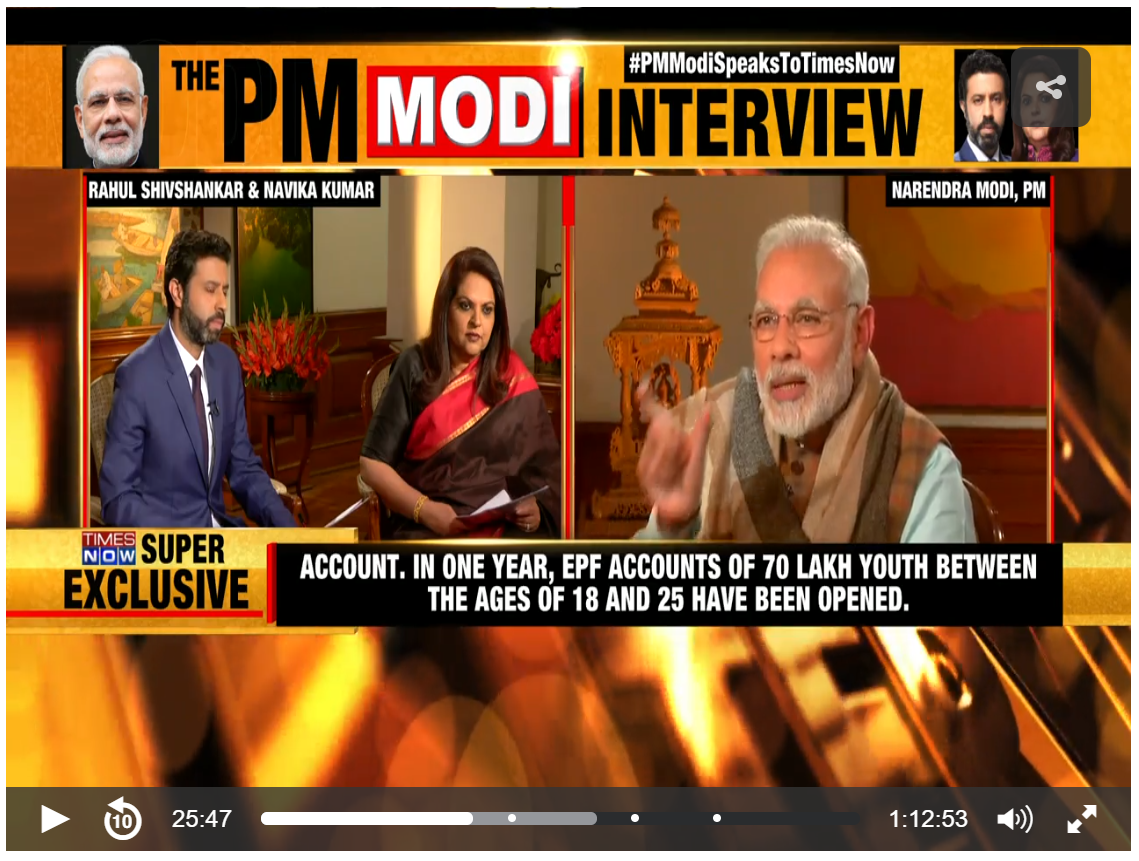
70 lakhs jobs in 2017 - a blatant bluff


Prof Pulak Ghosh and Dr Soumya Kanti Ghosh created a minor storm when they claimed that 70 lakh new ‘payroll’ jobs will be created in India in the organised sector in 2017-18. They reported that the EPFO manages a corpus of over Rs 11 lakh crore for its 550 lakh subscribers. According to the authors, 45.4 lakh new subscribers in the age band 18-25 years had enrolled under the EPFO in 2016-17 and started making their monthly contributions to the Fund. They also found that 36.8 lakh new subscribers in the same age band had enrolled between April and November 2017 and, therefore, they estimated that, for the full year 2017-18, 55.2 lakh new subscribers would be enrolled.
  • Seventy lakh new jobs is a claim that will take one’s breath away. The total ‘payroll’ stock as on March 31, 2017, was 919 lakh. It has taken the country 70 years to create a ‘payroll’ stock of 919 lakh jobs but, miraculously, in just 12 months, the country will generate 70 lakh new ‘payroll’ jobs — that is nearly 7.5 per cent of the current stock!
  • By comparison, China with a GDP five times that of India, adds about 150 lakh jobs a year.
  • If organised sector that employs 20 or more persons can generate 55 lakh new jobs in a year that qualified for enrollment under the EPFO, then we can declare that India has truly and comprehensively slain the demon of unemployment!
  • If we assume that for every ‘payroll’ job counted by the authors there will be another job created in the informal sectors, then the count will rise to 140 lakh in 2017-18. According to the Ghoshs’ report, 150 lakh persons enter the labour force every year of which 66 lakh is skilled manpower. Soon, the problem will not be joblessness but lack of jobseekers!
  • The authors also pointed out that the limited data available in the public domain indicated that the number of contributing members in the EPFO grew by 7% in 2014-15 and 8% in 2015-16 but, according to the Ghoshs’ report, the number jumped by 20% in 2016-17 and by a further 23% up to December 2017.
  • The EPFO data indicates that the number of contributing members decreased from 4.62 crore in July to 4.38 crore in September this year (2017).
  • The PM Modi referred to the MUDRA scheme and said “over 31 million loans have been sanctioned to entrepreneurs. Even if conservatively each enterprise creates one sustainable job, this initiative itself amounts to 31 million new jobs.” Alas!
  • It seems Modi is intentionally confusing by mixing up self employment' as jobs and misleading. While a 'job' is certain, regular and reasonably secure, self employment is not. What we are talking about is jobs in formal sector.
  • If we equate self employed, under employed and casual employed as job holders, then there is neither unemployment nor joblessness.
  • Labour participation rate is a ratio of all adults willing to work, whether employed or unemployed, to the total population. This ratio was 48% in Jan 2016. It fell to below 45% in Nov 2016. Now it reached 43% in July 2017. Most Indians choose not to work. Low labour participation rate hinders economic growth. Labour participation rate in China is 71%. The world average is 63%. Other major countries are Indonesia with a labour participation rate of 67%, Pakistan (54%), Nigeria (56%), Bangladesh (62%) and Philippines (65%).
  • The 70 lakh jobs claim, as claimed by Modi, is not only a misleading boast but also a blatant bluff.

PM Modi’s recent assertion that a person earning Rs 200 a day by selling pakodas is also employed. The fact that the prime minister actually celebrates this kind of ’employment’ as a major success of his Mudra scheme is even more worrisome. It is not a pride that millions are managing to eke out a meagre income. Instead it should be seen as a sign of under-employment.

India is witnessing jobless economic growth during the past three years and the government doesn't know how to create jobs and hence making all false claims and propaganda. Demonetization and GST's faulty roll out have had destroyed informal sector employment. MNREGA was able to provide just 50 days of work against guarantee of 100 days. Mudra loans aimed at promoting  micro enterprises averaging Rs.43,000 is just useless and serves very little purpose. We all know that politicians speak lies, nothing but lies but we do expect Prime Minister to be truthful to the nation.


Thursday, 7 December 2017

Gujarat model OR Gujarat muddle?

Scholars have shown that Gujarat’s development achievements are actually far from dazzling. The State has grown fast in the last twenty years. And anyone who travels around Gujarat is bound to notice the good roads, mushrooming factories, and regular power supply. But what about people’s living conditions? Whether we look at poverty, nutrition, education, health or related indicators, the dominant pattern is one of indifferent outcomes. Gujarat is doing a little better than the all-India average in many respects, but there is nothing there that justifies it being called a “model.” Anyone who doubts this can download the latest National Family Health Survey report and verify the facts.


  • Development economist and activist John Dreze today said there was "no evidence" that the so-called "Gujarat Model" was a model in any sense, pointing out to the state's backwardness in social indicators.
  • Almost all ranking of development indicators, whether it is social indicators, human development index, child development index, multi-dimensional poverty index and all the standard poverty indexes of the planning commission. Gujarat almost always comes around the middle.
  • It was the case much before Modi became chief minister and it remained the case after that, said Dreze, who helped draft the first version of NREGA (now called the MNREGA).
  • He describes the Gujarat's development model as a counter-example, because of the disappointing social indicators inspite of the high growth in terms of standard economic indicators.
  • Dreze believes that something lacking and it can be an illustration of the limitations of relying on private-enterprise growth for development in the larger sense.
  • Commenting on ratings-agency Moody's recent upgrade of India's sovereign-credit rating to 'Baa2' from 'Baa3', Dreze says he doubts the credibility of such an index. "If you dig into the methods behind these indexes, there is very little to them, except that they are taken seriously!"
  • He also raised concerns about the Aadhaar scheme, fearing that it will create an infrastructure of surveillance. His opposition to Aadhaar was not related to welfare programmes, but civil liberties. Aadhaar multiplies the power of the state to keep track of everybody over time - he said, flagging apprehensions that it could lead to stifling of dissent, as a lot of the databases that are going to be linked will become accessible to the government.
  • Dreze partly blamed the stagnation of agricultural growth for the unrest and the recent agitations of Patidars, Jats and others for reservations. The people, who have seen the size of their landholding shrink with the population explosion in the last few decades, have certainly suffered. That creates a sense of grievance, but there must be other things also.


Read the article "Gujarat Muddle" dated April 11, 2014

Any development model with Public Private Partnership (PPP) is fundamentally flawed and unsustainable because it enables few enterprising people become extraordinarily rich at the state expense, breeding corruption and impoverishes the state and its people. The state ends up paying huge amounts of money in future payments in the range of 2-10 times. Consequently rich poor divide will increase. Modi's Ahmedabad-Mumbai bullet train is another white elephant in disguise which will enable Japan loot away our money perennially. Development based on market borrowing is not development at all but is similar to selling family silver for fancy expenses. 

Friday, 17 March 2017

Modi, the Prime Minister of Gujarat & UP


Centre announced waiver of farmer loans in UP in fulfillment of Modi's election promise in the just concluded UP Assembly election winning with huge majority, at an expense of Rs.50,000 crores. BJP is still unable to finalize CM candidate and new government yet to be formed and union agriculture minster announced in parliament that central government will pick up the bill. While helping distressed farmers is appreciable the same would have been for all farmers in the country, not just UP.
  • This is in contradiction of Centre's outright rejecting the demand of AP & Telangana government's request, 3 year ago, for RBI & Banks assistance in rescheduling the loans and eventual waiver by state governments citing banking norms and credit discipline.
  • Farmers are in distress and debt ridden in the entire country, not just in UP. This Centre's loan waiver for UP only is grossly discriminatory.
  • Going forward, farmers will never pay back loans, even if they can, awaiting waiver in next elections within 5 years.
  • This will destroy public sector banks, which are already saddled with over Rs. 6 lakh crores NPAs mainly due to defaults by industrialists.
  • Just 3 days ago, SBI Chairman Arundhati Bhattacharya said such sops may disrupt credit discipline among borrowers.
Apart from plethora of issues being faced by farmers, the foremost & utmost is the MSP (Minimum Support Price) of Centre which doesn't even cover expenses where as logically MSP should cover all expenses plus 50% profit margin for decent farmer livelihood. Lower MSP enables produce buyers to buy below MSP prices pushing weak farmers into distress and debt ridden. Mechanism must ensure that farmer is enabled to sell his produce at above MSP, which was forgotten several years ago. Other problems are non-timely availability of fertilizers and substandard seeds, pesticides, non availability of labour due to MNREGA, storage facilities etc. Erratic rains compounds farmers risk. Crop insurance with easy process of claims is a must.

Crop loan waiver has a major devastating effect of non availability of bank credit in future with fear of non-recovery and farmer will slip into hands of ruthless money lenders with interest rates 4-6 times bank rates. Today only 25% farmers (who are owners of land only) gets bank credit for crops and it must be ensured all farmers whether land owner or not must get crop loan if he is genuinely cultivating. Unless all these issues are resolved within short time frame, farmers will continue to be in distress and nation's future food security comes under threat. And uncontrolled rural to urban migration will not only increase rural distress but also stresses weak urban infrastructure.  

The practice of attending farmers issues once in 5 years during election and forgetting them thereafter must be stopped. It must be on year to year basis at budget time and uniform for all farmers of the country.

My View:
Farm loan waiver and rural focus are policies of Congress, never of BJP. Now I see BJP shifting towards rural issues and copying Congress. Anyway, 70% of population are rural & agriculture based and can't be ignored by rulers. All constitutional office bearers must remember that they are oath & constitution bound, not their election promises which are often senseless and mindless.

Modi, Jaitley & RBI have forgotten all the rules, regulations & principles cited while rejecting cooperation to AP & Telangana for farmer loan rescheduling & eventual waiver by state governments where as now centre waiving UP farmer loans without even being asked by UP Government is height of their arrogance & stupidity and doesn't go well with preservation of unity & integrity of India. Centre's discriminating attitude between states ruled by BJP and non-BJP will ignite north-south divide apart from being unconstitutional, illegal and violation of oath. Shamelessness & arrogance at its peak with Modi reducing himself as Prime Minister of Gujarat & UP.

14th finance commission has not made any provision for this type of money transfer from centre to UP and Budget 2017 has no mention about this item at all. How will this be done? When centre could do UP farmer loan waiver without budget & 14th Finance commission provision, why cant it grant special status to AP as promised while passing AP Reorganization Bill in Parliament in 2014? Any answer from Modi, Jaitley, Venkaiah Naidu etc? They won't answer because they are answerable to none.

PS: Unless rules are modified restricting spending money strictly as per provisions of approved budget and discretionary spending money is restricted only during war & natural calamity times by executive orders, irresponsible and unmonitored spending through banks and PSU's will go un-audited by CAG and unnoticed by parliament and is detrimental to fiscal discipline.

Friday, 27 January 2017

Modi transforms from reforms to welfarism

On Saturday Dec 31, 2016, it was expected that Modi will give details of success of demonetization and declare further big steps on eliminating black money & corruption. But he went in for some avuncular moralizing and then proceeded to announce a slew of welfarist measures, ostensibly as a balm for the pains that his government’s demonetization has caused thus confirming the disastrous failure of demonetization in achieving its stated objectives viz. elimination of black money, corruption, fake currency and terrorism financing.

Modi’s welfarism is a full U-turn from the promised “minimum government”, but the measures themselves would do little to address the ill-effects of demonetization but deceptively doing some help the citizens in their time of need. In all of these small sops one thing that stood out was that...nothing stood out. A plan to build more houses or a lower rate of tax for some small businesses were so banal that they were worthy of nothing. Few schemes were already part of the government’s policy matrix: the maternity benefit exists as a part of the National Food Security Act, and the RuPay card is hardly a new idea. Other than the optics of managing anger due to demonetization and making a show of the government caring, it is unclear how these small schemes will help India get over the shocks of demonetization.

It is clear that Modi has given up on his 'minimum government' programme. Sops is what the prime minister turns to as a crutch in times of need. The fact that Modi had to now pull out a provision of the UPA’s Food Security Act – which both the UPA and his government had denied to women – is telling. It is unlikely that these small sops will do anything to ease the pain of demonetization. As India steps into the new year, mitron, it’s clear that the pain will continue.

With mounting costs of demonetization for government & nation, loss of millions of livelihoods in informal sector resulting in 60% spurt in MNREGA beneficiries, banks financial condition precarious with unbearable NPA's, GDP & growth rate shrinking and other effects of demonetization will leave Modi without any money to do anything. On the contrary, taxes will go up, welfare expenditure will skyrocket, fiscal deficit gets widened from 3% to 3.5% or even 4% and above all crude oil prices are likely to double in coming months will result in runaway inflation leaving Modi and economic pundits stare helplessly. Worst is that our rating might get downgraded to 'junk status' signalling capital flight to foreign countries.

Nation will be paying dearly for Modi's quack advised economic adventures which are mainly aimed at striking headlines and disarming opposition political parties rather than doing any good to country.

It is necessary to restrict executive taking whimsical decisions like demonetization with wide ranging ramifications, in future, by strengthening institutions with much greater autonomy and teeth and reducing or minimizing discretionary decision making powers at all levels and replacing them with robust procedures. That is the only way our democracy can survive and ensure unity & integrity of India.